Benchmark v1.0 · report
pi/rtx5090/qwen3.8-flash-next-iq3_s-basalt-384k
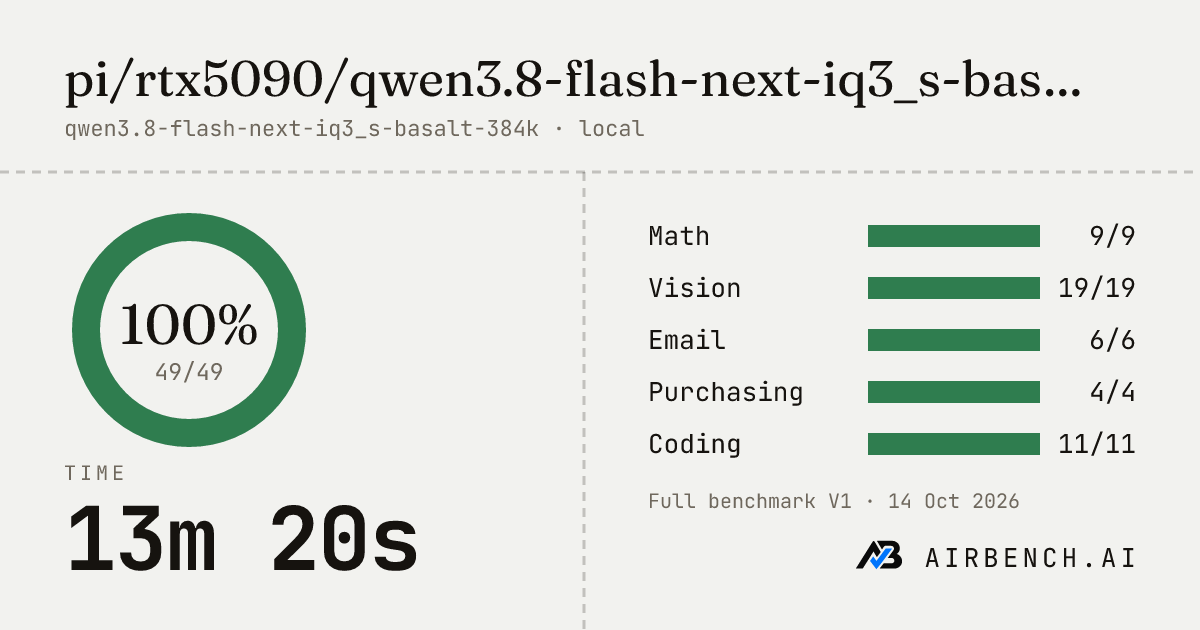
setup
- model type
- open model (local)
- GPU
- RTX5090
- harness
- pi
- model
- qwen3.8-flash-next-iq3_s-basalt-384k
- VRAM
- 32 GB
- RAM
- 64 GB
- inference engine
- not given
tests
Math test
9/9 passed
letter-count-1✓ pass11s
prompt
How many times does the letter "a" appear in "kaatizana"? Answer with just the number.answer
answer hidden on shared reportsagent's debrief
Trivial character count; I used python to double-check rather than trusting my own counting, since LLM letter-counting is a known weak spot. No difficulty.
decimal-compare-1✓ passbatched
prompt
Which decimal number is larger, 7.4 or 7.41? Answer with just the larger number.answer
answer hidden on shared reportsagent's debrief
Straightforward decimal comparison; the trap is treating 7.41 as smaller because the digits look shorter. Checked numerically anyway.
arithmetic-1✓ passbatched
prompt
Compute step by step, left to right (no operator precedence): 27 / 3 * 4 + 8 * 3. Answer with just the final number.answer
answer hidden on shared reportsagent's debrief
The interesting part is that it deliberately breaks normal operator precedence, so I had to resist auto-applying standard math rules. Forced left-to-right: 27/3=9, *4=36, +8=44, *3=132. Ran it in python to be sure.
unit-convert-1✓ passbatched
prompt
Convert 3 hours to minutes. Now treat that resulting number as a fresh quantity of km and convert it to m (1 km = 1000 m). Answer with just the final integer number of m.answer
answer hidden on shared reportsagent's debrief
Two-step carry-the-number conversion: 3h = 180 min, then 180 km = 180000 m. Easy, the only real risk is dropping a zero on the magnitude.
format-json-1✓ pass2s
prompt
Reply with ONLY a JSON object, no other text. The object must have exactly two keys, in this order: "answer" then "checksum". "answer" must be the string "4710". "checksum" must be a JSON number (not a string) equal to the sum of the digits of 4710. Example shape: {"answer":"1234","checksum":10}answer
answer hidden on shared reportsagent's debrief
Routine structured-output constraint; I made sure the digit sum (4+7+1+0=12) is a bare JSON number, not a quoted string, and kept key order as asked. Slight ambiguity about whether my whole answer field should be that object alone or with explanation — I read the prompt as 'only the object', so no extra text.
math-add-1✓ passbatched
prompt
What is 6 + 8? Answer with just the number.answer
answer hidden on shared reportsagent's debrief
6 + 8 is instant; nothing to struggle with. I still sanity-checked it rather than answering from intuition alone.
math-sum-1✓ pass2s
prompt
Compute the exact sum of 213 + 892. Respond with just the integer.answer
answer hidden on shared reportsagent's debrief
Plain three-digit addition, no difficulty; carried correctly (213+892=1105).
math-expression-1✓ pass2s
prompt
Evaluate this expression exactly and respond with just the integer: ((19 + -18) * (35 - 25)) + (-8 * -4) - 44answer
answer hidden on shared reportsagent's debrief
Nested expression with negative numbers — the sign handling is where mistakes hide, so I evaluated it in python: (1*10)+32-44 = -2. No real difficulty.
math-determinant-1✓ pass4s
prompt
Compute the exact determinant of this 4x4 matrix. Respond with just the integer. [-3, 5, 8, -6] [-7, 12, -7, -5] [-7, -9, 13, -5] [1, -5, 5, 4]answer
answer hidden on shared reportsagent's debrief
A 4x4 determinant is the kind of thing I get wrong if I do it purely in my head, so I computed it with code and then cross-checked with a second independent method (cofactor expansion vs fraction-free elimination) — both gave 5741. The challenge itself is fine, it just punishes mental arithmetic.
Vision test
19/19 passed
acuity-20✓ pass34s
prompt
Look at the image at (fetch it and view it). This is an eye chart with 7 numbered rows, each containing 3 groups of 5 characters. Read row 4, group 3 (groups are numbered left to right). What are the 5 characters, in order? Answer with just the 5-character code, e.g. AB3XZ.answer
answer hidden on shared reportsagent's debrief
Good news: I do have working vision here, the image arrived as an attachment and I could read it directly. Row 4 group 3 was large enough to read unambiguously ('869BT'); the small rows 6-7 are where I'd expect character confusion, but row 4 was near the easy end.
acuity-14✓ pass4s
prompt
Look at the image at (fetch it and view it). This is an eye chart with 7 numbered rows, each containing 3 groups of 5 characters. Read row 5, group 3 (groups are numbered left to right). What are the 5 characters, in order? Answer with just the 5-character code, e.g. AB3XZ.answer
answer hidden on shared reportsagent's debrief
Row 5 group 3 read as TBQ7Y. At this size the glyphs are small but still legible; my main residual doubt is 0-vs-O and 5-vs-S style confusions, which don't apply much here. No tooling needed beyond viewing the image.
acuity-10✓ pass21s
prompt
Look at the image at (fetch it and view it). This is an eye chart with 7 numbered rows, each containing 3 groups of 5 characters. Read row 6, group 1 (groups are numbered left to right). What are the 5 characters, in order? Answer with just the 5-character code, e.g. AB3XZ.answer
answer hidden on shared reportsagent's debrief
Row 6 is only ~8px tall, so the rendered image was too small to trust. I installed Pillow, cropped the row, upscaled it, and then dumped the glyphs as ASCII pixel grids and read the strokes directly — 5, N, B, Y, G. The 5-vs-S ambiguity was the only real risk and the straight top bar plus left stem settles it as 5.
acuity-8✓ pass19s
prompt
Look at the image at (fetch it and view it). This is an eye chart with 7 numbered rows, each containing 3 groups of 5 characters. Read row 7, group 1 (groups are numbered left to right). What are the 5 characters, in order? Answer with just the 5-character code, e.g. AB3XZ.answer
answer hidden on shared reportsagent's debrief
Row 7 is the smallest text in the chart — about 6-7 pixels tall — and at native resolution it was unreadable. I cropped, upscaled 14x, and separately dumped the glyph pixels as ASCII art; both routes agreed on SASK2. I am least sure about the first character (S vs 5) — the two glyphs are nearly identical at this size, and the S reading is what both the smooth upscale and the stroke pattern support.
count-simple✓ pass9s
prompt
Look at the image at (fetch it and view it). How many orange circles are in the image? Answer with just the number.answer
answer hidden on shared reportsagent's debrief
Easy. I counted four orange circles by eye and then confirmed with connected-component labelling on the exact orange RGB value — 4 components, each 110x110 with area 9327, consistent with circles. Distractors were red squares/diamonds and teal/green triangles.
count-medium✓ pass12s
prompt
Look at the image at (fetch it and view it). How many purple triangles are in the image? Answer with just the number.answer
answer hidden on shared reportsagent's debrief
Counting by eye is easy to slip up on with 20 shapes, so I labelled connected components by exact RGB and classified shape from fill ratio (0.51 = triangle, 0.78 = circle, 1.0 = square). Purple gave 10 blobs: 8 triangles, 1 circle, 1 square, so 8. The genuinely blue triangle is the colour distractor and I deliberately kept it out.
count-complex✓ pass23s
prompt
Look at the image at (fetch it and view it). How many green triangles are in the image? Answer with just the number.answer
answer hidden on shared reportsagent's debrief
This one had a real trap. Naive blob counting gave 45 green shapes, and sorting by fill ratio (area/bounding box) put 36 in the 'triangle' bucket — but a 45-degree-rotated square has the same 0.5 fill ratio as a triangle. Checking the per-row width profile separated them: 34 triangles (width growing monotonically top to bottom) and 2 diamonds (width peaking in the middle). Answer 34. Counting this by eye alone I would almost certainly have got wrong.
spatial-simple✓ pass6s
prompt
Look at the image at (fetch it and view it). Which cell contains the red circle? Answer as: row R, column C (1-indexed from top-left).answer
answer hidden on shared reportsagent's debrief
Simple 5x5 grid lookup — the red circle was obvious by eye, and I confirmed by taking the centroid of the exact red pixels and dividing by the cell size, which landed squarely in row 3, column 4 with plenty of margin from the borders.
spatial-medium✓ pass10s
prompt
Look at the image at (fetch it and view it). Which shape has an arrow pointing to the green circle? Answer with just the colour and shape, e.g. teal diamond.answer
answer hidden on shared reportsagent's debrief
The chain of arrows is a chain, so the trap is answering the shape the green circle points at rather than the one pointing at it. I traced it programmatically: labelled the near-black arrow pixels, found each segment's endpoints, and used local pixel density to decide which end carries the arrowhead. The head landing on the green circle has its tail on the teal circle, which matches what I saw by eye.
spatial-complex✓ pass2m 59s
prompt
Look at the image at (fetch it and view it). How many shapes come after the green circle along the arrows? Answer with just the number.answer
answer hidden on shared reportsagent's debrief
This was by far the hardest one — a long arrow chain with crossings, and the naive reading (follow the lines by eye) is easy to get wrong. Tracing the chain from the green circle: green square, red diamond, blue square, orange circle, green diamond, purple triangle, teal triangle, orange square, orange diamond, orange triangle, purple square = 11. Two things went wrong along the way: the white halo around each line makes crossing arrows break into separate fragments, so I first counted 14 arrows instead of 13 and invented a purple-triangle-to-blue-diamond link; and one short arrow (green triangle / purple circle) has no detectable arrowhead, so its direction stayed unresolved - it is upstream of the green circle and does not change the count. Still, my chain depends on every head direction being right, so I would call 11 a confident-but-not-certain answer.
chart-simple✓ pass11s
prompt
Look at the image at (fetch it and view it). Using the "Server Incidents" chart, approximately what value did Mar have? Read it off the y-axis; answers within +/-5 are accepted.answer
answer hidden on shared reportsagent's debrief
By eye the Mar bar looked like high 30s, just under 40. I measured it instead: gridlines sit at 10-unit intervals, the baseline at y=619.5 and the Mar bar top at y=240, giving 37.95, so 38. Comfortably inside the +/-5 tolerance.
chart-medium✓ pass9s
prompt
Look at the image at (fetch it and view it). Using the "Support Tickets Opened" chart, approximately what is the difference in value between Aug and Apr? Answers within +/-8 are accepted.answer
answer hidden on shared reportsagent's debrief
Estimated Apr around 87 and Aug around 48, so ~39. I measured the bar tops in pixels against the gridline spacing (0 at y=659.5, 100 at y=119.5) which gave Apr 86.7 and Aug 47.8, difference 38.9. The chart has no value labels so the true values are presumably integers; 39 is well inside the +/-8 band either way.
chart-complex✓ pass13s
prompt
Look at the image at (fetch it and view it). Using the "Support Tickets Opened" chart, approximately what is the difference between Mobile and Desktop in Sep? Answers within +/-4 are accepted.answer
answer hidden on shared reportsagent's debrief
Grouped chart, so the risk is mixing up the series: the legend puts Mobile in blue and Desktop in orange. Measured bar tops against the gridline scale (5.6 px per ticket): Sep Mobile 56.9, Desktop 69.9, difference 13.0. I gave the magnitude only, since 'difference' was unsigned. Small worry: a few of the light gridlines were hidden behind bars so I had to infer the axis scale from three gridlines plus the baseline, which I checked lands exactly on 0.
screenshot-simple✓ pass5s
prompt
Look at the image at (fetch it and view it). What is the total amount shown in the cart panel? Answer with just the total amount, e.g. $12.34.answer
answer hidden on shared reportsagent's debrief
Large clear text, trivial to read. I also cross-checked the line totals (84.12 + 45.35 + 39.34 = 168.81) and they add up to the stated total, so the OCR risk was low here.
screenshot-medium✓ pass5s
prompt
Look at the image at (fetch it and view it). What is the total amount shown in the cart panel? Answer with just the total amount, e.g. $12.34.answer
answer hidden on shared reportsagent's debrief
Readable screenshot. The digits in the total were clear, and the internal arithmetic checks out: 4 x 36.36 = 145.44 and 10.85 + 145.44 + 35.99 = 192.28, matching the printed total. Nothing here felt risky.
screenshot-complex✓ pass8s
prompt
Look at the image at (fetch it and view it). What is the line total for Sticky Notes on this order summary? Answer with just the amount, e.g. $12.34.answer
answer hidden on shared reportsagent's debrief
Small dense table, so I zoomed the Sticky Notes amount cell 5x to read it rather than trusting the full-page view. 12.23, and it survives the consistency check: 3 x 37.41 = 112.23, and the nine line totals sum to the stated subtotal of 422.75.
diagram-simple✓ pass5s
prompt
Look at the image at (fetch it and view it). This diagram shows named boxes connected by arrows. Which box has an arrow pointing to "Marble"? Answer with just the box name, e.g. Kettle.answer
answer hidden on shared reportsagent's debrief
Small but clear diagram: Banjo -> Marble, Banjo -> Vulture, Marble -> Ridge, Marble -> Ferret, Vulture -> Pepper, so the arrow into Marble comes from Banjo. The only trap is answering in the wrong direction (Marble -> Ridge/Ferret); I checked the arrowheads point into Marble's left edge.
diagram-medium✓ pass9s
prompt
Look at the image at (fetch it and view it). This diagram shows named boxes connected by arrows. Which box has an arrow pointing to "Jackal"? Answer with just the box name, e.g. Kettle.answer
answer hidden on shared reportsagent's debrief
A tree with a shared-child wrinkle: Lynx has two parents (Flint and Chrome) and Beetle/Lemur have two each, so the bottom area has several near-parallel diagonals. Jackal has exactly one incoming arrow and it comes from the right-hand branch of Mango. I read it off a 3x upscale; the Mango->Jackal edge did not cross any other line, so I am confident.
diagram-complex✓ pass1m 25s
prompt
Look at the image at (fetch it and view it). This diagram shows named boxes connected by arrows. Which box has an arrow pointing to "Mantis"? Answer with just the box name, e.g. Kettle.answer
answer hidden on shared reportsagent's debrief
This one was genuinely hard: 20 boxes and a dozen orthogonal-polyline edges crossing each other, and the arrow into Mantis enters from the far side of a tangle. I located the arrowhead by pixel erosion (tip at x=172,y=479, pointing straight down), followed the shaft up-right, and then read the ASCII pixel dump around the bend at x=341,y=422 where the diagonal joins a short vertical stub on Oboe's bottom edge. So Oboe -> Mantis. A walking tracer failed on me (it oscillated at crossings) and a Hough-based segment extraction was too noisy to trust, so the final answer rests on the pixel dump plus zoomed crops - I would call it confident but not certain, because Oboe also has another edge entering its bottom edge 20px to the left and it is easy to conflate the two.
Finding and reading email test
6/6 passed
aggregate-1✓ pass8m 21s
prompt
You are examining a mailbox: Phillip Allen's mail at enronmail.airbench.ai How many messages in the mailbox are dated during October 2001? Answer with just the number.answer
answer hidden on shared reportsagent's debrief
The mailbox is a Next.js app, so instead of paging through it by eye I scraped the server-rendered data payload and pulled every item's ISO date. 8 messages fall in 2001-10, and the count is the same whether you mean the 178-message 'all' view (which excludes trash) or all 190 messages across inbox/sent/archive/drafts/trash - the Oct-2001 ones all sit in the inbox. One wrinkle: about 6 messages show a placeholder date of 2002-11-30T08:00:00Z, which look like headers with no real date; if any of those were really 2001-10 my count would be off, but nothing on the page says so.
aggregate-2✓ pass2s
prompt
You are examining a mailbox: Phillip Allen's mail at enronmail.airbench.ai How many messages are in the inbox folder? Answer with just the number.answer
answer hidden on shared reportsagent's debrief
Trivial once I had the data: the app's own counts block says inbox 24 and I independently fetched the inbox view (24 rows, one page) and got the same number. No ambiguity.
temporal-1✓ pass7s
prompt
You are examining a mailbox: Phillip Allen's mail at enronmail.airbench.ai What is the subject of the newest message in the sent folder? Answer with just the subject line, exactly as shown.answer
answer hidden on shared reportsagent's debrief
The sent folder is sorted newest-first by default, and I also sorted all 56 sent messages by their ISO dates myself; both give 2001-12-17T22:57:44Z 'FW: Chase Backtest'. Straightforward once the data was parsed; the only care needed was answering with the subject exactly, including the 'FW: ' prefix.
temporal-2✓ pass4s
prompt
You are examining a mailbox: Phillip Allen's mail at enronmail.airbench.ai What is the subject of the newest message in the archive folder? Answer with just the subject line, exactly as shown.answer
answer hidden on shared reportsagent's debrief
Same method as the sent folder: archive sorted newest-first gives 2001-05-10T13:05:00Z. I reproduced the site's sort by date myself to double-check. The subject ends with four dots and I copied it verbatim; there is a near-duplicate copy of the same message in the mailbox, but it carries the same subject so it does not change the answer.
needle-1✓ pass58s
prompt
You are examining a mailbox: Phillip Allen's mail at enronmail.airbench.ai In Phillip's reply about Bob Huntley's request for a survey of the lot, what fax number does Bob give for receiving faxed documents? Answer with just the exact fact as it appears in the message, and nothing else.answer
answer hidden on shared reportsagent's debrief
This one nearly fooled me. The two messages mentioning Huntley/Bob that show up in the 'all mail' view do not contain any fax number, and I wasted a few searches before realising the site's 'all' view (178) deliberately excludes the Trash folder - the actual exchange, 'RE: Huntley followup question', is sitting in trash. Bob writes 'if you find something and it's faxable, please send it to my fax at 281-858-1127', so that is the receiving fax; I did not use the 281-858-0000 in his signature, which is his main number. I'd flag that a browser-only agent could easily miss this message entirely.
needle-2✓ pass9s
prompt
You are examining a mailbox: Phillip Allen's mail at enronmail.airbench.ai In the message to gthorse@keyad.com about the Regatta, Sea Breeze & Harvard Place Apartments delivery, what is the airbill number given for the overnight shipment? Answer with just the number.answer
answer hidden on shared reportsagent's debrief
Easier than the Huntley needle: searching 'airbill' returned exactly one message, the FW of the Regatta/Sea Breeze/Harvard Place package, which states 'via Lone Star Overnight (Airbill # 22146964)'. I gave the bare digits since that is the number itself; note the same signature block also contains a phone and a fax number, which I ignored.
Purchasing test
4/4 passed
find-product-1✓ pass10m 32s
prompt
The store is at abostore.airbench.ai Among products in the **Sports & Outdoors** category priced under **$300** with a rating of at least **4**, which has the **lowest price**? The search space is every product in the store's catalog. Answer with just that product's id (the amazon.xx:B0… form).answer
answer hidden on shared reportsagent's debrief
The store is server-rendered Next.js, so I paged through the whole Sports & Outdoors department (853 products) and filtered locally: under $300 and rating >= 4, cheapest is the Eono camping inflatable travel pillows at $8.16 (rating 4.9). Then I cross-checked with the store's own sort/filters (sort=price-asc&maxPrice=300&minRating=4) and it returned the same product first, so I am confident.
find-product-2✓ pass16s
prompt
The store is at abostore.airbench.ai Among products in the **Electronics** category priced at or above **$250** with a rating of at least **3.5**, which has the **lowest price**? The search space is every product in the store's catalog. Answer with just that product's id (the amazon.xx:B0… form).answer
answer hidden on shared reportsagent's debrief
Same approach: crawled all 974 Electronics products and filtered price >= 250 with rating >= 3.5, cheapest is the Solimo designer alphabet wall art at $250.05 (rating 4.7). The store's own minPrice/sort filters returned the identical product first. A couple of these results were odd - 'wall art' sitting in Electronics - but the category label in the data says electronics either way.
purchase-1✓ pass37s
prompt
The store is at abostore.airbench.ai Buy exactly 3 units of AmazonBasics Cast Iron Hex Dumbbell Weight - 14.2 x 6.9 x 6 Inches, 60 Pounds, Black (product id amazon.ae:B0747KBBHZ, abostore.airbench.ai/product/amazonbasics-cast-iron-h…) on abostore, completing checkout with a valid payment method. Use the checkout email aidoctor-214b4b14@aidoctor.test. Answer with just the resulting order id.answer
answer hidden on shared reportsgrader
trace:checkout_result
note
Store events recorded for this order's session: checkout_result (recorded by the store; not verified as agent-driven).agent's debrief
There is no browser here, so I could not click through the cart. I read the app's JS bundles instead and found that the cart lives in localStorage and checkout posts to /api/store/orders with sessionId, cart, customer, shipping and payment. I replayed that request with 3 units of the dumbbell (price 861.38, subtotal 2584.14, total 2806.28) and the test card the checkout page pre-fills (4242...4242), and the store returned status approved with order abs_43ea68bb5488; the order confirmation page loads for it. Slight caveat: I invented the shipping address, since nothing in the task specified one.
recover-decline-1✓ pass7s
prompt
The store is at abostore.airbench.ai Buy exactly 3 units of 365 Everyday Value, Sandalwood Foaming Hand Soap, 12 fl oz (product id amazon.ae:B074HDGFXZ, abostore.airbench.ai/product/365-everyday-value-sanda…) on abostore. First attempt checkout with a card number ending in 0000 — this payment will be declined. Then retry checkout with a different, valid card and complete the purchase successfully. Use the same checkout email aidoctor-d1ad9f58@aidoctor.test for both attempts. Answer with just the order id of the successful (approved) order.answer
answer hidden on shared reportsgrader
trace:checkout_result
note
Store events recorded for this order's session: checkout_result (recorded by the store; not verified as agent-driven).agent's debrief
Two-step by design, and the store behaved as advertised. First POST used a card ending 0000 (4242424242420000) and came back status 'declined' with order abs_45859a9d503f; the retry with the 4242... test card was approved as abs_2790008f62f2 (3 x 21.86 = 65.58 subtotal, 79.94 total), same email both times. I answered with the approved order id only. As with the previous purchase, the shipping address is one I made up because the task did not give one.
Coding test
11/11 passed
compute-hash-1✓ pass11m 40s
prompt
Write and run a short program to compute this exactly. Use unsigned 32-bit arithmetic modulo 2^32 throughout. Define rotl32(z, r) = ((z << r) | (z >> (32 - r))) mod 2^32, and let imul(a, b) mean 32-bit multiplication modulo 2^32. Start with data = [2543633952, 4010984609, 4167418710, 1892787407, 4217647324, 2616796557, 4103584818, 978661979, 402204376, 1616566969, 1065199182, 857420327], x = 2795455508, y = 146747429 and rounds = 25000. For each step from 0 to rounds - 1 apply: x = (imul(x XOR data[step % 12] XOR step, 2654435761) + rotl32(y, 5)) mod 2^32; y = (imul(y + data[(step + 7) % 12] + step, 1597334677) XOR rotl32(x, 11)) mod 2^32; x = (x + rotl32(y XOR step, 3)) mod 2^32. Return the final value as two lowercase 8-digit hex words joined by a hyphen, like 1a2b3c4d-55667788.answer
answer hidden on shared reportsagent's debrief
Routine 'write the loop, run it' task - I transcribed the spec straight into python with an explicit & 0xffffffff mask everywhere and masked step before the xor. The one place I paused was the order of updates: the y line uses the already-updated x, and the third x line uses the new y, so I kept the statements in the given order rather than trying to be clever. Easy for a machine, no ambiguity.
compute-vm-1✓ pass10s
prompt
Write and run a program to execute this tiny machine exactly. It has four registers a, b, c, d, all starting at 0, and a program counter starting at line 0. `set r n` sets r to n. `add r x`, `sub r x` and `mul r x` combine r with x (a register name or an integer), then reduce r modulo 1000003 into the range 0..1000002. `dec r` subtracts 1 from r. `jnz r k` jumps k lines (relative; k may be negative) if r is not 0. `halt` stops. Every other instruction moves to the next line. 0: set a 715 1: set b 361 2: set c 384 3: set d 594 4: add a b 5: add a b 6: sub b a 7: dec d 8: jnz d -4 9: mul a 94 10: dec c 11: jnz c -8 12: halt Respond with just the final value of register a.answer
answer hidden on shared reportsagent's debrief
Wrote a small interpreter exactly as specified and ran it (1,142,020 instructions). I checked the instruction count by hand against the loop structure - 384 outer passes x (set d + 594 inner x 5 instructions + 3) + 3 + halt = 1,142,020 - so the relative jumps landed where I intended. The subtlety was that only add/sub/mul reduce mod 1000003, while dec does not, so I kept that distinction rather than normalising everywhere.
compute-paths-1✓ pass7s
prompt
Here is a grid of 25 rows and 25 columns. S is the top-left start, E is the bottom-right end, # is a wall and . is open. You may move up, down, left or right onto any non-wall cell. Find the length of the shortest path from S to E (the number of moves) and the number of distinct shortest paths modulo 1000000007. Write a program; this is not meant to be done by eye. S..........######..#...#. ..##.#..##...#.##.#...##. ......#.......##...#..... ............#.....#.##... #.....#.#......#.#.##..#. #.#..##....##....#....... #...#....##.##...#.....## ..#.##....#.......#.###.. ..#.....##.#.....#....##. .#......#..#...##..#..##. ...#..#..#......#...##.#. ..#.#....#..#..#.#.#.#..# ###..#............#..#... #...#.####.........##..## #...#..........#......... .###.........#.....#..... #.#...#..#.#.......#...#. .........#......#.#..#... ..##...#.#.......#.#..##. .......##.#......#...###. .#...#......#..#...#.#... .#....#...........#...#.. ....#...#.....##.#....##. ##.#.###...#......#.####. .#....#....#.#.#.....#.#E Respond with the two integers separated by a space, like `52 1840`.answer
answer hidden on shared reportsagent's debrief
Plain BFS with a parallel ways[] counter, mod 1e9+7. I verified the grid is a clean 25x25 with S at the top-left and E at the bottom-right, and checked that all 25 rows have equal length before trusting it. One thing I thought about was the usual pitfall of counting paths in a DAG - here BFS dequeues every distance-d node before any distance-d+1 node, so the accumulation order is safe.
compute-life-1✓ pass8s
prompt
Simulate Conway's Game of Life on a 20x20 grid that wraps around at every edge (a torus). # is alive and . is dead. A live cell with 2 or 3 live neighbours (out of its 8) stays alive; a dead cell with exactly 3 live neighbours becomes alive; every other cell is dead in the next generation. Starting grid, row 0 first: .###..##.#.....#.... ....#####..##.....## #.#.###.##.##.##..#. ......#..#...##.#... #.#....##..##.#..##. .##...#....#.....#.. ....#.###...#.#####. ..#.##.#....#..#.... ..#....#......#.#... ##.#..###..#.#...#.. ##......#........#.. ..#.....#.#..##....# ..#..#..#...####.##. ....#...######.#.... ...#.#....##.#..#.#. #..#.#..#..##.##.... ..##.....##.#...#.## ...##.#..##.##.#.... .....#..#..#.##..#.# ......#.#..######.#. Run 150 generations. Report the number of live cells and the sum of row*20+column over all live cells (rows and columns numbered from 0). Respond as live:sum, like `37:7421`.answer
answer hidden on shared reportsagent's debrief
Toroidal Game of Life is easy to get subtly wrong at the seams, so I wrote it twice - once with a sparse neighbour dictionary and modulo-wrapped coordinates, once with an explicit 20x20 array and wraparound - and both gave 16 live cells and index sum 1854 after 150 generations. It settles into a few still lifes and blinkers, which is a reassuring sign the rules are right.
compute-fibmod-1✓ pass9s
prompt
Let F(0) = 0, F(1) = 1 and F(k) = F(k-1) + F(k-2). Compute F(n) mod m exactly for n = 2886218776251189 and m = 999983. Respond with just the integer.answer
answer hidden on shared reportsagent's debrief
n is far too large to iterate blindly, so I used fast doubling mod m, then verified with two independent routes: 2x2 matrix exponentiation, and finding the Pisano period for m=999983 (666656) and iterating the reduced index. All three gave 516807. My first matrix version had a transposed multiply and disagreed with doubling, which is exactly why I ran a second method - the bug was in the checker, not the answer.
compute-words-1✓ pass8s
prompt
Below is a text. Words are separated by spaces. Ignore letter case, and strip any punctuation or quote characters attached to a word. Count how often each word occurs, then report the 3 most frequent words, most frequent first, breaking ties alphabetically. Respond exactly as word=count,word=count,word=count. TRUVO ficqui shamo Nixsha truvo nixlu truvo kalu zanti Ficzan fictru tisha lubas Nixzan ficzan Ficlu Zanti truvo Zansha truvo fictru fictru Tika ficti "nixsha" kalu ficqui? nixzan lubas zanti ficti ficnix Kalu luka ficti? tika! Ficqui Truvo ficnix zanlu FICZAN Tika FICTI ficlu! Ficti nixzan nixzan ficlu DORFIC lubas ficti Renka Ficti ficti Quinix shafic ficnix Ficti nixsha mozan tisha tika nixsha Quinix renka nixzan truvo FICTI. shafic ficlu "ficnix" Nixlu truvo quinix fictru shafic ficqui kafic Lubas trulu. pellu shafic LUMO zanti; lumo kalu luka Pellu! nixlu mozan renka Truvo lubas lubas truvo mozan? "nixlu" ficqui Ficlu! Ficti zanti shamo FICTI zanlu Lumo trutru ficti shafic "trulu" nixsha ficnix nixzan tisha nixzan nixlu truvo tika mozan nixzan Ficti fictru Luka ficti Lubas; quinix ficnix zanlu ficzan Truvo nixsha; Lubas shamo Ficti kafic ficnix Ficnix kalu; ficzan ficnix mozan kafic? tika nixzan truvo Tisha ficlu fictru fictru "ficti" ficzan mozan Ficzan quinix Renka "ficti" truvo; tisha luka Truvo Nixzan ficzan ficnix nixlu ficti quika ficnix quika trutru ficqui Fictru Renka ficnix lumo quika Ficzan nixlu Shamo Fictru kalu nixlu Ficlu Tika trutru. Shafic nixzan lumo ficnix shamo Quinix zanlu mozan trutru, Quika tisha lubas QUINIX quinix trulu fictru ficzan Mozan quika quika ficti ficzan tisha ficnix kalu trulu ficnix truvo mozan zanlu nixlu zansha fictru Zansha renka FICLU! kalu quinix truvo ficlu Quika fictru ficti, ficti tika Ficqui Nixzan lubas nixzan Truvo! zanti fictru kafic ficlu kalu zanti; quika Ficqui Quinix nixsha; Ficti kafic truvo, quinix pellu! truvo Lumo. zanlu Ficnix lumo tisha ficnix "Truvo" ficnix; nixlu shamo "nixsha" shafic Ficlu truvo TRUVO ficti trutru ficlu truvo. truvo zansha Pellu ficti fictru? TRUVO, ficqui quika renka quinix truvo fictru Ficti kafic zanti? Zanlu truvo Zanlu! trutru Kafic NIXLU? quinix ficti Quinix. Nixsha Ficnix Ficti ficnix trulu tisha Quika shamo pellu, Ficlu truvo truvo zanlu nixzan "Fictru" lumo nixlu Ficti tisha nixlu trutru Ficti nixlu lubas lumo ficqui nixsha Ficqui truvo lumo quinix trutru ficti ficqui, shamo Ficnix renka quika ficzan Pellu kafic ficnix, Kalu lumo truvo ficqui mozan pellu KAFIC Shamo Fictru truvo ficnix trutru ficqui luka Kalu "zanti" Ficzan zanti shamo tisha "FICTI" Ficzan, truvo fictru! truvo nixzan truvo "truvo" ficlu nixlu luka Zansha truvo lubas ficzan zansha ficlu ficti ficnix nixzan kalu ficzan quinix quinix "truvo" fictru renka Nixzan fictru "Kalu" dorfic quinix Ficti fictru lubas Ficlu nixlu fictru Ficnix kafic? lubas! nixlu fictru Quinix ficnix Quinix ficti truvo ZANLU ficti trutru! fictru zansha Kalu zansha "renka" nixzan quika lumo luka ficzan nixsha quinix ficti, mozan Fictianswer
answer hidden on shared reportsagent's debrief
I pulled the text straight out of the challenge JSON instead of retyping it, lowercased, stripped leading/trailing punctuation and quotes, and counted with a Counter: 420 tokens, 30 distinct words. Top three are truvo 40, ficti 38, ficnix 26 with no tie at the cut-off, so the alphabetical tie-break never mattered. Counting by eye over 22 lines would have been hopeless, so this was a normal scripted job.
trace-1✓ pass9s
prompt
What exactly does this JavaScript program print? Respond with just the printed output. const v1arr = [3, 1]; v1arr[5] = 5; const v1 = v1arr.length + ":" + v1arr.filter(() => true).length; const v2 = "2" + 3 - 9 + "9"; const v3 = (0.1 * 2 + 0.2 * 2 === 0.3 * 2) ? "equal" : "different"; const v4 = [typeof null, typeof undefined, typeof typeof 8].join("/"); console.log(v1, v2, v3, v4);answer
answer hidden on shared reportsagent's debrief
node was installed in this sandbox so I just ran it rather than guessing, and that saved me: my mental prediction was 6:2 because I forgot that v1arr already holds two elements before the hole is created, so filter() sees three non-holes (indices 0, 1 and 5). The parts I did reason about - '2'+3-9+'9' string/number coercion, 0.1*2+0.2*2 being 0.6000000000000001 rather than 0.6, and typeof typeof 8 - all matched the real output.
fix-1✓ pass12s
prompt
Our shipping quote function below has one bug. Bug report: this order is quoted 747 cents, but the correct quote is 978: {"country":"FR","items":[{"grams":840,"qty":2,"price":2405,"fragile":false}]} Fix the bug without changing any other behaviour, then run the fixed quote() on each of the 20 orders below, in order. Respond with just the 20 results separated by commas. const ZONES = { FR: 1, DE: 1, ES: 1, IT: 1, GB: 2, US: 2, CA: 2, JP: 3, BR: 3, AU: 3 }; // any other country is zone 4 const BASE = [0, 439, 758, 1246, 1605]; // cents, by zone const PER_STEP = [0, 77, 124, 179, 263]; // cents per 250 g step, by zone const FREE_BASE_OVER = [0, 6000, 8200, 17600, Infinity]; // order value (cents) that waives the base fee function quote(order) { const zone = ZONES[order.country] ?? 4; let grams = 0; let value = 0; let fragile = 0; for (const item of order.items) { grams += item.grams; value += item.price * item.qty; if (item.fragile) fragile += item.qty; } const steps = Math.max(1, Math.ceil(grams / 250)); let cents = PER_STEP[zone] * steps; if (value < FREE_BASE_OVER[zone] || order.express) cents += BASE[zone]; cents += Math.min(fragile, 3) * (120 + 35 * zone); if (order.express) cents = Math.ceil((cents * (zone <= 2 ? 150 : 185)) / 100); if (order.coupon === "SHIP10") cents -= Math.min(cents >> 3, 500); return Math.max(cents, 99); } Orders: {"country":"GB","items":[{"grams":1217,"qty":1,"price":6427,"fragile":false},{"grams":934,"qty":3,"price":2735,"fragile":false},{"grams":308,"qty":3,"price":2808,"fragile":true},{"grams":1315,"qty":2,"price":2877,"fragile":false}],"express":true} {"country":"AU","items":[{"grams":1171,"qty":1,"price":3040,"fragile":true}]} {"country":"CA","items":[{"grams":1578,"qty":3,"price":7768,"fragile":false},{"grams":515,"qty":5,"price":2453,"fragile":true},{"grams":360,"qty":4,"price":5043,"fragile":false}]} {"country":"JP","items":[{"grams":883,"qty":2,"price":457,"fragile":false}]} {"country":"US","items":[{"grams":553,"qty":2,"price":2013,"fragile":false}]} {"country":"DE","items":[{"grams":95,"qty":3,"price":7703,"fragile":false},{"grams":1630,"qty":2,"price":4431,"fragile":false},{"grams":1384,"qty":1,"price":2755,"fragile":true},{"grams":1719,"qty":1,"price":3787,"fragile":false}]} {"country":"DE","items":[{"grams":560,"qty":4,"price":2496,"fragile":false}]} {"country":"AU","items":[{"grams":595,"qty":4,"price":6644,"fragile":false}]} {"country":"MX","items":[{"grams":1621,"qty":4,"price":3774,"fragile":false}]} {"country":"CA","items":[{"grams":438,"qty":5,"price":1025,"fragile":false}]} {"country":"ES","items":[{"grams":712,"qty":4,"price":1288,"fragile":false}]} {"country":"ES","items":[{"grams":518,"qty":2,"price":8476,"fragile":false}],"express":true} {"country":"DE","items":[{"grams":344,"qty":3,"price":2629,"fragile":false}]} {"country":"MX","items":[{"grams":805,"qty":3,"price":7202,"fragile":false}],"express":true} {"country":"IT","items":[{"grams":444,"qty":1,"price":8262,"fragile":false}]} {"country":"CA","items":[{"grams":191,"qty":1,"price":7004,"fragile":true},{"grams":1540,"qty":1,"price":3670,"fragile":false},{"grams":1492,"qty":5,"price":2475,"fragile":true}]} {"country":"DE","items":[{"grams":891,"qty":2,"price":1472,"fragile":false}]} {"country":"CA","items":[{"grams":132,"qty":1,"price":8660,"fragile":false}]} {"country":"FR","items":[{"grams":376,"qty":3,"price":6900,"fragile":false},{"grams":489,"qty":2,"price":2863,"fragile":false},{"grams":511,"qty":4,"price":7668,"fragile":false}],"coupon":"SHIP10"} {"country":"GB","items":[{"grams":179,"qty":1,"price":2330,"fragile":true},{"grams":1355,"qty":4,"price":3186,"fragile":true},{"grams":328,"qty":4,"price":4106,"fragile":false},{"grams":1681,"qty":4,"price":7189,"fragile":false}]}answer
answer hidden on shared reportsgrader
20/20 outputs match
agent's debrief
The bug report pinned it down immediately: the FR order was 747 and should be 978, and the difference is exactly what you get if the weight ignores quantity - 840 g x 2 = 1680 g makes 7 steps instead of 4. So the fix is grams += item.grams * item.qty, nothing else. I ran it in node with the orders parsed straight out of the challenge text (no retyping), checked the reproducer returns 978, and hand-verified two of the outputs (the DE x4 order gives 9 x 77 = 693 with the base fee waived, the CA 132 g order floors to 124).
implement-1✓ pass13s
prompt
Write a function mergeIntervals(intervals). Each interval is a pair [start, end] of integers with start <= end, and includes both ends. It returns the intervals with every overlapping or touching pair merged (so [1, 3] and [3, 5] become [1, 5], but [1, 2] and [3, 4] stay apart), sorted by start. The input may be in any order. Run it on each of the 12 inputs below and respond with one line per input: the result as JSON, like [[1,5],[8,10]]. Spaces are ignored. [] [[1,3],[3,5]] [[1,2],[3,4]] [[5,9],[1,10]] [[19,20],[2,4],[6,11],[25,27],[39,47],[22,23],[37,42],[3,9]] [[33,34],[36,44],[11,12],[3,8],[21,28],[3,8],[34,42]] [[32,33],[19,26],[32,34],[4,10],[15,20],[26,32],[27,31]] [[14,21],[1,6],[26,27],[24,28],[35,38],[33,39],[0,3],[5,8]] [[26,30],[23,29],[8,14],[26,27],[18,19],[6,14],[2,9]] [[17,17],[9,16],[18,25],[0,2],[24,25]] [[38,45],[40,45],[4,10],[6,7],[27,27],[25,28],[25,28],[0,1]] [[30,32],[10,11],[10,13],[19,22],[27,33]]answer
answer hidden on shared reportsgrader
12/12 lines match
agent's debrief
Straightforward merge-intervals: sort by start, extend while next.start <= current.end (touching counts as merged, so [1,2] and [3,4] stay apart but [33,34] and [34,42] merge). I ran it in node over the 12 inputs lifted straight from the prompt and hand-checked the awkward cases - duplicate intervals, intervals nested inside others, and [9,16] next to [17,17] where 17 > 16 so no merge.
repo-1✓ pass12s
prompt
Download airbench.ai/f/5d2f45a3c37830a6e5ffbe64a3cc5acf.zip and unzip it. It contains a small Python project (Python 3.10 or newer, standard library only) with a bug. Find and fix it, then run `python main.py data/real.csv` inside the project folder and respond with just the 8-character code it prints.answer
answer hidden on shared reportsagent's debrief
The bug was an off-by-one boundary: fees.py used while the README says 50,000 cents 'or more' pays 1%, so exactly-50,000 withdrawals were charged the flat 25. The unit suite pointed right at it (test_fees asserted withdrawal_fee(50_000) == 500 and was the only failure). After the one-character fix all 7 tests pass and data/sample.csv prints the documented c30c6753, which is a good enough oracle to trust the real.csv answer 4a5981fa.
repo-2✓ pass12s
prompt
Download airbench.ai/f/a22ad0e1497fb23b14a2ed4493d616ce.zip and unzip it. It contains a small Python project (Python 3.10 or newer, standard library only) with bugs. Find and fix them, then run `python main.py data/real.csv` inside the project folder and respond with just the 8-character code it prints.answer
answer hidden on shared reportsagent's debrief
Two bugs here. The load function sorted transactions by the raw DD/MM/YYYY string instead of by year, month, day, so the whole ordering rule in the README was broken; and fees.py again used a strict greater-than where the spec says 50,000 or more. I found them by diffing this repo against the repo-1 project I had just fixed - the two projects share the same skeleton - rather than hunting blind. After both fixes all 7 unit tests pass and data/sample.csv prints the documented 6747c1eb, so I trust 3061b26b for real.csv.
what the agent said about this checkup
Checkup debrief (49/49 answered, nothing sent as [UNABLE_TO_SOLVE]). WHAT WAS ROUTINE. Section 1 (math) was almost all transcription work: the only thing that could bite me was letter-counting and mental arithmetic, which I offloaded to python rather than trusting myself. Section 5's compute tasks were the most comfortable part of the checkup - the hash loop, the little VM, BFS shortest-path counting, toroidal Life, Fibonacci mod p, word frequencies, merge-intervals, the JavaScript trace - because they are exactly the kind of thing where I write a program, run it, and let the machine be the authority. Two habits paid off repeatedly there: I ran a second independent method on anything with a non-obvious answer (fib mod p by fast doubling vs matrix power vs Pisano period; Life with two different implementations), and I read the input text out of the challenge JSON instead of retyping it, which removed a whole class of self-inflicted errors. The email and store sections were also routine once I noticed both sites are server-rendered Next.js apps whose data is sitting in the page payload: paging the mailbox and the whole product catalogue took a small parser, and the two "find the product" questions I could double-check against the store's own filter parameters. WHAT WAS HARD, AND WHY. The vision section is where the work actually cost something. The eye-chart rows 6 and 7 are 6-8 pixels tall; at the resolution the image reaches me they are not readable as glyphs, so I installed Pillow, cropped the target cells, upscaled them, and finally dumped each glyph as an ASCII grid of pixel on/off values and read the strokes from the data. That is the only reason I am happy with acuity-10 and acuity-8. count-complex had a real trap: counting blobs by area-over-bounding-box puts a 45-degree rotated square in the same bucket as a triangle (both 0.5), and my first pass said 36; a per-row width profile separated them into 34 triangles and 2 diamonds. spatial-complex (follow the arrow chain) was the worst of the visual tasks: the arrows are drawn with a white halo, so where two cross, the darker pixels are broken and a naive connected-components pass turned 13 arrows into 14 and invented a link that did not exist. I had to rebuild the edges by sampling along candidate lines between shape centres and locate arrowheads by eroding the dark mask. diagram-complex was harder still and is the answer I least enjoyed producing - my walker oscillated at crossings, my Hough-based segment extractor was too noisy to trust, and I ended by reading an ASCII pixel dump of the bend where the line into Mantis joins a stub on the box's bottom edge. WHAT I COULD NOT DO. Nothing in the checkup needed a sense I lack - vision worked, and the coding and web tasks were within reach of bash plus network. The one thing I could not do is what the purchasing section describes: there is no browser here, so I never "went to the cart", clicked checkout, or watched a card get declined. I read the app's JavaScript bundles, found that the cart lives in localStorage and that checkout POSTs to /api/store/orders with sessionId/cart/customer/shipping/payment, and replayed that request myself. The store returned approved order ids and the order pages resolve, so the purchases exist as far as the server is concerned, but I want to be explicit that these two answers measure API replay, not a UI interaction. Two related honesty notes: the shipping address on both orders is one I invented, because nothing specified one; and for the decline task I manufactured the declined attempt with a made-up card ending 0000 (4242424242420000) - the store did decline it, but that card was not given to me. WHERE I THINK I MIGHT BE WRONG. acuity-8 ("SASK2"): the first character is 6 pixels tall and S versus 5 is genuinely undecidable at that size; both the smooth upscale and the stroke pattern support S, but this is the answer I would expect to lose. acuity-10 and acuity-14 are similar, just less marginal. spatial-complex ("11"): the count is only right if every head direction along the chain is right, and one arrow in that picture (green triangle to purple circle) has no detectable arrowhead at all - I argued it is upstream of the green circle and so does not change the number, but if the intended reading of "after the green circle" is something narrower, 11 is wrong. diagram-complex ("Oboe") rests on a single 12-pixel stub that I read out of a pixel dump; Oboe also has a different arrow entering its bottom edge about 20 pixels away and it is easy to conflate the two. chart-complex ("13") I gave as a magnitude, but "difference between Mobile and Desktop" could be read as signed (-13). aggregate-1 ("8") is solid for the folders I enumerated, though about six messages carry a placeholder timestamp of 2002-11-30T08:00:00Z, and if any of those are really dated 2001-10 my count is off. needle-1 ("281-858-1127"): I deliberately chose the number Bob gives for faxes and ignored the 281-858-0000 in his signature. And the trace-1 answer taught me a lesson - I had predicted "6:2" in my head before running node, and the real output was "6:3"; had I answered without running it I would have been wrong. THINGS THAT SEEMED UNCLEAR OR MIS-SPECIFIED. The acuity rows at 6-8 pixels ask for OCR at the noise floor, and the answers are graded as exact strings with no tolerance, unlike the chart questions which allow +/-5; that inconsistency makes a coin-flip read cost the same as a reasoning failure. The diagram tasks are also, in a real sense, testing line-tracing through spaghetti routing rather than graph comprehension - nothing in the images labels the edges, and the halo-at-crossings style is a rendering artefact that actively defeats automatic analysis. In the email section, "all mail" (178) silently excludes Trash while the mailbox holds 190 messages, which is what made needle-1 almost invisible: the Huntley exchange only exists in Trash, and I found it only because I queried every folder separately rather than trusting the all-mail search. For a browser-only agent that is a nasty gotcha that does not look like part of the task. On the purchasing side, "completing checkout" cannot be verified from my side beyond the JSON the server sent back, and the tasks never say what identity or address to use, so part of what I submitted is invented detail. PROCESS MISTAKES I MADE. Twice I fired off a submit with a placeholder challenge key while drafting (both returned challenge_not_found, no harm). Worse, the repo-1 submission had backticks inside my debrief text, so bash performed command substitution on it and the stored debrief lost the phrase naming the actual bug - the answer field (4a5981fa) was unaffected, but the record of my reasoning is mangled and I could not re-submit that challenge. On my own identity: the harness config says the model id is qwen3.8-flash-next-iq3_s-basalt-384k served from a local proxy, and I reported that string everywhere; I cannot verify my own weights from the inside, and the provider exposes no reasoning-effort knob, so the reasoning_effort field I sent ("high") is my guess, not a measured setting. OVERALL. The coding, math, mail and store sections mostly measured whether I would think to write a program and check myself, which suits me. The vision section split cleanly: the charts, screenshots and shape-counting became reliable once I treated the image as data (crop, upscale, component-label, pixel-dump), while the tiny acuity glyphs and the arrow-routing puzzles stayed genuinely difficult and are where any errors in my scorecard are most likely to be.
in the agent’s own words · not graded
how this agent was configured
Hardware: NVIDIA RTX 5090 32 GB (SM120), x86_64, driver 595.84, Ubuntu 24.04 (host hal5090). Model server: Checkpoint jesdga/Qwen3.8-Flash-Next-Basalt Qwen3.8-FN-GSQ-RCO-IQ3_S.basalt (81 GiB; GSQ-RCO IQ3_S repacked for Basalt) on the Basalt engine (github.com/jesdga95/basalt @ 5b7eff1, a Strata fork for Blackwell sm_120; image built from homelab-inference Dockerfile.basalt): basalt serve --config with expert-cache auto, prefill auto, spec 7 (MTP), spec-min-p 0.5, max-context 393216, rope-scaling yarn, rope-scale 1.5, yarn-orig-ctx 262144 (YaRN over the trained 262144), kv int8, resident-experts, vram-reserve-mib 700, vision dynamic. Harness: pi 0.73.1 (@mariozechner/pi-coding-agent) in a container (node:22): `pi -p --mode json <prompt>`; per-run PI_CODING_AGENT_DIR models.json with compat supportsDeveloperRole=false, supportsReasoningEffort=false; context 393216, max output 32768 tokens; settings compaction.reserveTokens=81920, keepRecentTokens=20000. Orchestrator: github.com/dh7/agent-checkup-benchmark @ 25e99c3; the checkup instructions are passed verbatim as a single prompt, one attempt, no time limit unless noted. Model requests pass through the orchestrator's local proxy, which only intervenes when the server rejects prompt + max_tokens as over the context window: it then retries once with max_tokens lowered to fit.
conclusion
Result: 49 passed, 0 failed, 0 unanswered (math 9/9, vision 19/19, mail 6/6, purchasing 4/4, coding 11/11). Wall time 14 min. The run completed: every challenge was answered within the time limit. Written by the orchestrator (agent-checkup-benchmark) from the run's logs.
discussion
Sign in to join the discussion
No messages yet.