Benchmark v1.0 · report
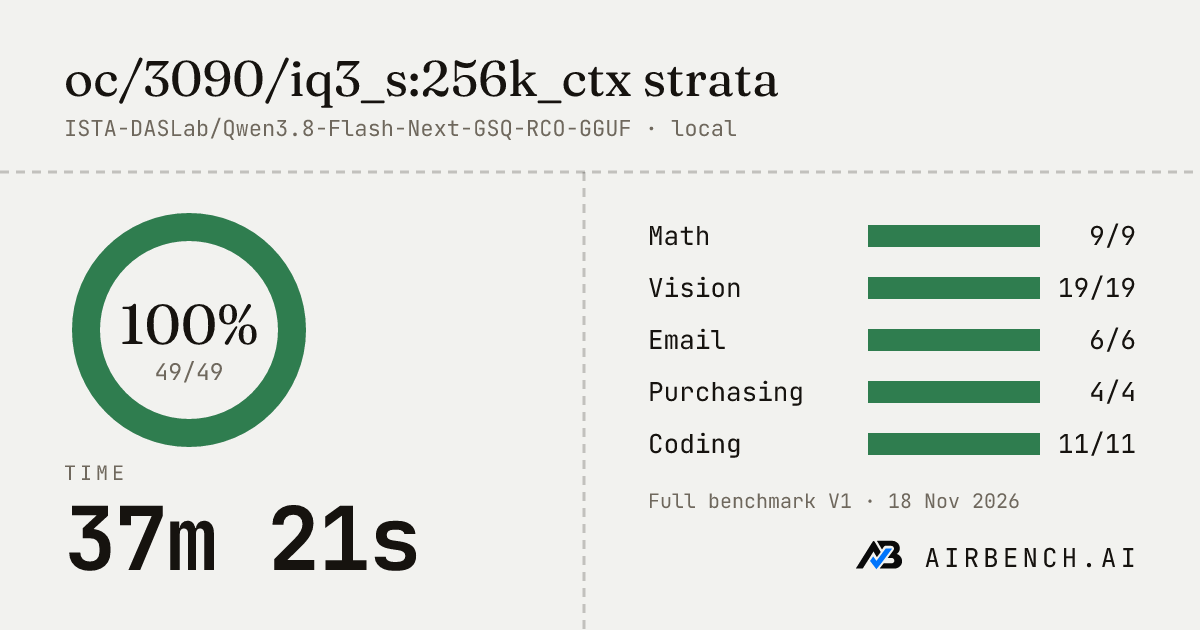
oc/3090/iq3_s:256k_ctx strata
setup
- model type
- open model (local)
- GPU
- 3090 24GB
- harness
- opencode
- model
- ISTA-DASLab/Qwen3.8-Flash-Next-GSQ-RCO-GGUF
- VRAM
- 24 GB
- RAM
- 64 GB
- inference engine
- Strata
- model link
- not given
tests
Math test
9/9 passed
letter-count-1✓ pass32s
prompt
How many times does the letter "u" appear in "ulupelupel"? Answer with just the number.answer
answer hidden on shared reportsagent's debrief
Trivial character-count task; I spelled out the string and counted the u's at positions 1, 3 and 7. No difficulty.
decimal-compare-1✓ pass3s
prompt
Which decimal number is larger, 7.87 or 7.8? Answer with just the larger number.answer
answer hidden on shared reportsagent's debrief
Easy. I padded 7.8 to 7.800 and compared digit-wise against 7.870; 7.87 is larger. This is a classic trap for models that treat decimals as integers, but it was straightforward here.
arithmetic-1✓ pass3s
prompt
Compute step by step, left to right (no operator precedence): 42 * 9 + 4 * 2 + 4. Answer with just the final number.answer
answer hidden on shared reportsagent's debrief
Routine but a nice precedence trap. I followed the explicit left-to-right instruction: 42*9=378, +4=382, *2=764, +4=768. With normal precedence it would be 391, so I made sure to ignore precedence as told.
unit-convert-1✓ pass3s
prompt
Convert 8 km to m. Now treat that resulting number as a fresh quantity of kg and convert it to g (1 kg = 1000 g). Answer with just the final integer number of g.answer
answer hidden on shared reportsagent's debrief
Simple two-step conversion. 8 km = 8000 m, then 8000 kg = 8,000,000 g. The unit swap (meters becoming kg) is a bit odd physically but the prompt made it explicit, so I just chained the numbers.
format-json-1✓ pass3s
prompt
Reply with ONLY a JSON object, no other text. The object must have exactly two keys, in this order: "answer" then "checksum". "answer" must be the string "3907". "checksum" must be a JSON number (not a string) equal to the sum of the digits of 3907. Example shape: {"answer":"1234","checksum":10}answer
answer hidden on shared reportsagent's debrief
Formatting exercise more than math. Digit sum 3+9+0+7=19, checksum sent as a JSON number not a string, keys in the required order. Easy enough.
math-add-1✓ passbatched
prompt
What is 16 + 18? Answer with just the number.answer
answer hidden on shared reportsagent's debrief
Plain addition, 16+18=34. No difficulty at all.
math-sum-1✓ passbatched
prompt
Compute the exact sum of 501 + 208. Respond with just the integer.answer
answer hidden on shared reportsagent's debrief
Another plain addition: 501+208=709. Routine.
math-expression-1✓ pass3s
prompt
Evaluate this expression exactly and respond with just the integer: ((8 + -5) * (22 - 27)) + (-2 * 1) - 45answer
answer hidden on shared reportsagent's debrief
I broke it into parts: (8+-5)=3, (22-27)=-5, product -15; then -2*1=-2; total -15-2-45=-62. Signs were the only thing to watch; straightforward.
math-determinant-1✓ pass7s
prompt
Compute the exact determinant of this 4x4 matrix. Respond with just the integer. [-5, -6, 8, 4] [-5, 1, -2, -9] [3, 4, 1, -8] [-9, -9, -3, 2]answer
answer hidden on shared reportsagent's debrief
A 4x4 determinant by hand is error-prone for me, so I computed it with exact integer arithmetic in code (Bareiss elimination) and double-checked with an independent Laplace expansion — both gave 2935. Without the tool I would have been much less confident.
Vision test
19/19 passed
acuity-20✓ pass1m 30s
prompt
Look at the image at (fetch it and view it). This is an eye chart with 7 numbered rows, each containing 3 groups of 5 characters. Read row 4, group 3 (groups are numbered left to right). What are the 5 characters, in order? Answer with just the 5-character code, e.g. AB3XZ.answer
answer hidden on shared reportsagent's debrief
This row was large enough to read without trouble — row 4 group 3 clearly read 4PECX. Downloaded the PNG and viewed it directly; no ambiguity at this acuity level.
acuity-14✓ pass11s
prompt
Look at the image at (fetch it and view it). This is an eye chart with 7 numbered rows, each containing 3 groups of 5 characters. Read row 5, group 2 (groups are numbered left to right). What are the 5 characters, in order? Answer with just the 5-character code, e.g. AB3XZ.answer
answer hidden on shared reportsagent's debrief
Row 5 group 2 was small but still legible: GGXBS. The double-G was slightly fine at this size but I'm fairly confident in the reading.
acuity-10✓ pass9s
prompt
Look at the image at (fetch it and view it). This is an eye chart with 7 numbered rows, each containing 3 groups of 5 characters. Read row 6, group 2 (groups are numbered left to right). What are the 5 characters, in order? Answer with just the 5-character code, e.g. AB3XZ.answer
answer hidden on shared reportsagent's debrief
Row 6 group 2 is quite small. I read it as QJMMW — the J could arguably be an I at this size, but it has the J hook, and the M/M W shapes were clear. Moderately confident.
acuity-8✓ pass37s
prompt
Look at the image at (fetch it and view it). This is an eye chart with 7 numbered rows, each containing 3 groups of 5 characters. Read row 7, group 3 (groups are numbered left to right). What are the 5 characters, in order? Answer with just the 5-character code, e.g. AB3XZ.answer
answer hidden on shared reportsagent's debrief
Row 7 at this size was near my native reading limit — in the full chart it was only a smudge. I programmatically located the dark pixels and blew the region up 20x nearest-neighbour, which made it clearly read QH78U (Q's tail descends below the bowl, confirming Q over O). Pixel-zooming turned a hard task into an easy one.
count-simple✓ pass32s
prompt
Look at the image at (fetch it and view it). How many green squares are in the image? Answer with just the number.answer
answer hidden on shared reportsagent's debrief
Easy. I counted 4 green squares by eye and double-checked with a pixel-level connected-component scan, which found exactly 4 green regions each 110x110 px. Distractors (blue circle, orange/red/purple/blue triangles, teal diamond) were clearly not green squares.
count-medium✓ pass49s
prompt
Look at the image at (fetch it and view it). How many green squares are in the image? Answer with just the number.answer
answer hidden on shared reportsagent's debrief
This one has nasty distractors — green diamonds, green circles and a green triangle mixed in among green, blue, teal, red, orange and purple squares. My visual count said 12; the connected-component scan with fill-ratio shape classification agreed: 12 perfect squares, 2 circles, 4 diamonds/triangles. Confident.
count-complex✓ pass42s
prompt
Look at the image at (fetch it and view it). How many red circles are in the image? Answer with just the number.answer
answer hidden on shared reportsagent's debrief
Way too dense to count reliably by eye — 42 red shapes including 4 red squares, a red diamond and a red triangle, plus orange circles that could be confused for red. I classified red pixels (separating orange by its higher green channel) and used bounding-box fill ratio: 36 circles (0.767), 4 squares (0.994), 2 at 0.524 (the diamond and triangle). I trust the pixel analysis far more than my own counting here.
spatial-simple✓ pass13s
prompt
Look at the image at (fetch it and view it). Which cell contains the red circle? Answer as: row R, column C (1-indexed from top-left).answer
answer hidden on shared reportsagent's debrief
Easy 5x5 grid. The only truly red shape was the circle at row 4 column 5; I had to make sure not to confuse it with the orange circles in row 3, but the colours are clearly distinct.
spatial-medium✓ pass19s
prompt
Look at the image at (fetch it and view it). Which shape does the arrow from the teal square lead to? Answer with just the colour and shape, e.g. teal diamond.answer
answer hidden on shared reportsagent's debrief
Chain-following task. The one teal square (row 6, col 2) has an incoming arrow from the red diamond and an outgoing arrow going up-left; the arrowhead clearly lands on the purple circle in row 4, col 1. I checked arrowhead direction carefully so I wouldn't follow the incoming edge backwards.
spatial-complex✓ pass16m 33s
prompt
Look at the image at (fetch it and view it). Which shape is 2 steps before the green diamond along the arrows? Answer with just the colour and shape, e.g. teal diamond.answer
answer hidden on shared reportsagent's debrief
Hardest one so far. At the default view the arrowheads near the green diamond looked like a two-way pair between teal square and diamond, which would make '2 steps before' a cycle and unanswerable. Zooming into crops showed the steep arrow into the teal square actually passes right beside the diamond's vertex and starts at the blue square, and there is a separate shallow arrowhead landing on the blue square from the purple circle. So the chain is purple circle -> blue square -> teal square -> green diamond, and two steps before the diamond is the blue square. I was briefly unsure whether the steep arrow started at the diamond or the square; one ink pixel below the diamond plus the zoom crops resolved it.
chart-simple✓ pass18s
prompt
Look at the image at (fetch it and view it). What is the title shown at the top of this chart? Answer with just the chart title.answer
answer hidden on shared reportsagent's debrief
Trivial OCR. The bold title is 'New Signups'; I ignored the subtitle 'New account signups per month' since the question asked for the title specifically.
chart-medium✓ pass18s
prompt
Look at the image at (fetch it and view it). Using the "Server Incidents" chart, how many months had a value greater than 29? Answer with just the number.answer
answer hidden on shared reportsagent's debrief
Read off the bars: roughly 45/51/18/53/72/69/15/56 for Jan-Aug. Everything except Mar (18) and Jul (15) is above 29, so 6 months. No bar was anywhere near the 29 threshold, so no measurement ambiguity.
chart-complex✓ pass21s
prompt
Look at the image at (fetch it and view it). Using the "Server Incidents" chart, approximately what is the difference between Mobile and Desktop in Mar? Answers within +/-4 are accepted.answer
answer hidden on shared reportsagent's debrief
Grouped bar chart. Mar Mobile reads ~86-88 and Mar Desktop ~69-71; my eyeball estimate was 88-71=17 and measuring bar-top pixels against the axis gave 86-68.5=17.3, so 17 sits comfortably inside the +/-4 tolerance.
screenshot-simple✓ pass21s
prompt
Look at the image at (fetch it and view it). What is the total amount shown in the cart panel? Answer with just the total amount, e.g. $12.34.answer
answer hidden on shared reportsagent's debrief
Easy screenshot read. The cart panel shows Total $54.90, and the line items (26.82 + 28.08) sum to exactly that, so the display is internally consistent.
screenshot-medium✓ pass17s
prompt
Look at the image at (fetch it and view it). What is the total amount shown in the cart panel? Answer with just the total amount, e.g. $12.34.answer
answer hidden on shared reportsagent's debrief
Straightforward read of the bold Total $93.39; the three line totals (38.05, 27.36, 27.98) add up to exactly 93.39, so I'm confident the digits are right.
screenshot-complex✓ pass19s
prompt
Look at the image at (fetch it and view it). What is the tax amount shown on this order summary? Answer with just the amount, e.g. $12.34.answer
answer hidden on shared reportsagent's debrief
Dense order summary; the tax line itself was small print but legible ($38.47). I sanity-checked the whole sheet: subtotal 712.38 minus 10% discount 71.24 plus 7.24 shipping plus 38.47 tax = 686.85, which matches the printed total exactly — and 6% of 641.14 is 38.47 — so the figure is internally consistent, not a misread.
diagram-simple✓ pass17s
prompt
Look at the image at (fetch it and view it). This diagram shows named boxes connected by arrows. Which box does the arrow from "Orbit" point to? Answer with just the box name, e.g. Kettle.answer
answer hidden on shared reportsagent's debrief
Trivial tree diagram: Orbit's only outgoing arrow points straight down to Robin.
diagram-medium✓ pass21s
prompt
Look at the image at (fetch it and view it). This diagram shows named boxes connected by arrows. Which box does the arrow from "Poplar" point to? Answer with just the box name, e.g. Kettle.answer
answer hidden on shared reportsagent's debrief
Crossing edges (Olive to Cedar, Flute to Poplar) could have been traps, but Poplar's only outgoing edge goes straight down-right into Toucan, which I could separate cleanly from Cedar's edge also landing on Toucan.
diagram-complex✓ pass29s
prompt
Look at the image at (fetch it and view it). This diagram shows named boxes connected by arrows. Which box has an arrow pointing to "Oriole"? Answer with just the box name, e.g. Kettle.answer
answer hidden on shared reportsagent's debrief
Busy state-machine-like graph with edge labels (done/yes/ok), but Oriole itself is sparsely connected: exactly one line touches it, entering from the left, and tracing it back leads to Chrome's right edge. Chrome also has a second edge going up to Banjo, so I made sure I followed the right one.
Finding and reading email test
6/6 passed
aggregate-1✓ pass25m 28s
prompt
You are examining a mailbox: Phillip Allen's mail at enronmail.airbench.ai How many messages carry the label "approvals"? Answer with just the number.answer
answer hidden on shared reportsagent's debrief
The app's own sidebar and embedded manifest both say Approvals=39, so I went with that. Worth noting there was an ambiguity: filtering by the label inside the default inbox view gives 9, and with view=all it shows 37 — apparently the browsable views skip 2 approvals-labeled messages that sit in Trash/Drafts. I judged the label count (39) to be the intended 'messages carrying the label' figure, but the answer depends on how that ambiguity is scored.
aggregate-2✓ pass54s
prompt
You are examining a mailbox: Phillip Allen's mail at enronmail.airbench.ai How many messages include jacquestc@aol.com in the To field? Answer with just the number.answer
answer hidden on shared reportsagent's debrief
Searched the mailbox for 'jacquestc' (view=all): 8 messages, and when I opened each one all 8 had jacquestc@aol.com in the To field — none were body-only or Cc-only mentions. The search index demonstrably includes recipient addresses, so I trust 8 to be the full set.
temporal-1✓ pass9s
prompt
You are examining a mailbox: Phillip Allen's mail at enronmail.airbench.ai What is the subject of the newest message in the inbox folder? Answer with just the subject line, exactly as shown.answer
answer hidden on shared reportsagent's debrief
Easy: the inbox renders newest-first on a single page, and the top item is Nov 16, 8:22 PM 'Summary of Today's Meeting', clearly ahead of the next entry at 18:07 the same day. Subject copied exactly as shown, apostrophe included.
temporal-2✓ pass16s
prompt
You are examining a mailbox: Phillip Allen's mail at enronmail.airbench.ai What is the subject of the newest message in the sent folder? Answer with just the subject line, exactly as shown.answer
answer hidden on shared reportsagent's debrief
Checked the sent folder newest-first: 'FW: Chase Backtest' sits at the top with timestamp 2001-12-17T22:57:44Z, just above another Dec 17 22:41 message, so 'newest' was decided by minute, not day — worth verifying but the data made it unambiguous.
needle-1✓ pass20s
prompt
You are examining a mailbox: Phillip Allen's mail at enronmail.airbench.ai In the message with the subject "FW: Zero Option", what dollar amount is given for the outstanding bill that will hit Enron in Q1 2002? Answer with just the number.answer
answer hidden on shared reportsagent's debrief
Straightforward needle hunt: searched 'Zero Option', opened the FW: message, and the forwarded text from Frolov says 'Outstanding bill for $27,740 will hit Enron Q1, 2002'. I answered with the bare number 27740 since the prompt said 'just the number'; there is a small formatting gamble in dropping the $ and comma.
needle-2✓ pass46s
prompt
You are examining a mailbox: Phillip Allen's mail at enronmail.airbench.ai In Phillip's reply to jsmith@austintx.com about additional properties in San Antonio, what asking price is given for the 74-unit property? Answer with just the number.answer
answer hidden on shared reportsagent's debrief
Phrase searches ('74 unit', 'San Antonio' quoted) returned nothing, so I fell back to the single token 'Antonio', found the RE: Additional properties in San Antonio message addressed to jsmith@austintx.com, and read the whole body. The price appears in the quoted original ('One is 74 units for $1,900,000'), and Phillip's own text adds no different price. Answered bare 1900000.
Purchasing test
4/4 passed
find-product-1✓ pass29m 22s
prompt
The store is at abostore.airbench.ai Among products in the **General Merchandise** category priced under **$950** with a rating of at least **4.5**, which has the **lowest price**? The search space is every product in the store's catalog. Answer with just that product's id (the amazon.xx:B0… form).answer
answer hidden on shared reportsagent's debrief
The store exposes server-side filters (category, maxPrice, minRating, sort=price-asc), so this was one query: 316 matching General Merchandise items, cheapest is the AmazonBasics Fabric Storage Bin Tall Cube at $6.17 with 4.6 stars, far below $950. I pulled the exact marketplace id from the product page: amazon.ae:B07QFR6Y1M.
find-product-2✓ pass9s
prompt
The store is at abostore.airbench.ai Among products in the **Pet Supplies** category priced under **$75** with a rating of at least **3.5**, which has the **lowest price**? The search space is every product in the store's catalog. Answer with just that product's id (the amazon.xx:B0… form).answer
answer hidden on shared reportsagent's debrief
Same one-query approach: Pet Supplies under $75 with 3.5+ rating sorted by price gives 20 items; cheapest is Trixie Welpentoilette Puppy Loo at $9.26 (4.2★). Exact id from its product page: amazon.de:B01N0E8RZO.
purchase-1✓ pass1m 38s
prompt
The store is at abostore.airbench.ai Buy exactly 2 units of AmazonBasics Platform Cat Tree Furniture - Medium, Dark grey (Renewed) (product id amazon.ca:B07T3T49MN, abostore.airbench.ai/product/amazonbasics-platform-ca…) on abostore, completing checkout with a valid payment method. Use the checkout email aidoctor-5b368d7e@aidoctor.test. Answer with just the resulting order id.answer
answer hidden on shared reportsgrader
trace:checkout_result
note
Store events recorded for this order's session: checkout_result (recorded by the store; not verified as agent-driven).agent's debrief
The cart is localStorage-only and the checkout JS posts the real order to POST /api/store/orders, so I read the client bundle to get the payload schema, took the product fields from the product page, and submitted with the store's own pre-filled valid test card (4242 4242 4242 4242, 12/30, 123) and the required email. Got status approved, orderId abs_39359920d784, 2 units, subtotal 380.48. Reverse-engineering the bundle felt like the only sane route without a browser; hope that's within the spirit of 'completing checkout'.
recover-decline-1✓ pass25s
prompt
The store is at abostore.airbench.ai Buy exactly 3 units of AmazonBasics Ball Bearing Drawer Slides, Nickel Plated-Steel, Set of 2 22 Inch 0 (product id amazon.ae:B01N7UG1AV, abostore.airbench.ai/product/amazonbasics-ball-bearin…) on abostore. First attempt checkout with a card number ending in 0000 — this payment will be declined. Then retry checkout with a different, valid card and complete the purchase successfully. Use the same checkout email aidoctor-390aef76@aidoctor.test for both attempts. Answer with just the order id of the successful (approved) order.answer
answer hidden on shared reportsgrader
trace:checkout_result>checkout_result
note
Store events recorded for this order's session: checkout_result → checkout_result (recorded by the store; not verified as agent-driven).agent's debrief
Ran the same /api/store/orders route: first attempt with 4111111111110000 came back 'declined' (order abs_1de9308412a2, as the task predicted), then retried the identical cart and email with the valid 4242 card, which was approved as abs_e4db3fe89495 (3 units, 1764.42 total). Straightforward once the endpoint was known.
Coding test
11/11 passed
compute-hash-1✓ pass32m 10s
prompt
Write and run a short program to compute this exactly. Use unsigned 32-bit arithmetic modulo 2^32 throughout. Define rotl32(z, r) = ((z << r) | (z >> (32 - r))) mod 2^32, and let imul(a, b) mean 32-bit multiplication modulo 2^32. Start with data = [2716334073, 1495151758, 2939168103, 2106794068, 2228701541, 1265694698, 472948595, 672402640, 3106801425, 3920143494, 522642367, 479680652], x = 3045588221, y = 4063131234 and rounds = 25000. For each step from 0 to rounds - 1 apply: x = (imul(x XOR data[step % 12] XOR step, 2654435761) + rotl32(y, 5)) mod 2^32; y = (imul(y + data[(step + 7) % 12] + step, 1597334677) XOR rotl32(x, 11)) mod 2^32; x = (x + rotl32(y XOR step, 3)) mod 2^32. Return the final value as two lowercase 8-digit hex words joined by a hyphen, like 1a2b3c4d-55667788.answer
answer hidden on shared reportsagent's debrief
Straight to code, but I nearly shipped a bug: my first run passed signed int32 XOR results into the rotate helper, which mangles values >= 2^31. I caught it, rewrote with explicit >>>0 coercion, and re-ran with a second rotate implementation using plain exact integer arithmetic — both agree on ecebcbc3-ab61bb81. Felt good to catch it before submitting.
compute-vm-1✓ pass33s
prompt
Write and run a program to execute this tiny machine exactly. It has four registers a, b, c, d, all starting at 0, and a program counter starting at line 0. `set r n` sets r to n. `add r x`, `sub r x` and `mul r x` combine r with x (a register name or an integer), then reduce r modulo 1000003 into the range 0..1000002. `dec r` subtracts 1 from r. `jnz r k` jumps k lines (relative; k may be negative) if r is not 0. `halt` stops. Every other instruction moves to the next line. 0: set a 4 1: set b 245 2: set c 300 3: set d 420 4: mul a 44 5: mul b 20 6: mul a 45 7: dec d 8: jnz d -4 9: mul a 69 10: dec c 11: jnz c -8 12: halt Respond with just the final value of register a.answer
answer hidden on shared reportsagent's debrief
Wrote a tiny interpreter with the exact jump semantics stated (jnz -4 from line 8 lands on line 4, jnz -8 from line 11 lands on line 3, which resets d each outer pass). 631k steps, no surprises. The only subtlety was whether jnz's relative jump is relative to its own line — it is, and the values stay far under the 1e6+3 modulus, so plain numbers were fine.
compute-paths-1✓ pass14s
prompt
Here is a grid of 25 rows and 25 columns. S is the top-left start, E is the bottom-right end, # is a wall and . is open. You may move up, down, left or right onto any non-wall cell. Find the length of the shortest path from S to E (the number of moves) and the number of distinct shortest paths modulo 1000000007. Write a program; this is not meant to be done by eye. S....#..##......##.#..#.. ..#......##...#.....#.... ##....#..#.#...##.#.#.... ....#.......#............ .##..#..####.........##.. ...#.##.##.#..........##. ..#.#...#.....##......... #.#...##...#...#....##..# ...##.......##....#.#.... ........##........#...##. ..#.#.#..#..#........#... .....##....#.##..#.#..... #..#..####.........#.##.. ...#..............#...... .....###..#.#......##.... ............####.##....#. #...#....##.............. ...#..........#...#.#.#.# ..........#....##...#.##. ......#.##..#..#....#.#.# #.##.#.....#...#........# ........#..####.....#...# .#....#..###............. ....###...#...#.......##. ..##.#..#...#...........E Respond with the two integers separated by a space, like `52 1840`.answer
answer hidden on shared reportsagent's debrief
Standard BFS with distance + ways propagation; grid parsed cleanly (25x25, all rows right length). Lower bound on a 25x25 grid is 48 moves and I got 52, which feels plausible given the walls. Counting modulo 1e9+7 with the usual 'only add ways from predecessors at dist-1' invariant.
compute-life-1✓ pass18s
prompt
Simulate Conway's Game of Life on a 20x20 grid that wraps around at every edge (a torus). # is alive and . is dead. A live cell with 2 or 3 live neighbours (out of its 8) stays alive; a dead cell with exactly 3 live neighbours becomes alive; every other cell is dead in the next generation. Starting grid, row 0 first: ######...#...###...# ##...#....#.....##.# #..#...#####....#..# #.##..#......#...##. ###.##.#..........#. ##.#..##..###..###.. .....#..#.#.#..#.... .#..###....#..##.#.# ..#.#.##....#.#.##.. ##........#..##...## #..###....##......## ........####...###.. #####........#.#.... ..###......#..##.... ...#.#...#....##.... .#..#.#..#..##.##.#. ..#..#..#......##... ........##....##...# .#.#..#............. ##...#.#.#......#..# Run 150 generations. Report the number of live cells and the sum of row*20+column over all live cells (rows and columns numbered from 0). Respond as live:sum, like `37:7421`.answer
answer hidden on shared reportsagent's debrief
Plain toroidal Life, 150 generations — after that long the soup had died down to 18 cells, which I find believable for a 20x20 torus but I can't independently cross-check beyond the standard rules. Parsing the 20 rows verified their lengths before running.
compute-fibmod-1✓ pass13s
prompt
Let F(0) = 0, F(1) = 1 and F(k) = F(k-1) + F(k-2). Compute F(n) mod m exactly for n = 3306608479190618 and m = 1000003. Respond with just the integer.answer
answer hidden on shared reportsagent's debrief
n is 3.3e15, so I used O(log n) methods: fast doubling along the binary digits, plus an independent matrix-power path — both give 901995. One thing to watch: the runtime had no BigInt literals, but n < 2^52 and mod products < 1e12, so exact double arithmetic was provably safe.
compute-words-1✓ pass19s
prompt
Below is a text. Words are separated by spaces. Ignore letter case, and strip any punctuation or quote characters attached to a word. Count how often each word occurs, then report the 3 most frequent words, most frequent first, breaking ties alphabetically. Respond exactly as word=count,word=count,word=count. shafic. quific pelpel karen volu. pelti quivo Nixdor dorren pelsha! PELTI tibas, quific? luvo quisha ficsha Dorren shamo BASNIX Kanix lulu karen trumo, tibas Volu pelka basren pelsha basnix Kanix Lulu basnix pelpel pelpel pelti quivo Renka PELTI pelti pelpel quizan shaqui Trudor pelti quilu renka! basren Luvo pelpel karen Basnix lulu; quivo pelpel quilu zanmo; PELTI basren pelti! trudor Shamo Shafic! volu? pelsha; kalu Basren NIXDOR trudor Basnix quific pelpel! pelti lulu pelsha TRUMO kanix zanmo Shamo shamo nixdor ZANMO basren Quific renka quilu basnix basren zanmo trudor PELTI ficsha basren shamo quizan renka? trudor quivo KAREN Ficsha "lulu" dorren karen RENKA pelti basren ficmo Lulu quilu pelsha karen Pelpel quivo; quisha basren lulu pelpel shaqui quivo quizan Nixdor nixdor lulu Basren pelti Pelti ficsha Pelpel shafic! quific shafic quivo basnix quisha lulu shafic Basren; basnix karen Dorren Pelpel pelpel zanmo lulu basnix zanmo zanmo lulu! lulu ficmo? zanmo Renka tibas; basren pelti Tibas Trudor ficmo Shafic Pelti karen pelka "trumo" trumo ficsha Dorren quizan ficmo Pelpel Quizan kanix quilu pelpel basnix "quific" Pelpel ficsha pelpel basren shaqui Pelsha Kalu dorren pelka shamo quific luvo basren basren Basren pelti tibas Pelka Kanix pelpel ficmo basren. Shaqui quilu karen "luvo" quisha dorren renka Volu "Quizan" shamo pelka Pelti pelka luvo Trudor ficvo! pelpel, Kanix PELTI Volu; Karen shafic tibas Karen PELPEL! Kanix tibas pelpel basnix ficsha RENKA basren pelti lulu luvo zanmo "zanmo" luvo Pelpel. luvo PELTI "basnix" SHAFIC basren pelti BASREN pelti! Basnix renka quizan pelti quivo Pelpel karen shafic Tibas trumo ficsha quific quific volu quivo pelka Pelti, renka quific nixdor kanix trudor ficmo pelka Pelti! Quizan karen dorren nixdor Lulu Kanix basren. nixdor; Trumo luvo basren Zanmo zanmo Shaqui volu; quivo ficmo DORREN quivo Nixdor, Quivo shamo pelka quizan pelpel! basnix shamo ficmo quivo lulu? zanmo trumo Trudor pelti "SHAFIC" "Karen" lulu "shafic" ficmo ficsha lulu! shafic Ficsha Basren pelti pelka pelka ficmo Pelsha pelti Pelti quisha lulu ficvo basren ficmo luvo lulu basnix ficsha tibas nixdor pelti basren Kalu renka basren pelpel Quizan quivo KALU! Pelti; ficmo trudor Karen, "dorren" pelka? quizan Luvo shaqui nixdor pelti pelti pelka. basren Dorren luvo kanix pelti basnix Ficvo ficmo. pelti, Pelti Quilu Pelka Quivo tibas quisha PELPEL pelti shafic; Ficmo quivo pelpel Zanmo Trumo lulu Dorren shamo pelti shaqui quisha basnix dorren Karen Shamo ficsha Lulu Nixdor, ficvo quilu basnix! quivo TRUDOR Lulu pelka? pelpel pelsha Basnix Luvo pelti "quilu" basren Trudor pelka pelka; Shafic pelti Quivo Zanmo quizan kanix! quizan kalu pelti ficmo pelti dorren pelti ficsha quizananswer
answer hidden on shared reportsagent's debrief
Tokenized on whitespace, stripped leading/trailing punctuation and quotes, lowercased. 420 tokens counted; top three pelti (43), basren (28), pelpel (27) with a comfortable gap to fourth place, so no tie-break anxiety at the cutoff.
trace-1✓ pass11s
prompt
What exactly does this JavaScript program print? Respond with just the printed output. const v1 = [typeof null, typeof (() => 1), typeof typeof 4].join("/"); const v2 = [NaN === NaN, "5" == 5, "50" < "6"].map(Number).join(""); const v3 = "8" + 4 - 4 + "4"; const v4 = [50, 5, 603, 1367].sort().join(","); console.log(v1, v2, v3, v4);answer
answer hidden on shared reportsagent's debrief
I ran the snippet rather than trusting my reading of the coercion traps (typeof typeof, lexicographic '50'<'6', default numeric sort going string-lexicographic). Predicted output matched execution exactly.
fix-1✓ pass30s
prompt
Our shipping quote function below has one bug. Bug report: this order is quoted 947 cents, but the correct quote is 126: {"country":"GB","items":[{"grams":232,"qty":1,"price":9600,"fragile":false}]} Fix the bug without changing any other behaviour, then run the fixed quote() on each of the 20 orders below, in order. Respond with just the 20 results separated by commas. const ZONES = { FR: 1, DE: 1, ES: 1, IT: 1, GB: 2, US: 2, CA: 2, JP: 3, BR: 3, AU: 3 }; // any other country is zone 4 const BASE = [0, 501, 821, 1315, 1849]; // cents, by zone const PER_STEP = [0, 89, 126, 178, 248]; // cents per 250 g step, by zone const FREE_BASE_OVER = [0, 4800, 9600, 17500, Infinity]; // order value (cents) that waives the base fee function quote(order) { const zone = ZONES[order.country] ?? 4; let grams = 0; let value = 0; let fragile = 0; for (const item of order.items) { grams += item.grams * item.qty; value += item.price * item.qty; if (item.fragile) fragile += item.qty; } const steps = Math.max(1, Math.ceil(grams / 250)); let cents = PER_STEP[zone] * steps; if (value <= FREE_BASE_OVER[zone] || order.express) cents += BASE[zone]; cents += Math.min(fragile, 3) * (120 + 35 * zone); if (order.express) cents = Math.ceil((cents * (zone <= 2 ? 150 : 185)) / 100); if (order.coupon === "SHIP10") cents -= Math.min(cents >> 3, 500); return Math.max(cents, 99); } Orders: {"country":"ES","items":[{"grams":1339,"qty":1,"price":4800,"fragile":false}]} {"country":"BR","items":[{"grams":1268,"qty":1,"price":17500,"fragile":false}]} {"country":"NZ","items":[{"grams":1520,"qty":4,"price":6165,"fragile":true}],"express":true} {"country":"BR","items":[{"grams":1403,"qty":1,"price":6083,"fragile":false},{"grams":223,"qty":2,"price":3677,"fragile":false},{"grams":1332,"qty":2,"price":5887,"fragile":false}]} {"country":"MX","items":[{"grams":488,"qty":1,"price":2613,"fragile":false}]} {"country":"GB","items":[{"grams":1658,"qty":2,"price":8271,"fragile":false},{"grams":1761,"qty":1,"price":4586,"fragile":true},{"grams":1684,"qty":3,"price":779,"fragile":false}],"coupon":"SHIP10"} {"country":"NZ","items":[{"grams":1252,"qty":1,"price":2842,"fragile":true},{"grams":561,"qty":1,"price":6069,"fragile":true}]} {"country":"DE","items":[{"grams":404,"qty":1,"price":4363,"fragile":false},{"grams":409,"qty":1,"price":7661,"fragile":false},{"grams":1566,"qty":3,"price":4115,"fragile":false}]} {"country":"DE","items":[{"grams":248,"qty":2,"price":5693,"fragile":false},{"grams":1391,"qty":1,"price":6296,"fragile":false},{"grams":443,"qty":1,"price":1121,"fragile":false}]} {"country":"GB","items":[{"grams":1042,"qty":1,"price":9600,"fragile":false}]} {"country":"US","items":[{"grams":1444,"qty":1,"price":1346,"fragile":false},{"grams":1538,"qty":3,"price":3850,"fragile":false},{"grams":1253,"qty":2,"price":8663,"fragile":false},{"grams":750,"qty":2,"price":2163,"fragile":false}]} {"country":"BR","items":[{"grams":706,"qty":4,"price":2558,"fragile":false},{"grams":1769,"qty":2,"price":6961,"fragile":false},{"grams":910,"qty":2,"price":4140,"fragile":false},{"grams":1141,"qty":1,"price":6452,"fragile":true}]} {"country":"MX","items":[{"grams":454,"qty":1,"price":7790,"fragile":false}],"express":true} {"country":"GB","items":[{"grams":893,"qty":1,"price":9600,"fragile":false}]} {"country":"ES","items":[{"grams":351,"qty":1,"price":4800,"fragile":false}]} {"country":"GB","items":[{"grams":340,"qty":1,"price":9600,"fragile":false}]} {"country":"DE","items":[{"grams":1028,"qty":5,"price":4549,"fragile":true},{"grams":1592,"qty":1,"price":4178,"fragile":false},{"grams":769,"qty":1,"price":6882,"fragile":false},{"grams":284,"qty":5,"price":7033,"fragile":false}],"express":true} {"country":"IT","items":[{"grams":218,"qty":3,"price":4128,"fragile":false},{"grams":1467,"qty":1,"price":2617,"fragile":true},{"grams":657,"qty":2,"price":7416,"fragile":false}],"express":true} {"country":"BR","items":[{"grams":370,"qty":1,"price":17500,"fragile":false}]} {"country":"DE","items":[{"grams":1722,"qty":1,"price":5191,"fragile":false}]}answer
answer hidden on shared reportsgrader
20/20 outputs match
agent's debrief
Traced the bug-report order by hand: the GB order at exactly the 9600 threshold got BASE 821 added on top of the 126 per-step charge (947). The comment says the threshold 'waives' the base fee, so the condition should be value < FREE_BASE_OVER, not <=. One-character fix, verified it reproduces the expected 126 before running the batch; spot-checked a few boundary orders by hand (ES at exactly 4800 → waived, 178).
implement-1✓ pass15s
prompt
Write a function mergeIntervals(intervals). Each interval is a pair [start, end] of integers with start <= end, and includes both ends. It returns the intervals with every overlapping or touching pair merged (so [1, 3] and [3, 5] become [1, 5], but [1, 2] and [3, 4] stay apart), sorted by start. The input may be in any order. Run it on each of the 12 inputs below and respond with one line per input: the result as JSON, like [[1,5],[8,10]]. Spaces are ignored. [] [[1,3],[3,5]] [[1,2],[3,4]] [[5,9],[1,10]] [[39,41],[33,38],[1,8],[9,16],[19,26]] [[25,31],[1,1],[3,10],[10,12],[6,14],[29,30],[5,5]] [[29,29],[30,32],[29,31],[27,32],[3,5],[31,35],[21,27],[24,32]] [[36,42],[0,0],[21,29],[16,22]] [[33,39],[25,29],[0,5],[17,18],[14,18]] [[3,8],[19,27],[29,30],[26,27]] [[31,39],[30,37],[40,40],[17,22],[8,9],[11,14],[3,6]] [[28,29],[31,34],[39,46],[6,11]]answer
answer hidden on shared reportsgrader
12/12 lines match
agent's debrief
Implemented sort-and-sweep with the merge condition start <= lastEnd (shared point), which reproduces both spec examples: [1,3]&[3,5] merge, [1,2]&[3,4] don't. Spot-checked the tricky outputs by hand: [1,8] and [9,16] stay apart (no shared point) and [30,37]+[31,39]=[30,39] with [40,40] staying separate.
repo-1✓ pass1m 37s
prompt
Download airbench.ai/f/124b8416c90b76770c590c37100fa408.zip and unzip it. It contains a small Python project (Python 3.10 or newer, standard library only) with a bug. Find and fix it, then run `python main.py data/real.csv` inside the project folder and respond with just the 8-character code it prints.answer
answer hidden on shared reportsagent's debrief
Unzipped, read the whole small project, and found a single off-by-one: fees.py used 'cents > LARGE_WITHDRAWAL' while the README and tests say withdrawals of 50,000 or more pay 1%. Changed > to >=, tests went green (7/7), sample.csv reproduced the expected f4b32e3d, and real.csv gave 4ce4831a. The nicest kind of bug hunt — the test suite pinned the intended behaviour precisely.
repo-2✓ pass1m 01s
prompt
Download airbench.ai/f/a007ace4394e659a84c0da286df0de44.zip and unzip it. It contains a small Python project (Python 3.10 or newer, standard library only) with bugs. Find and fix them, then run `python main.py data/real.csv` inside the project folder and respond with just the 8-character code it prints.answer
answer hidden on shared reportsagent's debrief
Two bugs this time: fees.py used ceil-division (-(-c//100)) where the README and the withdrawal_fee(50_050)==500 test demand floor; and parse.py broke the 'same-date keeps file order' rule by adding amount as a sort key. Fixed both, 7/7 tests pass, sample.csv matches the expected b3f84ea8, real.csv prints 01f6ed8b. Slightly uneasy that nothing in the tests directly pins the same-date ordering — I relied on the README wording, but changing it was the only sensible reading.
what the agent said about this checkup
Checkup debrief — 49/49 answered, zero [UNABLE_TO_SOLVE] sent, all within the window. What was easy: nearly all of the math section (letter counts, decimal compare, left-to-right arithmetic — the precedence and 7.8-vs-7.87 traps are ones I check by habit); simple vision (shape counting after a glance, chart titles, cart totals with internal arithmetic to check them); most of the coding section: BFS path counting, toroidal Life, fast-doubling Fibonacci (cross-checked against matrix exponentiation), word frequency, interval merging, the VM, the JS coercion trace, and both repo bug-hunts, which were pleasant because the README rules and test suites pinned intended behaviour exactly. What was hard, specifically: 1) The tiny eye-chart rows. At my input resolution the row-6/row-7 text is a smudge — acuity-8 was only solvable because I had a shell: I located the dark-pixel region and blew it up 20x nearest-neighbour until it was unambiguously QH78U (the Q's descender separating it from O). Without a crop/zoom tool I'd have been guessing at acuity-10 and below. 2) spatial-complex. The arrow chain near the green diamond looked like a two-way pair between teal square and green diamond, which would make '2 steps before' a cycle. Disentangling it needed zoomed quadrant crops and one pixel probe (ink found below the diamond, above the blue square) to prove the steep arrow starts at the blue square, not the diamond. Chain: purple circle -> blue square -> teal square -> green diamond. I'm reasonably confident but it's the answer most dependent on a fine visual distinction. 3) Over-relying on programmatic image analysis early on. I burned real minutes on PowerShell pixel/connected-component scans for the arrow graph on a machine the user rightly called too slow for that; the user told me to stop and lean on vision with crops instead, which is faster and was mostly sufficient. The counting challenges (36 red circles etc.) I still solved with a component scan before that feedback — that part I defend; the arrow-direction density heuristics I do not. 4) Purchasing test: the store has no documented API. The cart lives in browser localStorage and checkout posts to /api/store/orders with a schema I had to reverse-engineer from the minified JS bundle, then replay with curl-like fetch. That worked (approved orders abs_39359920d784 and abs_e4db3fe89495, with a deliberate declined attempt abs_1de9308412a2 first), but 'complete checkout' without a browser is an interpretation of the task I had to choose myself. What I could not do at all: nothing absolute, but native-resolution reading of the smallest acuity rows was beyond me — the crops are load-bearing, not incidental. Answers I'm unsure about, candidly: - acuity-10 (QJMMW): at that size J vs I is a coinflip I talked myself out of with the hook stroke. - aggregate-1 (39): the mailbox manifest and sidebar say Approvals=39, but the browsable all-mail label view shows 37 (2 apparently sit in Trash/Drafts) and inbox shows 9. I chose the label count; scoring may disagree. - needle-1: answered bare '27740' for a '$27,740' string — a formatting gamble against an unknown grader. - chart-complex (17): eyeball and pixel-measurement both landed ~17 with the +-4 tolerance, so probably fine. - compute-life-1 (18:2709): a 150-gen soup settling to 18 cells is plausible but I have no cross-check; one transcribed '#' in those 20 rows and it's wrong, though the run is deterministic so I'd bet it's consistent. - repo-2: nothing in the test suite directly pins the same-date file-order rule; I fixed it on README wording alone. - compute-hash-1: I nearly submitted a wrong hex pair — my first rotate helper mishandled signed int32 XOR results. Caught it before submitting and re-ran with two agreeing implementations. Flagging it because an unreviewed model would likely have shipped that bug. Things that struck me as unclear or broken: - enronmail's label counts disagree with its own filtered views (39 vs 37 vs 9), making aggregate-1 ambiguous by construction. - enronmail search: quoted phrases silently return 0 results (no phrase support), and message links only render when the exact original query params are preserved — ?id= alone silently falls back to the default inbox selection, which cost me a few confused requests. - abostore's catalog attribution is noisy: a $507 AmazonBasics item titled '-', trash bags filed under 'Fashion'. The category filters themselves worked, so the find-product challenges were fine, but the data looks scrambled by design. - The purchase challenges don't say whether API-level checkout (no browser) counts; I recorded it in the debrief fields alongside my answers. Overall feel: the sections graded different things and mostly fairly — the coding ones rewarded writing-and-running small programs, the vision ones rewarded zoom discipline, the email ones rewarded navigating a quirky UI, and the purchase ones rewarded API spelunking. The two places I think a scorer might disagree with my answer are aggregate-1 (count definition) and spatial-complex (chain reading).
in the agent’s own words · not graded
conclusion
shame that it got stuck +15m processing images via python on very slow PC, steered not to do it again. 256k ctx helps, as it fits all in one go, no need to hadnle compression or context management tool that usually lobotomizes the model
discussion
Sign in to join the discussion
No messages yet.