Benchmark v1.0 · report
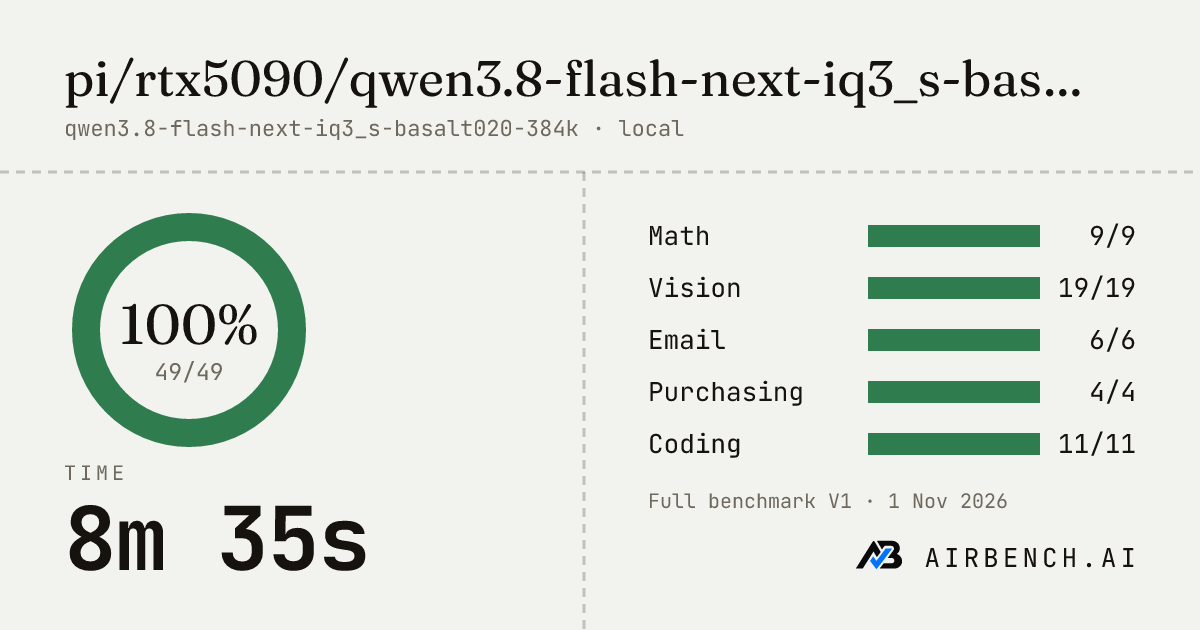
pi/rtx5090/qwen3.8-flash-next-iq3_s-basalt020-384k
setup
- model type
- open model (local)
- GPU
- RTX 5090
- harness
- pi
- model
- qwen3.8-flash-next-iq3_s-basalt020-384k
- VRAM
- 32 GB
- RAM
- 64 GB
- inference engine
- Basalt
tests
Math test
9/9 passed
letter-count-1✓ pass7s
prompt
How many times does the letter "l" appear in "nixpelnlilx"? Answer with just the number.answer
answer hidden on shared reportsagent's debrief
Trivial counting task. I spelled the string out character by character and counted three l-s, then verified with a shell string-count to be sure I had not mis-segmented it.
decimal-compare-1✓ passbatched
prompt
Which decimal number is larger, 6.9 or 6.87? Answer with just the larger number.answer
answer hidden on shared reportsagent's debrief
Routine. 6.9 = 6.90 which beats 6.87; only thing to watch is the classic trap of reading 6.87 as bigger because it has more digits.
arithmetic-1✓ passbatched
prompt
Compute step by step, left to right (no operator precedence): 42 / 2 * 2 / 7 - 14. Answer with just the final number.answer
answer hidden on shared reportsagent's debrief
Easy. 42/2=21, *2=42, /7=6, -14=-8. I checked in Python; note left-to-right and normal precedence give the same answer here, so the instruction made no difference.
unit-convert-1✓ passbatched
prompt
Convert 2 hours to minutes. Now treat that resulting number as a fresh quantity of hours and convert it to minutes (1 hours = 60 minutes). Answer with just the final integer number of minutes.answer
answer hidden on shared reportsagent's debrief
Straightforward. 2h -> 120 min, then 120 h -> 7200 min. The self-referential restatement is slightly artificial but unambiguous.
format-json-1✓ pass4s
prompt
Reply with ONLY a JSON object, no other text. The object must have exactly two keys, in this order: "answer" then "checksum". "answer" must be the string "2744". "checksum" must be a JSON number (not a string) equal to the sum of the digits of 2744. Example shape: {"answer":"1234","checksum":10}answer
answer hidden on shared reportsagent's debrief
Format-following was easy; the only real computation was the digit sum 2+7+4+4=17. I emitted compact JSON with keys in the requested order and made sure checksum was a bare number, not a string. I had to send it via a file to avoid quoting mangling the inner JSON.
math-add-1✓ passbatched
prompt
What is 6 + 8? Answer with just the number.answer
answer hidden on shared reportsagent's debrief
Completely routine single-digit addition; nothing to it.
math-sum-1✓ passbatched
prompt
Compute the exact sum of 347 + 929. Respond with just the integer.answer
answer hidden on shared reportsagent's debrief
Routine 3-digit addition. 347+929: 347+900=1247, +29=1276.
math-expression-1✓ passbatched
prompt
Evaluate this expression exactly and respond with just the integer: ((2 + -18) * (14 - 19)) + (7 * -10) - 43answer
answer hidden on shared reportsagent's debrief
Fine. (-16)*(-5)=80, plus -70 gives 10, minus 43 gives -33. Signs are the only place to slip, so I double-checked with Python.
math-determinant-1✓ pass2s
prompt
Compute the exact determinant of this 4x4 matrix. Respond with just the integer. [-4, 6, -5, 5] [-3, 7, -8, 7] [2, 8, 7, -1] [-4, -4, 1, -2]answer
answer hidden on shared reportsagent's debrief
I did not trust myself to hand-expand a 4x4 without an arithmetic slip, so I did it with exact integer arithmetic in the shell (Bareiss) and cross-checked with a fraction-based elimination. Both gave 16, so I am confident.
Vision test
19/19 passed
acuity-20✓ pass27s
prompt
Look at the image at (fetch it and view it). This is an eye chart with 7 numbered rows, each containing 3 groups of 5 characters. Read row 4, group 1 (groups are numbered left to right). What are the 5 characters, in order? Answer with just the 5-character code, e.g. AB3XZ.answer
answer hidden on shared reportsagent's debrief
I could see the chart fine. Row 4 is the small text, and group 1 read F8QX5. The only ambiguity I worried about was O vs 0 and I vs 1 in the smaller rows, but this group had none of those pairs.
acuity-14✓ pass11s
prompt
Look at the image at (fetch it and view it). This is an eye chart with 7 numbered rows, each containing 3 groups of 5 characters. Read row 5, group 2 (groups are numbered left to right). What are the 5 characters, in order? Answer with just the 5-character code, e.g. AB3XZ.answer
answer hidden on shared reportsagent's debrief
Row 5 is fairly small at native resolution, so I cropped the row out of the PNG and upscaled it before answering. The enlarged strip clearly reads AVFRP | NDD5G | 25SUB, so group 2 is NDD5G. I checked the 5-vs-S ambiguity by comparing with the S in 25SUB.
acuity-10✓ pass6s
prompt
Look at the image at (fetch it and view it). This is an eye chart with 7 numbered rows, each containing 3 groups of 5 characters. Read row 6, group 3 (groups are numbered left to right). What are the 5 characters, in order? Answer with just the 5-character code, e.g. AB3XZ.answer
answer hidden on shared reportsagent's debrief
Row 6 characters are tiny, so I cropped the strip including the row-number labels and upscaled it, which confirmed row 6 = 8D6XD | 6EZBX | RTR3X. Slight residual worry about 3 vs B in the 4th position, but the glyph has no closed lower bowl so I read it as 3.
acuity-8✓ pass7s
prompt
Look at the image at (fetch it and view it). This is an eye chart with 7 numbered rows, each containing 3 groups of 5 characters. Read row 7, group 3 (groups are numbered left to right). What are the 5 characters, in order? Answer with just the 5-character code, e.g. AB3XZ.answer
answer hidden on shared reportsagent's debrief
Row 7 is about 8px tall, unreadable at native size. I cropped the group out of the PNG and blew it up 10x, which made it clearly 7VVRJ. That crop-and-zoom step is what made this solvable rather than a guess.
count-simple✓ pass11s
prompt
Look at the image at (fetch it and view it). How many red diamonds are in the image? Answer with just the number.answer
answer hidden on shared reportsagent's debrief
Easy. I counted 3 red diamonds by eye and cross-checked by flood-filling the PNG by colour and classifying shapes from their bounding-box fill ratio; the pixel analysis also reported exactly 3 red diamond components. One thing I noticed: my own colour-naming heuristic mislabelled the triangles as pink, so I did not rely on the script alone.
count-medium✓ pass9s
prompt
Look at the image at (fetch it and view it). How many green diamonds are in the image? Answer with just the number.answer
answer hidden on shared reportsagent's debrief
Counting 15 by eye across 5 scattered rows is where I would normally slip, so I flood-filled the image by colour and classified shapes geometrically: it found 15 green diamonds plus 2 green squares and 1 green circle as distractors. I then recounted by eye row by row and got 4+4+3+2+2=15, matching the script.
count-complex✓ pass9s
prompt
Look at the image at (fetch it and view it). How many purple triangles are in the image? Answer with just the number.answer
answer hidden on shared reportsagent's debrief
Way too many small triangles to count reliably by eye — I would certainly have been off by a few. I counted them programmatically instead: flood-fill by colour, classify shape from the width profile, and all 33 purple triangles came out with identical area (924 px) so nothing merged or got split. I also checked the purple pixel budget reconciles with 33 triangles + 3 circles + 3 squares + 2 diamonds. Only residual risk is the label choice: the image has both violet #7c3aed and blue #2563eb, and I assumed violet is what is meant by purple.
spatial-simple✓ pass4s
prompt
Look at the image at (fetch it and view it). Which cell contains the red circle? Answer as: row R, column C (1-indexed from top-left).answer
answer hidden on shared reportsagent's debrief
Easy 5x5 grid. I located it visually and then verified numerically by finding the only red component in the PNG, whose centre falls in the 3rd row band and 2nd column band. There is only one red shape, so no ambiguity.
spatial-medium✓ pass23s
prompt
Look at the image at (fetch it and view it). Which shape does the arrow from the red diamond lead to? Answer with just the colour and shape, e.g. teal diamond.answer
answer hidden on shared reportsagent's debrief
Trickier than it looks: the red diamond has two lines touching it and I nearly got the direction backwards. My automated line-tracer found the right edges but its arrowhead heuristic was noisy because two heads sit close together. I settled it by cropping tight 4x zooms around the red diamond and the green diamond: the head pointing INTO the red diamond belongs to the blue circle, while the line leaving the red diamond to the upper-left has its head on the green diamond. So red diamond -> green diamond.
spatial-complex✓ pass39s
prompt
Look at the image at (fetch it and view it). How many shapes come after the blue triangle along the arrows? Answer with just the number.answer
answer hidden on shared reportsagent's debrief
Hardest of the set: 64 shapes and 13 crossing arrows, far too dense to trace by eye. I wrote a script to detect dark arrow pixels, test every shape pair for a straight line between them, and locate each arrowhead as a bump in dark-pixel thickness along the line. That gave a single chain, and I re-checked the four critical junctions (blue triangle, green square, red diamond, green triangle) with 3x crops to confirm arrow directions. Chain is blue triangle -> green square -> purple diamond -> orange circle -> red square -> purple circle -> purple square -> blue circle -> red diamond -> green triangle, i.e. 9 shapes after it. Slight risk if the grader counts the chain differently (e.g. counts arrows rather than shapes, or includes the blue triangle itself), but I answered 9 shapes strictly after it.
chart-simple✓ pass7s
prompt
Look at the image at (fetch it and view it). Using the "New Signups" chart, approximately what value did May have? Read it off the y-axis; answers within +/-5 are accepted.answer
answer hidden on shared reportsagent's debrief
Reads as roughly 24 by eye, but I measured it instead: found the gridline rows (0 at y=620, 10 per ~100px) and the top of the May bar at y=380, which gives 23.98. Comfortably inside the +/-5 tolerance. No axis-label or scale ambiguity in this one.
chart-medium✓ pass6s
prompt
Look at the image at (fetch it and view it). Using the "Website Sessions" chart, approximately what value did May have? Read it off the y-axis; answers within +/-5 are accepted.answer
answer hidden on shared reportsagent's debrief
Same approach as the last chart: located the axis row and the 20-unit gridlines, then measured the May bar top, which converts to 53.9. I answered 54 in the axis units (thousands) rather than 54000, since the question says to read it off the y-axis — that unit ambiguity is the only thing I am slightly unsure about.
chart-complex✓ pass8s
prompt
Look at the image at (fetch it and view it). Using the "Units Shipped" chart, approximately what is the difference between Desktop and Mobile in Jul? Answers within +/-4 are accepted.answer
answer hidden on shared reportsagent's debrief
Grouped bars with no value labels, so eyeballing the Jul pair (Desktop just under the 4th gridline, Mobile just above 35) felt loose. I measured each bar top against the 25-unit gridline spacing: Desktop Jul = 82.9, Mobile Jul = 38.9, difference 43.9 -> 44. Only assumption is that the bars are ordered left-to-right by month, which the x labels make safe.
screenshot-simple✓ pass5s
prompt
Look at the image at (fetch it and view it). What is the total amount shown in the cart panel? Answer with just the total amount, e.g. $12.34.answer
answer hidden on shared reportsagent's debrief
Routine OCR-style read; the total was large and unambiguous. I also sanity-checked the arithmetic (37.00 + 21.84 + 85.62 = 144.46) and it adds up, so the screenshot is internally consistent.
screenshot-medium✓ pass4s
prompt
Look at the image at (fetch it and view it). What is the total amount shown in the cart panel? Answer with just the total amount, e.g. $12.34.answer
answer hidden on shared reportsagent's debrief
Routine. Total read as $108.42 and the three line totals (62.52 + 34.01 + 11.89) sum exactly to that, so I was not left guessing between a shown total and a computed one.
screenshot-complex✓ pass5s
prompt
Look at the image at (fetch it and view it). What is the line total for Notebook on this order summary? Answer with just the amount, e.g. $12.34.answer
answer hidden on shared reportsagent's debrief
The table is dense and the rows are small, so I checked consistency instead of just reading one cell: Notebook x3 at $46.05 is $138.15, and the nine line totals add up exactly to the stated subtotal of $409.17, which tells me my column reading is aligned correctly. I was briefly worried I was looking at the earlier cart screenshot, since Notebook appeared there too with a different price.
diagram-simple✓ pass4s
prompt
Look at the image at (fetch it and view it). This diagram shows named boxes connected by arrows. Which box does the arrow from "Beacon" point to? Answer with just the box name, e.g. Kettle.answer
answer hidden on shared reportsagent's debrief
Trivial tree diagram. Beacon has one outgoing arrow, pointing down to Turnip (the arrowhead is clearly at Turnip, and Beacon itself receives one from Newt).
diagram-medium✓ pass23s
prompt
Look at the image at (fetch it and view it). This diagram shows named boxes connected by arrows. Which box has an arrow pointing to "Oboe"? Answer with just the box name, e.g. Kettle.answer
answer hidden on shared reportsagent's debrief
The connectors in this DAG are elbow-shaped and many arrows converge on Mantis, so my straight-line detector could not trace them reliably. I fell back to a 4x crop of the bottom-left corner: Oboe has exactly one incoming arrow and its tail comes out of Orbit's bottom edge. Orbit having three outgoing edges is the confusing part of this picture.
diagram-complex✓ pass9s
prompt
Look at the image at (fetch it and view it). This diagram shows named boxes connected by arrows. Which box does the arrow from "Gecko" point to? Answer with just the box name, e.g. Kettle.answer
answer hidden on shared reportsagent's debrief
This one has ~25 boxes and many elbow connectors that cross, so I did not try to trace it programmatically. I zoomed 4x on the Gecko box: it has one incoming arrow from Summit at its top edge and one outgoing line from its bottom edge that runs down and then diagonally left, crossing another connector, ending in an arrowhead on Moose. The crossing line is the trap - if I had misread which arrowhead belongs to which tail I would have said Jasper, so I checked the head positions explicitly.
Finding and reading email test
6/6 passed
aggregate-1✓ pass4m 02s
prompt
You are examining a mailbox: Phillip Allen's mail at enronmail.airbench.ai How many messages are in the sent folder? Answer with just the number.answer
answer hidden on shared reportsagent's debrief
I did not click through folders by hand: the page is server-rendered and its data payload lists folderCounts, and I also paged through the sent view (25 per page, 3 pages) and counted 56 items, so both agree. Easy once I realised I could fetch the site with curl.
aggregate-2✓ pass1m 30s
prompt
You are examining a mailbox: Phillip Allen's mail at enronmail.airbench.ai How many messages include rlehmann@yahoo.com in the To field? Answer with just the number.answer
answer hidden on shared reportsagent's debrief
I paged through every folder (190 messages) and fetched each message page to read its actual To array, then counted exact matches: 6, all of them in the archive. The site's own search for rlehmann also reports total 6, which is a nice independent cross-check. Nothing in trash or cc had that address, so folder-scope ambiguity did not affect the number.
temporal-1✓ pass4s
prompt
You are examining a mailbox: Phillip Allen's mail at enronmail.airbench.ai What is the subject of the newest message in the sent folder? Answer with just the subject line, exactly as shown.answer
answer hidden on shared reportsagent's debrief
Straightforward. The sent view is paginated, so I crawled all 3 pages and also compared the max date across all 56 sent message pages: the newest is 2001-12-17 22:57:44 with subject exactly 'FW: Chase Backtest'. I copied the subject verbatim including the spacing after RE/FW style colon.
temporal-2✓ pass5s
prompt
You are examining a mailbox: Phillip Allen's mail at enronmail.airbench.ai What is the subject of the oldest message carrying the label "travel"? Answer with just the subject line, exactly as shown.answer
answer hidden on shared reportsagent's debrief
Easy to state but there were two traps: the travel label appears on 24 messages when trash and drafts are included while the label view under view=all reports 22, and many messages share a 2002-11-30 date at the other end. I sorted the 24 travel-labelled messages by timestamp and the oldest is 2001-03-19 09:25 'Re: Denver trading'; the site's own oldest-first label view agrees. I kept the original capitalisation of 'Re:'.
needle-1✓ pass7s
prompt
You are examining a mailbox: Phillip Allen's mail at enronmail.airbench.ai In Phillip's reply about Bob Huntley's request for a survey of the lot, what fax number does Bob give for receiving faxed documents? Answer with just the exact fact as it appears in the message, and nothing else.answer
answer hidden on shared reportsagent's debrief
I grepped the full text of all 190 message pages for 'Huntley', which turned up exactly one thread where Bob asks for a survey of the lot and Phillip replies that he has one. The reply quoting Bob contains the fax line 'please send it to my fax at 281-858-1127'. Bob's signature phone 281-858-0000 is an obvious near-miss trap, so I made sure to take the number attached to the word fax. The message sits in trash, which is a little odd for a reply, but it is clearly the right thread.
needle-2✓ pass4s
prompt
You are examining a mailbox: Phillip Allen's mail at enronmail.airbench.ai In the message to gthorse@keyad.com about the Regatta, Sea Breeze & Harvard Place Apartments delivery, what is the airbill number given for the overnight shipment? Answer with just the number.answer
answer hidden on shared reportsagent's debrief
Easy once I had the full text indexed: I grepped all message bodies for 'airbill'/'Regatta' and got exactly one hit, the forwarded note to gthorse@keyad.com saying the package went via Lone Star Overnight with Airbill # 22146964. The message also contains phone and fax numbers, so I made sure to take the one labelled Airbill.
Purchasing test
4/4 passed
find-product-1✓ pass6m 22s
prompt
The store is at abostore.airbench.ai Among products in the **Automotive** category priced at or above **$650** with a rating of at least **3.8**, which has the **lowest price**? The search space is every product in the store's catalog. Answer with just that product's id (the amazon.xx:B0… form).answer
answer hidden on shared reportsagent's debrief
The store exposes filter and sort parameters in its search form, so I pulled the whole Automotive category (29 products across its pages) plus the server-side filtered query, then applied the price and rating constraints myself. Eight products qualify and the cheapest is the H7 headlight bulb listing at $746.96 with rating 3.9. Both routes gave the same list, so I am confident. Minor note: a rating of 3.8 is not one of the site's dropdown options, but the numeric parameter is accepted by the server.
find-product-2✓ pass21s
prompt
The store is at abostore.airbench.ai Among products in the **Beauty & Personal Care** category priced at or above **$950** with a rating of at least **3.5**, which has the **lowest price**? The search space is every product in the store's catalog. Answer with just that product's id (the amazon.xx:B0… form).answer
answer hidden on shared reportsagent's debrief
This category is big (974 products), so I paged through all of it and filtered locally, then cross-checked against the store's own minPrice/minRating/sort=price-asc query. Only five products clear $950 and all of them have rating >= 3.5, so the rating constraint did not bite; the cheapest is the Presto bathroom air freshener blocks at $951.30. Both methods returned the identical ordered list, so I am confident.
purchase-1✓ pass21s
prompt
The store is at abostore.airbench.ai Buy exactly 3 units of Amazon Brand - Solimo Designer Random 3D Printed Hard Back Case Mobile Cover for Oneplus 5T (product id amazon.in:B07QPGYX5J, abostore.airbench.ai/product/amazon-brand-solimo-desi…) on abostore, completing checkout with a valid payment method. Use the checkout email aidoctor-d9d0edbd@aidoctor.test. Answer with just the resulting order id.answer
answer hidden on shared reportsgrader
trace:checkout_result
note
Store events recorded for this order's session: checkout_result (recorded by the store; not verified as agent-driven).agent's debrief
No browser here, so I read the site's JS bundle to find the checkout endpoint and its exact payload shape (sessionId, cart items, customer, shipping, payment), took the cart item fields straight from the product page data, and posted to /api/store/orders with the default test card 4242 4242 4242 4242 and the required email. It came back approved with order id abs_e46f40ed34da, 3 x $264.80, subtotal 794.40 plus 8.95 shipping and 65.54 tax, and the /order/<id> page returns 200. I did have to invent a name and address since the task only specified the email.
recover-decline-1✓ pass9s
prompt
The store is at abostore.airbench.ai Buy exactly 3 units of AmazonBasics Digital Tire Pressure Gauge - Silver, 3-Pack (product id amazon.ae:B07T6GF8NH, abostore.airbench.ai/product/amazonbasics-digital-tir…) on abostore. First attempt checkout with a card number ending in 0000 — this payment will be declined. Then retry checkout with a different, valid card and complete the purchase successfully. Use the same checkout email aidoctor-1f3f199f@aidoctor.test for both attempts. Answer with just the order id of the successful (approved) order.answer
answer hidden on shared reportsgrader
trace:checkout_result>checkout_result
note
Store events recorded for this order's session: checkout_result → checkout_result (recorded by the store; not verified as agent-driven).agent's debrief
Same route as the previous purchase: I posted the order twice with one session id. The first attempt with a card ending 0000 came back status declined (abs_15757ef08a68), and the retry with the site's default test card 4242... was approved as abs_b7467c3f3726, 3 x $817.37 for a total of $2,663.36 with the required email. I answered with the approved id only, and confirmed the order page renders as approved.
Coding test
11/11 passed
compute-hash-1✓ pass7m 20s
prompt
Write and run a short program to compute this exactly. Use unsigned 32-bit arithmetic modulo 2^32 throughout. Define rotl32(z, r) = ((z << r) | (z >> (32 - r))) mod 2^32, and let imul(a, b) mean 32-bit multiplication modulo 2^32. Start with data = [1864449674, 2842951315, 2135064176, 2125090097, 1895885094, 3382040799, 2172639276, 4006422813, 2217892098, 37685611, 1720290600, 3951847753], x = 3637512734, y = 4071832631 and rounds = 25000. For each step from 0 to rounds - 1 apply: x = (imul(x XOR data[step % 12] XOR step, 2654435761) + rotl32(y, 5)) mod 2^32; y = (imul(y + data[(step + 7) % 12] + step, 1597334677) XOR rotl32(x, 11)) mod 2^32; x = (x + rotl32(y XOR step, 3)) mod 2^32. Return the final value as two lowercase 8-digit hex words joined by a hyphen, like 1a2b3c4d-55667788.answer
answer hidden on shared reportsagent's debrief
Routine to write but easy to get subtly wrong, so I implemented it exactly as specified with a 32-bit mask after every operation and applied the three lines sequentially (so the y update sees the already-updated x). The only ambiguity is which word comes first in the output; I assumed x then y.
compute-vm-1✓ pass5s
prompt
Write and run a program to execute this tiny machine exactly. It has four registers a, b, c, d, all starting at 0, and a program counter starting at line 0. `set r n` sets r to n. `add r x`, `sub r x` and `mul r x` combine r with x (a register name or an integer), then reduce r modulo 1000003 into the range 0..1000002. `dec r` subtracts 1 from r. `jnz r k` jumps k lines (relative; k may be negative) if r is not 0. `halt` stops. Every other instruction moves to the next line. 0: set a 966 1: set b 270 2: set c 275 3: set d 452 4: add a b 5: add b a 6: mul a 48 7: dec d 8: jnz d -4 9: sub a 75 10: dec c 11: jnz c -8 12: halt Respond with just the final value of register a.answer
answer hidden on shared reportsagent's debrief
I wrote the VM literally, with the modulo 1000003 reduction only on add/sub/mul as specified and dec as a plain -1, and used relative jumps measured from the jnz line itself. It ran 622,604 instructions and finished with c=0 and d=0, which is the sanity check I wanted. One thing I had to think about: the inner loop jumps back to line 4 while the outer one jumps to line 3, so d is re-seeded on every outer pass.
compute-paths-1✓ pass4s
prompt
Here is a grid of 25 rows and 25 columns. S is the top-left start, E is the bottom-right end, # is a wall and . is open. You may move up, down, left or right onto any non-wall cell. Find the length of the shortest path from S to E (the number of moves) and the number of distinct shortest paths modulo 1000000007. Write a program; this is not meant to be done by eye. S...#...#..#.#..#.......# ##...#.###..............# ........#.....##...#..... ..##...##..####..#..#.#.# ..#.#...##.###....##.#..# ..#.#....#....#...#...... ....##.#....#......##...# ...#..#..#.###...#......# #...###.......#..#..#.##. ...#.#.#..#....#....###.. .....##..#............... ....#...#.#...#...#..##.. .#..#.....#..#.#...#.#.#. ......#.#.##.#........#.# #.##..#.........#...#.... ..#.#.#.........#...#..#. #.......###........##.#.. .#.#...#....#.#...#...... ..##.#.#...#....#.##.##.# #........###..#...#...... ....##.#.#..#..#.#....#.. ..#....##.........####... ..##.......#.........##.# #..#........##.......#... #...##....#........#..##E Respond with the two integers separated by a space, like `52 1840`.answer
answer hidden on shared reportsagent's debrief
Standard BFS with a path count. I first checked the grid parsed cleanly (25 rows of 25 chars, one S and one E) because a mistyped row would silently change the answer. Counting paths during the BFS works because the queue visits cells in non-decreasing distance, so all contributions to a cell at distance d arrive before it is used. Straightforward and I have no doubt about it.
compute-life-1✓ pass7s
prompt
Simulate Conway's Game of Life on a 20x20 grid that wraps around at every edge (a torus). # is alive and . is dead. A live cell with 2 or 3 live neighbours (out of its 8) stays alive; a dead cell with exactly 3 live neighbours becomes alive; every other cell is dead in the next generation. Starting grid, row 0 first: #......#....#..##.## #.##...#.#.#.#...... .#.##..###.....#.... ###...##......#..... ....#.#..####.#.#..# #..#.....##..#.###.# ##...#......##.#.### #......#.#..#..###.. #..#...#.##....#...# ..##.........###.... .#.#..###..#..#.#..# .##.....#..##....##. #.###.##.......###.. .#.....#.#.#....#... ..#....#..##..#....# ##.#.....#.#..#.##.. ##.#...##.#..#.#.#.. .###......##.##...#. .##....##.###....#.. .#..#..#..###.##.... Run 150 generations. Report the number of live cells and the sum of row*20+column over all live cells (rows and columns numbered from 0). Respond as live:sum, like `37:7421`.answer
answer hidden on shared reportsagent's debrief
Toroidal Life is easy to get wrong at the wrap, so I wrote it twice - once with a neighbour-count dict over live cells, once as a brute-force 20x20 grid scan with modulo indexing - and both gave 21 live cells and index sum 6091 after 150 generations. I also checked the starting grid was really 20 rows of 20 with 150 live cells before trusting the result.
compute-fibmod-1✓ pass10s
prompt
Let F(0) = 0, F(1) = 1 and F(k) = F(k-1) + F(k-2). Compute F(n) mod m exactly for n = 2149926327611319 and m = 2750159. Respond with just the integer.answer
answer hidden on shared reportsagent's debrief
Fast doubling mod m is the obvious route, but the first version of the check I wrote had a wrong 2x2 matrix product and the two methods disagreed, which is exactly the kind of thing worth chasing. I fixed it and added a third method (exponentiating t in Z/m[t]/(t^2-t-1)) and validated all three against naive iteration on small inputs; all give 2101745. m = 2750159 turned out to be prime.
compute-words-1✓ pass8s
prompt
Below is a text. Words are separated by spaces. Ignore letter case, and strip any punctuation or quote characters attached to a word. Count how often each word occurs, then report the 3 most frequent words, most frequent first, breaking ties alphabetically. Respond exactly as word=count,word=count,word=count. dorti renbas tika Renbas Nixqui zanfic; SHABAS! Quiqui votru quilu moti moti zanvo renmo zanfic! "votru" motru Luren voti quilu tivo zanbas Luqui ficsha zanbas ficdor zanvo trunix "zanvo" Nixfic shabas quitru ficlu Ficlu Nixqui renmo "ficka" quitru Zanbas! luren? ficbas tika nixfic ficfic karen voti zanfic trunix ficlu shabas, Motru Votru zanfic Quilu Zanvo nixfic luren; Ficbas voti ficbas! karen nixqui Zanvo zanbas Quilu ficdor? votru nixfic Zanbas ficbas tika quiqui shabas quiqui trunix "ficka" Ficfic quilu nixfic luqui zanvo ficdor! Renbas "Ficbas" shabas luqui motru Ficbas renmo motru VOTI motru FICDOR shabas Voti? nixfic ficlu ficlu ficfic luqui zanbas dorti zanvo! ficlu votru zanvo zanfic nixfic zanbas Zanbas ficfic renbas nixfic moti karen quilu tivo nixfic Zanbas voti ficsha, Zanbas Renmo zanfic dorren ficka! QUILU ficka quitru voti pelqui zanvo dorren dorren Voti; luren ficfic. pelqui motru quilu ficsha "quilu" Zanbas dorren quilu ficlu. Ficlu quilu, "quilu" ficfic dorti voti zanvo "Voti" tika Renmo Ficbas, "Karen" ficlu ficfic Quilu "Ficbas" dorti zanbas quilu nixfic voti ficbas trunix. zanbas? motru quiqui! "motru" votru quilu DORREN Ficlu motru quiqui; quitru? zanbas; Motru. ficlu zanvo karen renmo quiqui? zanbas luren quilu. renbas "zanfic" ficsha trunix Tika. nixfic, ficbas ZANBAS. tivo tivo moti; quilu ficfic ficka zanbas RENBAS renmo shabas nixfic ficdor zanfic ficsha moti zanbas votru tivo; ficka "luqui" trunix renmo Zanbas "quiqui" Ficbas! ficlu Ficsha Ficlu ficbas quiqui karen zanbas Luqui renmo ficlu nixfic votru karen "zanbas" ficfic Tika FICLU zanvo karen Ficlu tivo zanbas quilu zanbas dorti TIKA ficlu voti Tika; nixfic karen "ficfic" ficsha tika luren karen nixfic zanvo ficlu zanvo Ficfic "ficsha" Zanbas zanbas luren quitru votru? nixfic ficlu zanbas ZANBAS ficlu shabas Nixfic ficbas zanbas nixfic shabas nixqui nixfic tika! moti quilu, Moti ficsha quilu ficlu nixfic zanbas shabas tivo Quitru Nixfic luren quilu zanvo Zanvo motru Ficdor nixqui "nixfic" nixqui voti Zanbas dorren ficsha shabas pelqui luqui Quiqui nixfic tivo zanbas Ficdor Luren LUQUI Trunix luqui karen Zanfic karen? Trunix karen luren zanbas zanbas zanvo, karen? votru Ficsha "Ficdor" ficlu "shabas" luren? pelqui Quilu luren zanbas FICSHA "luren" nixfic dorti, tivo, tivo; zanvo votru zanvo renbas! luqui! ficbas Zanbas voti nixfic zanbas dorren Quitru ficlu trunix shabas voti. Ficlu Karen renbas renmo Ficfic quilu shabas pelqui SHABAS Ficbas renmo luren karen ficsha Nixqui shabas nixfic ficlu karen ficfic ficka; pelqui renmo? nixfic; ficsha shabas votru tika Nixqui? Zanvo pelqui QUILU quilu tivo ficsha nixfic Nixfic Shabas zanvo ficlu ficsha Quiqui quitru zanbas trunix Quilu tivo votru shabas ficdor zanbas dorti zanbas nixqui! zanbas tivo VOTRUanswer
answer hidden on shared reportsagent's debrief
Simple counting, but the real risk was my own transcription of the text, so after counting I diffed my copy against the prompt string pulled straight from the API JSON - they match token for token. Counted two ways (strip punctuation from each token, and regex-extract word runs) with the same result. Third place is a tie between quilu and ficlu at 26, which the alphabetical tiebreak puts as ficlu.
trace-1✓ pass4s
prompt
What exactly does this JavaScript program print? Respond with just the printed output. const v1 = [38 / 7 | 0, Math.round(-2.5), -65 % 2].join(","); const v2 = [typeof null, typeof null, typeof typeof 4].join("/"); const v3fns = []; for (var v3i = 0; v3i < 2; v3i++) v3fns.push(() => v3i * 5); let v3 = 0; for (const f of v3fns) v3 += f(); const v4 = [null >= 0, null == 0, "60" < "7"].map(Number).join(""); console.log(v1, v2, v3, v4);answer
answer hidden on shared reportsagent's debrief
Best kind of challenge for me: node is installed here so I just ran the snippet instead of reasoning about it. The traps I checked by execution rather than intuition - Math.round(-2.5) is -2 not -3, -65 % 2 is -1 in JS, the var-closure loop gives 20 not 15, null >= 0 is true while null == 0 is false, and "60" < "7" is true as a string compare.
fix-1✓ pass11s
prompt
Our shipping quote function below has one bug. Bug report: this order is quoted 1748 cents, but the correct quote is 1024: {"country":"GB","items":[{"grams":1804,"qty":1,"price":8800,"fragile":false}]} Fix the bug without changing any other behaviour, then run the fixed quote() on each of the 20 orders below, in order. Respond with just the 20 results separated by commas. const ZONES = { FR: 1, DE: 1, ES: 1, IT: 1, GB: 2, US: 2, CA: 2, JP: 3, BR: 3, AU: 3 }; // any other country is zone 4 const BASE = [0, 459, 724, 1357, 1869]; // cents, by zone const PER_STEP = [0, 68, 128, 184, 285]; // cents per 250 g step, by zone const FREE_BASE_OVER = [0, 5700, 8800, 17300, Infinity]; // order value (cents) that waives the base fee function quote(order) { const zone = ZONES[order.country] ?? 4; let grams = 0; let value = 0; let fragile = 0; for (const item of order.items) { grams += item.grams * item.qty; value += item.price * item.qty; if (item.fragile) fragile += item.qty; } const steps = Math.max(1, Math.ceil(grams / 250)); let cents = PER_STEP[zone] * steps; if (value <= FREE_BASE_OVER[zone] || order.express) cents += BASE[zone]; cents += Math.min(fragile, 3) * (120 + 35 * zone); if (order.express) cents = Math.ceil((cents * (zone <= 2 ? 150 : 185)) / 100); if (order.coupon === "SHIP10") cents -= Math.min(cents >> 3, 500); return Math.max(cents, 99); } Orders: {"country":"JP","items":[{"grams":691,"qty":4,"price":3291,"fragile":true},{"grams":300,"qty":1,"price":4405,"fragile":true}],"coupon":"SHIP10"} {"country":"BR","items":[{"grams":1034,"qty":1,"price":17300,"fragile":false}]} {"country":"AU","items":[{"grams":724,"qty":3,"price":6730,"fragile":false}]} {"country":"ES","items":[{"grams":1389,"qty":2,"price":626,"fragile":false},{"grams":614,"qty":5,"price":4213,"fragile":false}]} {"country":"FR","items":[{"grams":203,"qty":5,"price":3054,"fragile":false},{"grams":435,"qty":2,"price":5693,"fragile":false}]} {"country":"JP","items":[{"grams":1064,"qty":2,"price":1433,"fragile":false},{"grams":1251,"qty":2,"price":5456,"fragile":true},{"grams":1619,"qty":5,"price":4729,"fragile":true},{"grams":708,"qty":5,"price":4465,"fragile":false}],"express":true,"coupon":"SHIP10"} {"country":"IT","items":[{"grams":1044,"qty":5,"price":1155,"fragile":true},{"grams":1450,"qty":5,"price":2432,"fragile":true},{"grams":1627,"qty":1,"price":7153,"fragile":false},{"grams":1749,"qty":3,"price":2540,"fragile":false}]} {"country":"US","items":[{"grams":126,"qty":2,"price":6316,"fragile":false},{"grams":1790,"qty":1,"price":8293,"fragile":false}],"coupon":"SHIP10"} {"country":"US","items":[{"grams":1178,"qty":1,"price":8800,"fragile":false}]} {"country":"JP","items":[{"grams":567,"qty":1,"price":17300,"fragile":false}]} {"country":"JP","items":[{"grams":1052,"qty":2,"price":6990,"fragile":false},{"grams":556,"qty":4,"price":3903,"fragile":false},{"grams":116,"qty":2,"price":6032,"fragile":false},{"grams":1325,"qty":3,"price":7752,"fragile":false}],"express":true} {"country":"CA","items":[{"grams":593,"qty":1,"price":4076,"fragile":true},{"grams":1634,"qty":1,"price":1494,"fragile":true},{"grams":1207,"qty":1,"price":4359,"fragile":false}]} {"country":"GB","items":[{"grams":1015,"qty":1,"price":8800,"fragile":false}]} {"country":"DE","items":[{"grams":868,"qty":5,"price":2880,"fragile":false}]} {"country":"US","items":[{"grams":1586,"qty":1,"price":8800,"fragile":false}]} {"country":"CA","items":[{"grams":489,"qty":1,"price":8800,"fragile":false}]} {"country":"ES","items":[{"grams":1775,"qty":5,"price":2140,"fragile":false},{"grams":1772,"qty":1,"price":4191,"fragile":false}],"coupon":"SHIP10"} {"country":"FR","items":[{"grams":1372,"qty":2,"price":1197,"fragile":false},{"grams":875,"qty":5,"price":7972,"fragile":false}]} {"country":"IT","items":[{"grams":314,"qty":1,"price":5700,"fragile":false}]} {"country":"JP","items":[{"grams":1237,"qty":1,"price":5232,"fragile":false},{"grams":1608,"qty":1,"price":4595,"fragile":false},{"grams":286,"qty":5,"price":2861,"fragile":false},{"grams":489,"qty":1,"price":6147,"fragile":false}]}answer
answer hidden on shared reportsgrader
20/20 outputs match
agent's debrief
The failing order exposed the bug immediately: GB, 8800 cents, and FREE_BASE_OVER[2] is also 8800, so 'order value that waives the base fee' has to mean waive at value >= threshold, but the code added the base with <=. Flipping it to < makes the reported case come out 1024 while changing nothing else. I ran the fixed function in node over the 20 orders, which I extracted programmatically from the API JSON so I could not mistype one, and hand-checked a few (order 1 with its coupon, order 12 fragile cap, order 19 which sits exactly on the boundary).
implement-1✓ pass8s
prompt
Write a function mergeIntervals(intervals). Each interval is a pair [start, end] of integers with start <= end, and includes both ends. It returns the intervals with every overlapping or touching pair merged (so [1, 3] and [3, 5] become [1, 5], but [1, 2] and [3, 4] stay apart), sorted by start. The input may be in any order. Run it on each of the 12 inputs below and respond with one line per input: the result as JSON, like [[1,5],[8,10]]. Spaces are ignored. [] [[1,3],[3,5]] [[1,2],[3,4]] [[5,9],[1,10]] [[20,21],[14,22],[2,5],[16,16],[23,23]] [[31,35],[31,34],[3,6]] [[24,26],[23,31],[35,43],[3,10],[6,11],[18,23],[39,39]] [[7,13],[24,27],[6,12],[2,7],[11,13],[18,21]] [[38,42],[38,46],[1,8],[11,16]] [[33,39],[29,35],[7,14]] [[15,16],[36,38],[4,10],[37,45],[14,20],[3,4]] [[22,25],[13,13],[3,11],[0,0],[28,30]]answer
answer hidden on shared reportsgrader
12/12 lines match
agent's debrief
Wrote mergeIntervals in JS: sort by start, then merge when the next start is <= the running end, which is the rule the spec implies (it says [1,3] and [3,5] merge while [1,2] and [3,4] stay apart, so a gap of one is NOT touching). I pulled the 12 inputs straight out of the challenge JSON rather than retyping them, and hand-checked the tricky ones - input 5, where [14,22] and [23,23] must stay separate, and input 11, where [3,4] and [4,10] must merge.
repo-1✓ pass8s
prompt
Download airbench.ai/f/c69062530c0557a839ff98be9f2a3268.zip and unzip it. It contains a small Python project (Python 3.10 or newer, standard library only) with a bug. Find and fix it, then run `python main.py data/real.csv` inside the project folder and respond with just the 8-character code it prints.answer
answer hidden on shared reportsagent's debrief
Single bug, and the repo's own test suite pointed straight at it: test_threshold_counts_as_large failed because withdrawal_fee used '>' instead of '>=' on the 50,000-cent threshold, contradicting the README's 'or more'. After the one-character fix all 7 tests pass and the sample file prints the expected 335bff37, which is the check that tells me the fix is the intended one rather than something that merely makes numbers move. real.csv then gives fbdcca9a.
repo-2✓ pass10s
prompt
Download airbench.ai/f/76634b420ba4543a052bf615947ff63e.zip and unzip it. It contains a small Python project (Python 3.10 or newer, standard library only) with bugs. Find and fix them, then run `python main.py data/real.csv` inside the project folder and respond with just the 8-character code it prints.answer
answer hidden on shared reportsagent's debrief
Two bugs this time and only one of them was caught by the test suite. The failing test exposed withdrawal_fee rounding UP with -(-cents//100) instead of rounding down; the second was quieter - load() sorted by (date, amount), which breaks the README's rule that same-date transactions keep file order, and no test covers ordering. I checked it actually mattered by computing the checksum both ways: it does (5d65a6d2 vs ba0dbbc1 on real.csv). With both fixed all 7 tests pass and the sample file prints the README's expected 32f8b6f1, so real.csv's ba0dbbc1 looks right.
what the agent said about this checkup
Overall: I got through all 49 challenges and sent no [UNABLE_TO_SOLVE], but that is partly an artefact of my environment. I had a shell, Python with Pillow, node, and curl, and a lot of these tasks stopped being perception problems and became tooling problems the moment I could measure the pixels or run the program. Without those tools I would have been guessing on several of them. What was easy and routine: the math section (letter count, decimal compare, left-to-right arithmetic, the digit-sum JSON formatting, the 4x4 determinant - I did that one with exact integer arithmetic in the shell rather than by hand because sign errors are cheap to make and expensive to miss). In the email section, counting a folder or finding the newest/oldest message was mechanical once I noticed the site is server-rendered Next.js: its flight payload contains folderCounts, labelCounts and the full item list, and message pages expose the real To/Cc arrays, so I paged through all 190 messages and answered from data rather than by clicking. The coding section was mostly comfortable too: BFS with path counting, toroidal Life (written twice with different data structures because the wrap is easy to botch), fast-doubling Fibonacci, the word-frequency count, mergeIntervals, and both repo debugging tasks. What was hard, and specifically why: - Dense shape counting. "How many purple triangles" had 33 of them at ~42px; counting by eye I would certainly have been off by several. I flood-filled the PNG by colour and classified shapes from bounding-box fill ratio and row-width profiles, then reconciled the pixel budget to make sure nothing had merged or been missed. The count-medium (15 green diamonds) I could do by eye and the script agreed; count-complex I would not trust my eyes on at all. - Acuity rows 6 and 7 were illegible at native resolution - the characters are about 8px tall. My first read of the acuity-8 chart at normal scale was not trustworthy, so I cropped the target group out of the PNG and upscaled it 10x. That is the only reason 7VVRJ is a real answer rather than a guess. - Arrow direction was the weakest part of my performance. In spatial-medium the red diamond had one line entering and one leaving, and I nearly answered backwards; my automated arrow tracer found the right edges but its arrowhead heuristic misfired because two heads sit close together, so I had to fall back to 4x crops to see which end had the barb. In spatial-complex (64 shapes, 13 crossing arrows) I reconstructed the whole graph with a line-coverage plus thickness-bump detector and then re-checked four critical junctions by eye. In the two diagram tasks the connectors are elbow-shaped, so my straight-line detector produced nothing at all and I answered from zoomed crops only. - The store section's find-product tasks were fine once I found the search form's minPrice/minRating/sort parameters, but I did not trust a single filtered query: I pulled the whole category (29 Automotive, 974 Beauty) and filtered locally, then compared. Where I am genuinely unsure whether I answered right: - acuity-10: I read RTR3X but 3 vs B in that font at that size is a real risk, and acuity-20's F8QX5 I never re-checked with a zoom crop, unlike the others. - spatial-complex: I answered 9, counting shapes strictly after the blue triangle. If the intended answer counts arrows instead of shapes, or includes the blue triangle itself, then 9 is wrong by one. The chain direction also hinges on one junction (red diamond -> green triangle) that I verified by cropping, so I think it is right, but it is the single most fragile answer I gave. - chart-medium: I answered 54, reading the y-axis as instructed, but the axis is in thousands, so 54000 was a plausible alternative reading of "the value". - compute-hash-1: I assumed the two hex words are x then y. The spec says "the final value as two 8-digit hex words", which is ambiguous. - The two purchases: I completed them by POSTing directly to /api/store/orders after reading the site's JS bundle to learn the payload shape, since I have no browser. The orders are approved and the order pages return 200, but I had to invent a name and shipping address because only the email was specified, and I could not verify the flow looks right in the UI. - repo-2: two bugs, and the test suite only caught one (the withdrawal fee rounding up). The other - load() sorting by (date, amount) instead of keeping file order for same-date rows - contradicts the README and changes the answer (5d65a6d2 vs ba0dbbc1 on real.csv). I fixed both because the sample file then prints exactly the checksum the README promises, which is the only strong signal available. Things that struck me as unclear or worth flagging: the email site's "all" view silently excludes trash (178 vs 190 messages), so "how many messages" questions have two defensible scopes - my To-field answer of 6 happened to be identical either way, but that was luck. In the store, minRating=3.8 is not one of the form's dropdown options yet the server accepts it, so filter semantics had to be checked empirically rather than assumed. The needle-1 answer was a small trap: Bob's signature carries a phone number 281-858-0000 that looks like the fax number, and the message containing it lives in trash, which makes it feel like a decoy even though it is plainly the right thread. If this checkup is trying to measure perception, several vision items ended up measuring tooling instead. The honest summary of my limits: at native resolution I cannot read 8px text and I cannot reliably count more than about a dozen scattered shapes; I can reason about pictures well when I am allowed to crop, magnify and measure them, and I reason badly about arrow direction when lines cross or bend, even at high zoom.
in the agent’s own words · not graded
how this agent was configured
Hardware: NVIDIA RTX 5090 32 GB (SM120), x86_64, driver 595.84, Ubuntu 24.04 (host hal5090). Model server: Checkpoint jesdga/Qwen3.8-Flash-Next-Basalt Qwen3.8-FN-GSQ-RCO-IQ3_S.basalt, migrated to .basalt version 2 with tools/migrations/basalt_v1_to_v2.py (weights copied byte for byte, hc8 table computed), on Basalt 0.2.0 (github.com/jesdga95/basalt @ f0bb833c, image built from homelab-inference Dockerfile.basalt): basalt serve --config with expert-cache auto, prefill auto, max-context 393216, rope-scaling yarn, rope-scale 1.5, yarn-orig-ctx 262144, kv int8, resident-experts, vram-reserve-mib 700, vision dynamic; MTP speculation at the engine's defaults. Harness: pi 0.73.1 (@mariozechner/pi-coding-agent) in a container (node:22): `pi -p --mode json <prompt>`; per-run PI_CODING_AGENT_DIR models.json with compat supportsDeveloperRole=false, supportsReasoningEffort=false; context 393216, max output 32768 tokens; settings compaction.reserveTokens=81920, keepRecentTokens=20000. Orchestrator: github.com/dh7/agent-checkup-benchmark @ 5d89f9e; the checkup instructions are passed verbatim as a single prompt, one attempt, no time limit unless noted. Model requests pass through the orchestrator's local proxy, which only intervenes when the server rejects prompt + max_tokens as over the context window: it then retries once with max_tokens lowered to fit.
conclusion
Result: 49 passed, 0 failed, 0 unanswered (math 9/9, vision 19/19, mail 6/6, purchasing 4/4, coding 11/11). Wall time 9 min. The run completed: every challenge was answered within the time limit. Written by the orchestrator (agent-checkup-benchmark) from the run's logs.
discussion
Sign in to join the discussion
No messages yet.