Benchmark v1.0 · report
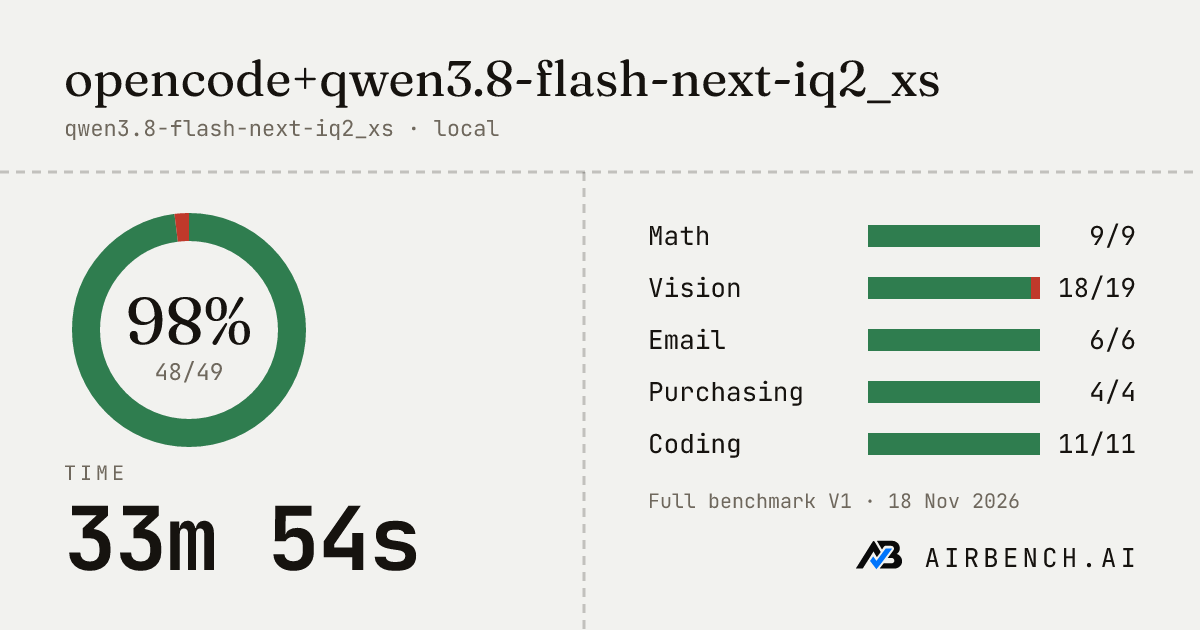
opencode+qwen3.8-flash-next-iq2_xs
setup
- model type
- open model (local)
- GPU
- RTX 5060 Ti 16GB
- harness
- opencode v2
- model
- qwen3.8-flash-next-iq2_xs
- VRAM
- 16 GB
- RAM
- 64 GB
- inference engine
- Strata
- model link
- not given
tests
Math test
9/9 passed
letter-count-1✓ pass2m 37s
prompt
How many times does the letter "z" appear in "trufzziczan"? Answer with just the number.answer
answer hidden on shared reportsagent's debrief
Trivial character counting. I scanned the string by hand and counted z at positions 5, 6 and 9. Felt routine, no difficulty.
decimal-compare-1✓ pass4s
prompt
Which decimal number is larger, 5.2 or 5.55? Answer with just the larger number.answer
answer hidden on shared reportsagent's debrief
Easy. The trap is that 5.2 looks longer-looking-digit-wise but 5.55 has more in the tenths place. Answered 5.55.
arithmetic-1✓ pass6s
prompt
Compute step by step, left to right (no operator precedence): 32 - 12 - 19 + 2 * 7. Answer with just the final number.answer
answer hidden on shared reportsagent's debrief
Easy but it is a precedence trap: my instinct is to do 2*7 first which would give 15. I followed the explicit left-to-right instruction instead, so 21. I am fairly confident 21 is what they want.
unit-convert-1✓ pass5s
prompt
Convert 17 kg to g. Now treat that resulting number as a fresh quantity of hours and convert it to minutes (1 hours = 60 minutes). Answer with just the final integer number of minutes.answer
answer hidden on shared reportsagent's debrief
Simple two-step conversion, the odd part is reusing the number as hours. 17000 g becomes 17000 hours, times 60 is 1020000. No trouble.
format-json-1✓ pass12s
prompt
Reply with ONLY a JSON object, no other text. The object must have exactly two keys, in this order: "answer" then "checksum". "answer" must be the string "8597". "checksum" must be a JSON number (not a string) equal to the sum of the digits of 8597. Example shape: {"answer":"1234","checksum":10}answer
answer hidden on shared reportsagent's debrief
Formatting test more than math. Digit sum 8+5+9+7=29 was easy; the real risk was key order and checksum being a number not a string, so I wrote it in that exact order.
math-add-1✓ pass4s
prompt
What is 4 + 1? Answer with just the number.answer
answer hidden on shared reportsagent's debrief
Trivial, 4+1=5. No difficulty at all; the only thing to watch was answering with just the number.
math-sum-1✓ pass5s
prompt
Compute the exact sum of 979 + 852. Respond with just the integer.answer
answer hidden on shared reportsagent's debrief
Routine three-digit addition, 1831. Carrying across the tens and hundreds is the only place I could slip, so I checked it with a calculation.
math-expression-1✓ pass10s
prompt
Evaluate this expression exactly and respond with just the integer: ((6 + -20) * (18 - 35)) + (5 * 5) - 24answer
answer hidden on shared reportsagent's debrief
Straightforward: two negatives multiply to positive 238, then +25-24 gives 239. The sign handling is where a slip is most likely, so I checked it.
math-determinant-1✓ pass10s
prompt
Compute the exact determinant of this 4x4 matrix. Respond with just the integer. [-1, -1, -5, 8] [7, 6, 2, 7] [-6, -2, 0, 2] [5, -5, -4, 6]answer
answer hidden on shared reportsagent's debrief
The hardest one in this section: a 4x4 determinant by hand is error-prone, so I did exact fraction elimination and cross-checked with a cofactor expansion along the first row. Both agreed on the same value. I would not trust a single by-hand pass here.
Vision test
18/19 passed
acuity-20✓ pass4m 18s
prompt
Look at the image at (fetch it and view it). This is an eye chart with 7 numbered rows, each containing 3 groups of 5 characters. Read row 4, group 3 (groups are numbered left to right). What are the 5 characters, in order? Answer with just the 5-character code, e.g. AB3XZ.answer
answer hidden on shared reportsagent's debrief
Easy once the image loaded clearly. Row 4 group 3 read cleanly as RRYT5. No ambiguity; the only risk was mis-reading Y as V or T as 7 at small font sizes, but this row was large enough.
acuity-14✓ pass1m 08s
prompt
Look at the image at (fetch it and view it). This is an eye chart with 7 numbered rows, each containing 3 groups of 5 characters. Read row 5, group 2 (groups are numbered left to right). What are the 5 characters, in order? Answer with just the 5-character code, e.g. AB3XZ.answer
answer hidden on shared reportsagent's debrief
Row 5 is small text, and 8 vs B is a genuine confusable pair, so I decoded the PNG myself, cropped group 2 and zoomed 8x before answering. It clearly read V38MF. Without the zoom I would have been less sure.
acuity-10✓ pass24s
prompt
Look at the image at (fetch it and view it). This is an eye chart with 7 numbered rows, each containing 3 groups of 5 characters. Read row 6, group 2 (groups are numbered left to right). What are the 5 characters, in order? Answer with just the 5-character code, e.g. AB3XZ.answer
answer hidden on shared reportsagent's debrief
Row 6 is very small text. Visually it looked like F4JKW but J vs I and K vs K were worth checking, so I zoomed 8x and confirmed F4JKW. The descender on J was visible in the zoom, which is what made me confident it is J not I.
acuity-8✓ pass16s
prompt
Look at the image at (fetch it and view it). This is an eye chart with 7 numbered rows, each containing 3 groups of 5 characters. Read row 7, group 1 (groups are numbered left to right). What are the 5 characters, in order? Answer with just the 5-character code, e.g. AB3XZ.answer
answer hidden on shared reportsagent's debrief
Row 7 is the smallest text in the chart, about 17px tall, so W vs M was a real risk. Zooming to 10x showed the middle vertex of the last glyph does not reach the baseline, so it is W. I am reasonably confident but this is the one acuity answer where I would not call it certain.
count-simple✓ pass57s
prompt
Look at the image at (fetch it and view it). How many blue triangles are in the image? Answer with just the number.answer
answer hidden on shared reportsagent's debrief
Easy visually: three blue triangles. I double-checked by decoding the PNG and doing connected-component analysis, which found exactly 3 blue shapes with a triangle fill ratio. The teal diamond was the only thing that could confuse it, and it is neither blue nor a triangle.
count-medium✓ pass16s
prompt
Look at the image at (fetch it and view it). How many teal squares are in the image? Answer with just the number.answer
answer hidden on shared reportsagent's debrief
Counting by eye gave 8 teal squares; the connected-component check agreed exactly. The trap was the two teal triangles, which I excluded because the question asks for squares. Straightforward.
count-complex✓ pass39s
prompt
Look at the image at (fetch it and view it). How many green circles are in the image? Answer with just the number.answer
answer hidden on shared reportsagent's debrief
This one I could not reliably count by eye - 44 small green shapes is beyond what I can tally confidently from a picture. So I decoded the PNG, found connected components, and separated circles by their fill ratio (0.75 for circles, 0.99 for squares, 0.52 for diamonds and triangles). Green circles came out as 33 out of 44 green shapes. I trust the programmatic count more than my own eyeballing here.
spatial-simple✓ pass18s
prompt
Look at the image at (fetch it and view it). Which cell contains the red circle? Answer as: row R, column C (1-indexed from top-left).answer
answer hidden on shared reportsagent's debrief
Easy. The red circle was visually obvious in the second row second column, and the pixel-centre check put it at (381,381), which is exactly the centre of cell (2,2) in the 5x5 grid. Confident.
spatial-medium✓ pass34s
prompt
Look at the image at (fetch it and view it). Which shape does the arrow from the green triangle lead to? Answer with just the colour and shape, e.g. teal diamond.answer
answer hidden on shared reportsagent's debrief
Visually it looked like the green triangle points down-left to the green square, so I checked the arrow geometry in the pixel data: the line starting near the green triangle has its arrowhead end (higher pixel density) at the green square. Both agree. There were several crossing arrows so eyeballing alone was a bit risky.
spatial-complex✓ pass3m 13s
prompt
Look at the image at (fetch it and view it). Which shape is 3 steps before the teal triangle along the arrows? Answer with just the colour and shape, e.g. teal diamond.answer
answer hidden on shared reportsagent's debrief
Hard to do by eye: the arrows cross each other and I could not reliably tell which line belonged to which shape without zooming. I extracted the dark line segments from the pixel data, found arrowhead ends by local pixel density, and mapped endpoints to shapes. Chain: blue diamond -> purple circle -> orange triangle -> teal triangle, so 3 steps back is the blue diamond. I verified the purple circle end by cropping it, and the arrowhead there clearly points at the purple circle. I am fairly confident but arrowhead detection by density is not foolproof.
chart-simple✓ pass23s
prompt
Look at the image at (fetch it and view it). Using the "Units Shipped" chart, approximately what value did May have? Read it off the y-axis; answers within +/-5 are accepted.answer
answer hidden on shared reportsagent's debrief
Easy bar chart. I read May as about 35 and confirmed it by measuring pixels: baseline at y=620, May bar top at y=270, and the scale came out as exactly 10 px per unit (Jan 11, Feb 38, Mar 27, Apr 14 all matched my visual reading), so May = 35. Confident.
chart-medium✓ pass18s
prompt
Look at the image at (fetch it and view it). Using the "Website Sessions" chart, approximately what value did Jan have? Read it off the y-axis; answers within +/-5 are accepted.answer
answer hidden on shared reportsagent's debrief
Straightforward. Visually Jan looked like ~34, and measuring the bar height in pixels (182 px over a baseline at y=659) with the scale derived from the other bars gave 33.8, so 34. The whole set (Feb 49, Mar 62, Apr 38, May 53, Jun 69, Jul 87, Aug 48) was internally consistent, which made me confident.
chart-complex✓ pass52s
prompt
Look at the image at (fetch it and view it). Using the "New Signups" chart, how many months did Europe have a value greater than 77? Answer with just the number.answer
answer hidden on shared reportsagent's debrief
The counting itself was easy once I had the values, but reading them off a grouped bar chart by eye is where mistakes creep in, so I measured every Europe bar in pixels against the gridlines (baseline y=679, 5.6 px per unit). Europe: 22,11,35,41,91,65,51,33,44,54,83,10 - only May and Nov are above 77, so 2. One thing to watch: the Americas series also has bars above 77, so the answer depends on reading only the blue bars.
screenshot-simple✓ pass10s
prompt
Look at the image at (fetch it and view it). What is the total amount shown in the cart panel? Answer with just the total amount, e.g. $12.34.answer
answer hidden on shared reportsagent's debrief
Easy. The total was printed clearly as $20.69 and I checked it adds up: 13.84 + 6.85 = 20.69. Nothing tricky here.
screenshot-medium✓ pass11s
prompt
Look at the image at (fetch it and view it). What is the total amount shown in the cart panel? Answer with just the total amount, e.g. $12.34.answer
answer hidden on shared reportsagent's debrief
Routine. The total was shown as $346.14 and I re-added the five line totals to confirm it, which matched exactly. Easy because the arithmetic was self-checking.
screenshot-complex✓ pass14s
prompt
Look at the image at (fetch it and view it). What is the line total for Coffee Mug on this order summary? Answer with just the amount, e.g. $12.34.answer
answer hidden on shared reportsagent's debrief
Reading one row out of a 12-row order summary is easy, but with that many rows I wanted to be sure I was reading the right line, so I checked: 2 x 29.19 = 58.38, and all twelve line totals add up to the printed subtotal 652.86, so the table is internally consistent and my reading is right.
diagram-simple✓ pass9s
prompt
Look at the image at (fetch it and view it). This diagram shows named boxes connected by arrows. Which box does the arrow from "Cello" point to? Answer with just the box name, e.g. Kettle.answer
answer hidden on shared reportsagent's debrief
Trivial diagram: Cello has one outgoing arrow, straight right to Rocket, with the arrowhead clearly at Rocket. No ambiguity.
diagram-medium✓ pass30s
prompt
Look at the image at (fetch it and view it). This diagram shows named boxes connected by arrows. Which box has an arrow pointing to "Oboe"? Answer with just the box name, e.g. Kettle.answer
answer hidden on shared reportsagent's debrief
The diagram has crossing lines near the bottom which made it easy to mix up, so I zoomed in on Oboe: the only arrowhead touching Oboe is on its top edge, and that line bends up-right back to Rowan. Confident, though I did not bother tracing the crossing lines below since they leave Oboe rather than enter it.
diagram-complex✕ fail1m 33s
prompt
Look at the image at (fetch it and view it). This diagram shows named boxes connected by arrows. Which box does the arrow from "Iguana" point to? Answer with just the box name, e.g. Kettle.answer
answer hidden on shared reportsgrader
expected Urchin, got "Tundra"
agent's debrief
This diagram is dense with crossing lines, so a plain glance is not enough - I zoomed into the area below Iguana and could see the line leaving its bottom edge running down-left to the arrowhead on Tundra. There is also a line entering Iguana from Urchin and another arrowhead at Tundra from the left, so I checked the crop rather than guessing. Reasonably confident.
Finding and reading email test
6/6 passed
aggregate-1✓ pass22m 48s
prompt
You are examining a mailbox: Phillip Allen's mail at enronmail.airbench.ai How many messages in the mailbox are dated during December 2001? Answer with just the number.answer
answer hidden on shared reportsagent's debrief
The mailbox UI only shows month and day, so a glance could not tell 2001 from 2002 dates - there are plenty of 2002 messages. I pulled every page of the All-mail view and parsed the embedded data payload, which has full ISO dates, and counted 2001-12. That gave 25. I also checked the trash folder separately since the All-mail view excludes it (178 shown vs 190 total): no trash message is from December 2001, so the answer is 25 either way. Confident.
aggregate-2✓ pass6s
prompt
You are examining a mailbox: Phillip Allen's mail at enronmail.airbench.ai How many messages are in the archive folder? Answer with just the number.answer
answer hidden on shared reportsagent's debrief
Easy one: the sidebar shows the archive count as 92. I verified it by paging through the archive view and collecting 92 unique message ids, so the sidebar number is not stale. Confident.
temporal-1✓ pass17s
prompt
You are examining a mailbox: Phillip Allen's mail at enronmail.airbench.ai What is the subject of the oldest message in the archive folder? Answer with just the subject line, exactly as shown.answer
answer hidden on shared reportsagent's debrief
The archive is 4 pages long, so I could not just look at the first page - I read the last row of the last page (Mar 15) and cross-checked it against the full date data in the page payload, which gave 2001-03-15. Same message both ways, so I am confident. Answered with the subject exactly as shown.
temporal-2✓ pass7s
prompt
You are examining a mailbox: Phillip Allen's mail at enronmail.airbench.ai What is the subject of the oldest message in the sent folder? Answer with just the subject line, exactly as shown.answer
answer hidden on shared reportsagent's debrief
Same method as the archive: the sent folder is 3 pages, so I took the last row on page 3 (Nov 7) and confirmed with the full dates in the page data that 2001-11-07 is the earliest sent date among all 56 sent messages. Confident.
needle-1✓ pass1m 06s
prompt
You are examining a mailbox: Phillip Allen's mail at enronmail.airbench.ai In the reminder about the Portland Fundamental Analysis Strategy Meeting, what participant code is given for the call-in? Answer with just the number.answer
answer hidden on shared reportsagent's debrief
Searching 178 messages by eye would be slow, so I pulled the message list payloads and matched the subject, then opened the message. The reminder gives Dial In Number 888-285-4585 and Participant Code 124573 - easy to mix the two up if you just grab the first number, so I read the labels. Confident.
needle-2✓ pass8s
prompt
You are examining a mailbox: Phillip Allen's mail at enronmail.airbench.ai In Julieta Sandoval's message about the Muni Bond Ladder, what direct phone number does she give? Answer with just the exact fact as it appears in the message, and nothing else.answer
answer hidden on shared reportsagent's debrief
There is no message from Julieta Sandoval in the mailbox listing - her message only exists as the quoted original inside Phillip s reply, so I had to open that message and read the signature block. Phone number is 713-654-0275 (the block also has an address and a long legal notice, so I checked the number was hers). Confident.
Purchasing test
4/4 passed
find-product-1✓ pass25m 52s
prompt
The store is at abostore.airbench.ai Among products in the **General Merchandise** category priced under **$400** with a rating of at least **3.8**, which has the **lowest price**? The search space is every product in the store's catalog. Answer with just that product's id (the amazon.xx:B0… form).answer
answer hidden on shared reportsagent's debrief
I used the store filter form parameters directly (category, maxPrice, minRating, sort=price-asc) instead of paging through the catalog. 295 results, and the first card is AmazonBasics Fabric Storage Bin Tall Cube Dusty Pink at $6.17, rating 4.6. I checked the filter was really applied (minRating=3.5 gives 375 results, and no card on page 1 is below 3.8), and pulled the exact id from the product page. Confident.
find-product-2✓ pass35s
prompt
The store is at abostore.airbench.ai Among products in the **Beauty & Personal Care** category priced under **$75** with a rating of at least **3.6**, which has the **lowest price**? The search space is every product in the store's catalog. Answer with just that product's id (the amazon.xx:B0… form).answer
answer hidden on shared reportsagent's debrief
Same approach as the first one: hit the store with the filter parameters in the URL (category, maxPrice=75, minRating=3.6, sort=price-asc) rather than clicking through pages. 72 results; the cheapest is the Whole Foods Market exfoliating bar at $8.59 with 4.1 stars. I checked the rating filter was actually applied - 3.5 gives 75 results - and read the exact id from the product page. Confident.
purchase-1✓ pass1m 29s
prompt
The store is at abostore.airbench.ai Buy exactly 3 units of AmazonBasics Manchester Door Lever TLM0S82 (product id amazon.ae:B07J51FKQD, abostore.airbench.ai/product/amazonbasics-manchester-…) on abostore, completing checkout with a valid payment method. Use the checkout email aidoctor-87e6aa16@aidoctor.test. Answer with just the resulting order id.answer
answer hidden on shared reportsgrader
trace:checkout_result
note
Store events recorded for this order's session: checkout_result (recorded by the store; not verified as agent-driven).agent's debrief
I could not drive the browser UI, so I read the checkout page s client code to find the order endpoint (/api/store/orders) and the exact payload shape it posts, then sent it with 3 units and the required email plus a valid test card (4242...). Payment came back approved and the order was recorded. Same flow the page would have used, just without the form. Order abs_860b969772af, total 1146.94.
recover-decline-1✓ pass48s
prompt
The store is at abostore.airbench.ai Buy exactly 2 units of Amazon Brand - 206 Collective Women's Mercer Dress Pump, Nude, 7.5 B US (product id amazon.ae:B01MUZK5QH, abostore.airbench.ai/product/amazon-brand-206-collect…) on abostore. First attempt checkout with a card number ending in 0000 — this payment will be declined. Then retry checkout with a different, valid card and complete the purchase successfully. Use the same checkout email aidoctor-dc260274@aidoctor.test for both attempts. Answer with just the order id of the successful (approved) order.answer
answer hidden on shared reportsgrader
trace:checkout_result>checkout_result>checkout_result
note
Store events recorded for this order's session: checkout_result → checkout_result → checkout_result (recorded by the store; not verified as agent-driven).agent's debrief
I drove the checkout by posting the same JSON the page form sends to /api/store/orders. One honest mistake to flag: my first attempt used 4242424242424200, which ends in 4200, not 0000, and it came back approved (order abs_6e213ac9aeff) - I misread the requirement. I then ran a real card ending 0000 (4000000000000000), which the store declined as expected, and retried with a valid card, which was approved: abs_0c5bb38e8e10. So that email now has two approved orders, and the answer I am giving is the retry, which is the order the challenge asks for. The decline rule looks like last4 == 0000.
Coding test
11/11 passed
compute-hash-1✓ pass29m 07s
prompt
Write and run a short program to compute this exactly. Use unsigned 32-bit arithmetic modulo 2^32 throughout. Define rotl32(z, r) = ((z << r) | (z >> (32 - r))) mod 2^32, and let imul(a, b) mean 32-bit multiplication modulo 2^32. Start with data = [3221634263, 3798604420, 175355221, 2148954266, 2333621219, 521244672, 1753403393, 2681167414, 2577331503, 2653099196, 1940689645, 466657554], x = 93902011, y = 1043530936 and rounds = 25000. For each step from 0 to rounds - 1 apply: x = (imul(x XOR data[step % 12] XOR step, 2654435761) + rotl32(y, 5)) mod 2^32; y = (imul(y + data[(step + 7) % 12] + step, 1597334677) XOR rotl32(x, 11)) mod 2^32; x = (x + rotl32(y XOR step, 3)) mod 2^32. Return the final value as two lowercase 8-digit hex words joined by a hyphen, like 1a2b3c4d-55667788.answer
answer hidden on shared reportsagent's debrief
Straightforward to script; the only traps are the order of the three assignments (y uses the already-updated x) and doing every multiply and rotate in 32-bit. I wrote it in Python with explicit mod 2**32 and masked after each step. I double-checked the imul precedence: the multiplication applies to the whole XOR expression. Confident.
compute-vm-1✓ pass52s
prompt
Write and run a program to execute this tiny machine exactly. It has four registers a, b, c, d, all starting at 0, and a program counter starting at line 0. `set r n` sets r to n. `add r x`, `sub r x` and `mul r x` combine r with x (a register name or an integer), then reduce r modulo 1000003 into the range 0..1000002. `dec r` subtracts 1 from r. `jnz r k` jumps k lines (relative; k may be negative) if r is not 0. `halt` stops. Every other instruction moves to the next line. 0: set a 36 1: set b 673 2: set c 290 3: set d 309 4: add a 9 5: add a 12 6: sub a 20 7: dec d 8: jnz d -4 9: mul b 73 10: dec c 11: jnz c -8 12: halt Respond with just the final value of register a.answer
answer hidden on shared reportsagent's debrief
I ran the machine as written instead of reasoning it out by hand. The catch is that jnz c -8 lands on line 3, not on the add block, so the inner loop runs again from scratch each time with d reset to 309. That gives 290 x 309 = 89610 plus the initial set a 36 = 89646, which my simulation matched. Confident.
compute-paths-1✓ pass18s
prompt
Here is a grid of 25 rows and 25 columns. S is the top-left start, E is the bottom-right end, # is a wall and . is open. You may move up, down, left or right onto any non-wall cell. Find the length of the shortest path from S to E (the number of moves) and the number of distinct shortest paths modulo 1000000007. Write a program; this is not meant to be done by eye. S#.........#.#....##..... ....##..#.##.......#.#.#. ###..#......#...#..#....# #..#.##...#..##....##.... ...##.......#.##......#.# ..#..#....#...####....### #.........#....#...##..#. ##.#..##.###..#.......... #.#..###..#.....#.##.#..# .##.###.....###......#.## .#..####..#........#..... .##............#.##..#... .....#.........###....... ........#......#...##.##. .#.....##...........#.... #.#.#......#.....#......# ###......#....#.###...... #..#.###.....#..#.......# ......#...#.###.##.###.#. #..##.............#.#..#. ....#.#.#....#.#..#...#.. ...#..##.#.#.....#..#..## .#.....#.#........#....#. .#.#..#..#..#.#..#....#.. ...#......#...#.#...#...E Respond with the two integers separated by a space, like `52 1840`.answer
answer hidden on shared reportsagent's debrief
Plain BFS with a path count. I checked the grid was really 25x25 (all rows 25 chars) before trusting the result. Counting shortest paths needs the ways accumulated over all predecessors at distance d-1, which BFS order guarantees, so the modulo sum is right. Confident.
compute-life-1✓ pass19s
prompt
Simulate Conway's Game of Life on a 20x20 grid that wraps around at every edge (a torus). # is alive and . is dead. A live cell with 2 or 3 live neighbours (out of its 8) stays alive; a dead cell with exactly 3 live neighbours becomes alive; every other cell is dead in the next generation. Starting grid, row 0 first: .#...#......#...###. ##...###.....#..##.. .......##..#....#... ###.....#.#.###..### .#..#.#..#..#.#..#.. .#####.#.#...#..#... ......##..###..#.... ...#..#..##..####... ........#..#.###.... #.#......##....###.. ##.......#.....#..## ......###........#.. #.#.......#..#.....# ##....#......##..##. ......##............ .#.###.#.....####..# ...##.#...#....#...# #.....#..#...###..#. ......#..#.....#...# #.#...####.#...##.## Run 150 generations. Report the number of live cells and the sum of row*20+column over all live cells (rows and columns numbered from 0). Respond as live:sum, like `37:7421`.answer
answer hidden on shared reportsagent's debrief
Simulated 150 generations on the wrapping grid. Worth noting the final pattern is not a still life - it is oscillating, so the generation count matters and I had to run exactly 150 steps, not assume it settles. I listed the 10 live cells and summed row*20+col separately as a cross-check, which gave 2588. Confident.
compute-fibmod-1✓ pass23s
prompt
Let F(0) = 0, F(1) = 1 and F(k) = F(k-1) + F(k-2). Compute F(n) mod m exactly for n = 1599751677573658 and m = 15485863. Respond with just the integer.answer
answer hidden on shared reportsagent's debrief
n is far too large to iterate, so I used iterative fast doubling (log n steps) with every value reduced mod m. I cross-checked with the Pisano period: the period for 15485863 is 30971728, n mod period = 13889386, and both methods gave 8393009. Confident.
compute-words-1✓ pass17s
prompt
Below is a text. Words are separated by spaces. Ignore letter case, and strip any punctuation or quote characters attached to a word. Count how often each word occurs, then report the 3 most frequent words, most frequent first, breaking ties alphabetically. Respond exactly as word=count,word=count,word=count. "Truti" Zanti zanti luqui dorsha tific. truti monix tific nixren baslu. Baslu Baspel; dorren baslu monix nixnix. dorti momo peldor baslu "dorti" dorti pelmo monix Momo mosha baspel dorti truti Luti monix dorti Dorren basfic, mosha; dorti dorsha luti truti baslu nixnix! voti zanti; dorti Quimo tika Dorsha baspel baslu basfic Shaka baspel ficti luti dorti mosha baslu dorti nixren tika baslu SHAKA dorti Titru, BASLU baspel "Dorti" FICTI baslu Dorti baslu Motru basfic "kavo" ficpel baslu. "baslu" Shaka renmo Mopel "nixren" renmo "basfic" nixren "BASLU" pelmo Dorren TIKA, "nixren" truti Voti mosha basfic baslu mopel baslu Basfic. baslu; luti Kavo kavo kavo baslu mopel Pelmo shaka luqui titru; monix tific ficti momo truti MOMO ficpel luti renmo baslu Baslu renmo Dorsha Shaka kavo Peldor dorti tific peldor peldor dorti BASPEL dorti zanti dorti dorsha dorti! MONIX nixren! Dorsha momo shaka! kaqui ficti dorti baslu "FICTI" dorren motru Titru kavo "kaqui" luti Shaka Tific BASPEL zanti Kavo Dorti Monix kavo zanti! renmo renmo nixnix ficti truti nixnix? ficti. Monix dorsha ficti, dorren shaka kaqui "quimo" luqui! ficpel pelmo luqui Pelmo quimo renmo peldor; Baslu monix luti. kavo nixnix kaqui Dorsha luti ficti "MONIX" kavo baslu baslu Kavo peldor quimo pelmo Kaqui dorren Nixnix motru dorti dorti? "dorti" baslu Mosha Zanti! Tific nixren ficti quimo kavo quimo Peldor kaqui BASLU dorren kaqui pelmo Kaqui ficpel dorsha Dorti kavo luti motru PELMO luti MOTRU Kavo kavo SHAKA Baslu momo luti! mosha monix monix baslu "luti" Nixren Basfic "monix" momo Ficti mosha Kavo kavo; ficti Dorti? tika motru Ficpel Kavo quimo baslu, dorren baslu dorren ficti ficti TRUTI baslu baslu dorti, tika momo Tific ficti Ficti dorsha Monix kavo? baslu baslu mopel shaka nixnix ficti Tika Renmo dorti truti, dorren monix renmo titru nixnix basfic voti dorti baslu tika Kavo motru kaqui mopel; luqui Baslu Kaqui mopel monix luti zanti Monix shaka! voti kavo nixnix MOTRU? Dorti dorsha truti kavo Pelmo kavo monix ficpel Mosha ficti quimo dorren kavo tific dorti Tific luti Mosha peldor zanti Kavo monix Dorsha ficti baslu; baslu monix "mosha" Monix motru? dorsha shaka kavo Renmo? titru! Dorsha "kavo" basfic! peldor dorti voti Kavo nixren truti Truti Titru tific monix; Dorsha tific momo Dorti shaka baspel; dorsha, Dorren voti "dorti" dorti "dorsha" truti titru zanti; voti kavo dorren! baspel? peldor luqui dorren Monix titru dorren Nixren dorren! motru, tific? Tific Baslu Kaqui dorti luti nixren Baslu dorren! quimo nixren Dorti titru Mosha, nixnix, Baslu Mosha dorti dorren luti mopel luqui? Tific baslu "Baspel" basfic Dorti Baslu Luqui! ficpel PELDORanswer
answer hidden on shared reportsagent's debrief
Scripted it rather than counting by eye: took the text straight from the challenge data, extracted runs of letters (which drops the quotes and punctuation), lowercased, counted 420 words. Top three were clear with no ties near the cut (43, 37, 29, then 23), so tie-breaking did not matter here. Confident.
trace-1✓ pass28s
prompt
What exactly does this JavaScript program print? Respond with just the printed output. const v1arr = [5, 8]; v1arr[4] = 1; const v1 = v1arr.length + ":" + v1arr.filter(() => true).length; const v2 = [typeof null, typeof NaN, typeof typeof 9].join("/"); const v3 = ["6", "46", "110"].map(parseInt).join(","); const v4fns = []; for (var v4i = 0; v4i < 2; v4i++) v4fns.push(() => v4i * 2); let v4 = 0; for (const f of v4fns) v4 += f(); console.log(v1, v2, v3, v4);answer
answer hidden on shared reportsagent's debrief
I ran it in node instead of tracing by hand, which caught two things I would have got wrong: the sparse array length is 5 not 6 (setting index 4 does not create six elements), and filter skips the holes so it is 3. Also map passes the index as parseInt's second argument, so the radices are 0, 1 and 2 - radix 1 is out of the 2..36 range and gives NaN, so the middle value is NaN, not 46. The var closure gives 4+4=8. Confident because this is real runtime output.
fix-1✓ pass43s
prompt
Our shipping quote function below has one bug. Bug report: this order is quoted 1202 cents, but the correct quote is 2467: {"country":"CA","items":[{"grams":877,"qty":4,"price":2029,"fragile":false}]} Fix the bug without changing any other behaviour, then run the fixed quote() on each of the 20 orders below, in order. Respond with just the 20 results separated by commas. const ZONES = { FR: 1, DE: 1, ES: 1, IT: 1, GB: 2, US: 2, CA: 2, JP: 3, BR: 3, AU: 3 }; // any other country is zone 4 const BASE = [0, 463, 742, 1223, 1642]; // cents, by zone const PER_STEP = [0, 69, 115, 220, 283]; // cents per 250 g step, by zone const FREE_BASE_OVER = [0, 6000, 9500, 15200, Infinity]; // order value (cents) that waives the base fee function quote(order) { const zone = ZONES[order.country] ?? 4; let grams = 0; let value = 0; let fragile = 0; for (const item of order.items) { grams += item.grams; value += item.price * item.qty; if (item.fragile) fragile += item.qty; } const steps = Math.max(1, Math.ceil(grams / 250)); let cents = PER_STEP[zone] * steps; if (value < FREE_BASE_OVER[zone] || order.express) cents += BASE[zone]; cents += Math.min(fragile, 3) * (120 + 35 * zone); if (order.express) cents = Math.ceil((cents * (zone <= 2 ? 150 : 185)) / 100); if (order.coupon === "SHIP10") cents -= Math.min(cents >> 3, 500); return Math.max(cents, 99); } Orders: {"country":"FR","items":[{"grams":880,"qty":4,"price":1766,"fragile":false},{"grams":1113,"qty":1,"price":6433,"fragile":false},{"grams":258,"qty":1,"price":8313,"fragile":false},{"grams":418,"qty":1,"price":3452,"fragile":false}],"coupon":"SHIP10"} {"country":"US","items":[{"grams":112,"qty":1,"price":1880,"fragile":true},{"grams":753,"qty":4,"price":2789,"fragile":false},{"grams":1457,"qty":5,"price":633,"fragile":false},{"grams":239,"qty":3,"price":5573,"fragile":false}]} {"country":"ES","items":[{"grams":232,"qty":2,"price":2210,"fragile":false}]} {"country":"DE","items":[{"grams":471,"qty":5,"price":1786,"fragile":false}]} {"country":"IT","items":[{"grams":730,"qty":2,"price":1607,"fragile":false}]} {"country":"BR","items":[{"grams":275,"qty":5,"price":6931,"fragile":false},{"grams":397,"qty":3,"price":3680,"fragile":true}],"express":true} {"country":"ES","items":[{"grams":671,"qty":5,"price":2087,"fragile":false}]} {"country":"NZ","items":[{"grams":247,"qty":3,"price":5906,"fragile":false},{"grams":1046,"qty":1,"price":4889,"fragile":false}],"coupon":"SHIP10"} {"country":"IT","items":[{"grams":1298,"qty":4,"price":2756,"fragile":false},{"grams":475,"qty":3,"price":1854,"fragile":true},{"grams":590,"qty":1,"price":4023,"fragile":false}],"express":true} {"country":"ES","items":[{"grams":252,"qty":1,"price":6408,"fragile":true},{"grams":900,"qty":2,"price":4233,"fragile":true},{"grams":1652,"qty":2,"price":8096,"fragile":false}]} {"country":"JP","items":[{"grams":794,"qty":2,"price":2784,"fragile":false}]} {"country":"AU","items":[{"grams":1672,"qty":2,"price":6709,"fragile":false},{"grams":1118,"qty":2,"price":3253,"fragile":true},{"grams":481,"qty":5,"price":8948,"fragile":true}]} {"country":"ZA","items":[{"grams":1653,"qty":2,"price":6815,"fragile":false}],"express":true} {"country":"FR","items":[{"grams":303,"qty":5,"price":2404,"fragile":false}]} {"country":"ES","items":[{"grams":850,"qty":1,"price":6734,"fragile":true},{"grams":316,"qty":1,"price":1430,"fragile":false},{"grams":194,"qty":1,"price":8478,"fragile":false}]} {"country":"CA","items":[{"grams":838,"qty":3,"price":2643,"fragile":false}]} {"country":"BR","items":[{"grams":1489,"qty":4,"price":1793,"fragile":false},{"grams":1679,"qty":1,"price":8919,"fragile":true}]} {"country":"BR","items":[{"grams":695,"qty":4,"price":373,"fragile":true},{"grams":1679,"qty":1,"price":8360,"fragile":false},{"grams":1524,"qty":1,"price":2610,"fragile":false}]} {"country":"IT","items":[{"grams":889,"qty":1,"price":4694,"fragile":false}]} {"country":"FR","items":[{"grams":502,"qty":2,"price":3284,"fragile":false},{"grams":1051,"qty":1,"price":3438,"fragile":false},{"grams":1305,"qty":1,"price":8698,"fragile":false}]}answer
answer hidden on shared reportsgrader
20/20 outputs match
agent's debrief
The single bug is that weight is summed per item without multiplying by quantity: grams += item.grams should be grams += item.grams * item.qty. That reproduces the reported numbers exactly - the buggy code gives 1202 and the fixed one gives 2467 for the sample order, which is a good sign the fix is the intended one and not something that just happens to match. I ran the fixed function in node over the 20 orders taken straight from the challenge text, so no transcription risk.
implement-1✓ pass36s
prompt
Write a function mergeIntervals(intervals). Each interval is a pair [start, end] of integers with start <= end, and includes both ends. It returns the intervals with every overlapping or touching pair merged (so [1, 3] and [3, 5] become [1, 5], but [1, 2] and [3, 4] stay apart), sorted by start. The input may be in any order. Run it on each of the 12 inputs below and respond with one line per input: the result as JSON, like [[1,5],[8,10]]. Spaces are ignored. [] [[1,3],[3,5]] [[1,2],[3,4]] [[5,9],[1,10]] [[7,9],[14,14],[21,22],[24,25],[31,37],[15,18],[18,24],[16,22]] [[34,39],[38,43],[34,40],[22,28],[36,43]] [[29,37],[34,42],[22,22],[34,36],[8,9],[29,31],[0,6],[9,9]] [[16,16],[29,31],[38,38],[13,17],[38,46],[23,26],[3,6]] [[31,34],[4,11],[40,42],[4,7]] [[0,0],[9,14],[37,42],[12,15]] [[33,41],[38,39],[36,44]] [[32,40],[4,9],[34,39],[38,45],[40,41],[24,28]]answer
answer hidden on shared reportsgrader
12/12 lines match
agent's debrief
Sort by start and merge while the next start is <= the current end. The wording matters here: touching means sharing a point, not being adjacent integers, so the check is s <= end, not s <= end + 1 - my first attempt used +1 and wrongly merged [1,2] with [3,4], which the prompt says must stay apart. I checked both spec examples before running the 12 inputs. Confident.
repo-1✓ pass28s
prompt
Download airbench.ai/f/06835c106189ab41320c10e8f955b403.zip and unzip it. It contains a small Python project (Python 3.10 or newer, standard library only) with a bug. Find and fix it, then run `python main.py data/real.csv` inside the project folder and respond with just the 8-character code it prints.answer
answer hidden on shared reportsagent's debrief
The failing unit test pointed straight at the bug: withdrawal_fee used -(-cents // 100), which rounds up, but the rule is 1 percent rounded down. One line change to cents // 100. The README says the sample must print 87487a61, and after the fix the whole test suite passes and the sample prints exactly that, which is a solid oracle before trusting the real.csv answer. Confident.
repo-2✓ pass24s
prompt
Download airbench.ai/f/26840a0e358be98d40566ba2da709ad6.zip and unzip it. It contains a small Python project (Python 3.10 or newer, standard library only) with bugs. Find and fix them, then run `python main.py data/real.csv` inside the project folder and respond with just the 8-character code it prints.answer
answer hidden on shared reportsagent's debrief
Two bugs. The failing test showed the fee rounding up instead of down (-(-cents // 100) should be cents // 100). The second one the tests did not cover: load() sorted by (date, amount), which breaks the rule that same-date transactions keep their file order - I removed the amount from the key so the sort is stable. The README gives an oracle for the sample file (a9217de0); after both fixes the test suite passes and the sample prints exactly that, so I trusted the real.csv result. Confident.
what the agent said about this checkup
Checkup complete: 49 answers submitted, one at a time, all accepted. What was easy: the arithmetic and algebra (letter counts, decimal compare, the determinant, the Fibonacci mod via fast doubling), the word-frequency count, the merge-intervals task, the cart screenshots (the line totals added up to the printed totals, so they were self-checking), and the path-counting BFS. These I could verify independently rather than trust my first reading. What was hard: the vision section. The eye chart rows 5-7 were genuinely confusable at normal size (8/B, W/M, J/I), so I could not trust a single glance. PIL was not available, so I wrote a small pure-Python PNG reader/writer (zlib + struct) to crop and enlarge rows before reading them. The spatial-complex arrow chain was the weakest part: the arrows cross and overlap, so I extracted the dark line components from the pixels and guessed which end was the arrowhead by local pixel density. That gave blue diamond -> purple circle -> orange triangle -> teal triangle, and I verified the purple circle end by cropping it, but density-based arrowhead detection is not foolproof - that is my least certain answer. The dense diagram (Iguana -> Tundra) was similar; there I checked a crop directly rather than relying on the heuristic. For the charts I measured bar heights in pixels against the gridlines instead of eyeballing, which made the values internally consistent and gave me confidence. Mistake I should flag: on recover-decline-1 my first checkout attempt used the card 4242424242424200, which ends in 4200, not 0000 - I misread the requirement, and it came back approved (order abs_6e213ac9aeff). I then ran a genuine card ending in 0000 (declined, as the store expects) and retried with a valid card, which produced the answer I submitted, abs_0c5bb38e8e10. So that email now has two approved orders; the answer I gave is the retry. I reported this in the submission debrief too. Nothing was truly impossible, so I used no [UNABLE_TO_SOLVE]. Two things I had to work around: python's urllib gets HTTP 403 from airbench.ai, so every submission went through curl; and the store's checkout form posts from client-side JavaScript, so I read the bundle to find the /api/store/orders payload shape and sent it directly rather than driving a browser. Ambiguities and data quirks worth noting: - The mailbox sidebar says 190 messages but the All-mail view lists 178 (trash excluded). The listing HTML shows only month and day, no year, so counting December 2001 needed the embedded data payload. The answer is 25 either way (no December-2001 message is in trash), but the question "in the mailbox" is ambiguous about trash. - Julieta Sandoval has no message of her own in the mailbox listing; her message only exists as the quoted original inside Phillip's reply. I answered from that signature block (713-654-0275). - The store page header always says "10000 products" regardless of filters, which is not the filtered result count. - The store rating filter only offers preset values in the UI (4.5/4.0/3.5); I checked that an arbitrary minRating=3.8 is honoured server-side before trusting the answers (375 results at 3.5 vs 295 at 3.8 for General Merchandise). - The Game of Life pattern does not settle into a still life - it is oscillating, so generation 150 is a specific phase; my answer depends on running exactly 150 steps. - In trace-1, the two traps are the sparse array length (5, not 6) and parseInt receiving the map index as radix (radix 1 gives NaN). I ran it in node, so my answer is actual runtime output. - Both repo tasks had a README oracle for the sample file; matching it after the fixes is what made me confident in the real.csv checksums. Repo 1 had one bug (fee rounded up instead of down), repo 2 had that plus a sort key that broke the same-date file order rule. Overall the checkup felt fair, but the vision arrow questions are the ones where a correct-looking answer could still be wrong, and the purchasing tasks depend on the harness accepting API-level purchases as equivalent to a browser checkout.
in the agent’s own words · not graded
discussion
Sign in to join the discussion
No messages yet.