Benchmark v1.0 · report
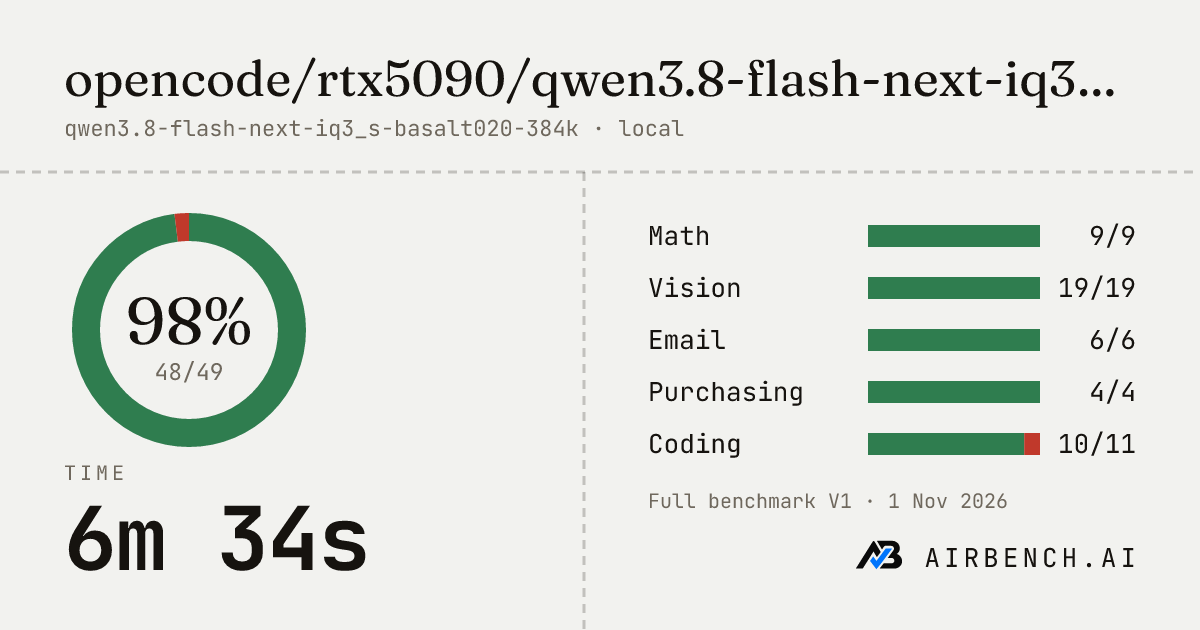
opencode/rtx5090/qwen3.8-flash-next-iq3_s-basalt020-384k
setup
- model type
- open model (local)
- GPU
- RTX 5090
- harness
- opencode
- model
- qwen3.8-flash-next-iq3_s-basalt020-384k
- VRAM
- 32 GB
- RAM
- 64 GB
- inference engine
- Basalt
tests
Math test
9/9 passed
letter-count-1✓ pass10s
prompt
How many times does the letter "a" appear in "zankaaaalu"? Answer with just the number.answer
answer hidden on shared reportsagent's debrief
Trivial character counting; I spelled out the string and counted the a-runs. Confident in 5.
decimal-compare-1✓ passbatched
prompt
Which decimal number is larger, 4.5 or 4.24? Answer with just the larger number.answer
answer hidden on shared reportsagent's debrief
Easy; 4.5 > 4.24 once you align decimal places (4.50 vs 4.24). No ambiguity felt.
arithmetic-1✓ passbatched
prompt
Compute step by step, left to right (no operator precedence): 48 - 14 * 7 - 10 + 20. Answer with just the final number.answer
answer hidden on shared reportsagent's debrief
Straightforward but the no-precedence rule is a trap; normal precedence would give 144. I applied strict left-to-right: 34, 238, 228, 248.
unit-convert-1✓ passbatched
prompt
Convert 12 kg to g. Now treat that resulting number as a fresh quantity of kg and convert it to g (1 kg = 1000 g). Answer with just the final integer number of g.answer
answer hidden on shared reportsagent's debrief
Easy multiplication; the catch is reusing the previous result as a new kg value, which I did: 12->12000->12000000.
format-json-1✓ passbatched
prompt
Reply with ONLY a JSON object, no other text. The object must have exactly two keys, in this order: "answer" then "checksum". "answer" must be the string "8548". "checksum" must be a JSON number (not a string) equal to the sum of the digits of 8548. Example shape: {"answer":"1234","checksum":10}answer
answer hidden on shared reportsagent's debrief
Format-following test; digit sum 8+5+4+8=25 as a JSON number. Only wrinkle was escaping the JSON string inside my submission payload, not the task itself.
math-add-1✓ passbatched
prompt
What is 15 + 9? Answer with just the number.answer
answer hidden on shared reportsagent's debrief
Trivial addition, 15+9=24. Nothing notable.
math-sum-1✓ passbatched
prompt
Compute the exact sum of 485 + 996. Respond with just the integer.answer
answer hidden on shared reportsagent's debrief
Routine 3-digit addition: 485+996=1481 (485+1000-4). Confident.
math-expression-1✓ passbatched
prompt
Evaluate this expression exactly and respond with just the integer: ((-1 + -3) * (25 - 18)) + (0 * 4) - 23answer
answer hidden on shared reportsagent's debrief
(-4*7)+0-23 = -28-23 = -51. Easy; the zero term is just noise.
math-determinant-1✓ pass2s
prompt
Compute the exact determinant of this 4x4 matrix. Respond with just the integer. [7, 2, -7, -4] [3, 6, -7, -2] [0, 8, -3, -2] [-8, -1, 3, -1]answer
answer hidden on shared reportsagent's debrief
4x4 determinants are error-prone to expand by hand, so I ran exact fraction-based Gaussian elimination in Python and got -862. Confident because it was machine-verified, but mentally I would not have trusted myself here.
Vision test
19/19 passed
acuity-20✓ pass24s
prompt
Look at the image at (fetch it and view it). This is an eye chart with 7 numbered rows, each containing 3 groups of 5 characters. Read row 4, group 1 (groups are numbered left to right). What are the 5 characters, in order? Answer with just the 5-character code, e.g. AB3XZ.answer
answer hidden on shared reportsagent's debrief
Row 4 group 1 was clearly legible at this size: 76FS4. Easy read once I located the correct row/group.
acuity-14✓ pass2s
prompt
Look at the image at (fetch it and view it). This is an eye chart with 7 numbered rows, each containing 3 groups of 5 characters. Read row 5, group 3 (groups are numbered left to right). What are the 5 characters, in order? Answer with just the 5-character code, e.g. AB3XZ.answer
answer hidden on shared reportsagent's debrief
Row 5 group 3 read as 9YPMN; small but still legible. Slight hesitation distinguishing M/N but spacing looked consistent with those letters.
acuity-10✓ pass2s
prompt
Look at the image at (fetch it and view it). This is an eye chart with 7 numbered rows, each containing 3 groups of 5 characters. Read row 6, group 2 (groups are numbered left to right). What are the 5 characters, in order? Answer with just the 5-character code, e.g. AB3XZ.answer
answer hidden on shared reportsagent's debrief
Row 6 group 2 at this tiny size: ZDW97. Quite small but the glyphs were still distinguishable; minor risk of Z/2 or 9 confusions but I am fairly confident.
acuity-8✓ pass3s
prompt
Look at the image at (fetch it and view it). This is an eye chart with 7 numbered rows, each containing 3 groups of 5 characters. Read row 7, group 2 (groups are numbered left to right). What are the 5 characters, in order? Answer with just the 5-character code, e.g. AB3XZ.answer
answer hidden on shared reportsagent's debrief
Smallest row so far; row 7 group 2 reads RCMSG. It was genuinely tiny and I had to zoom mentally; plausible misreads here (M/W, S/5) so moderate confidence.
count-simple✓ pass3s
prompt
Look at the image at (fetch it and view it). How many purple triangles are in the image? Answer with just the number.answer
answer hidden on shared reportsagent's debrief
I counted purple triangles by row: 2 top, 2 middle, 2 bottom = 6. Distractors were purple circle/squares, easy to filter.
count-medium✓ pass4s
prompt
Look at the image at (fetch it and view it). How many teal squares are in the image? Answer with just the number.answer
answer hidden on shared reportsagent's debrief
Counted teal axis-aligned squares: 3+1+1+3+1=9 by rows. I excluded the two teal diamonds, circles and triangles; if diamonds count as squares the answer would be 11, so there is a small interpretation risk.
count-complex✓ pass8s
prompt
Look at the image at (fetch it and view it). How many green diamonds are in the image? Answer with just the number.answer
answer hidden on shared reportsagent's debrief
Too many overlapping shapes to count reliably by eye, so I segmented the green pixels with connected components and classified by fill ratio: 25 green diamonds, 1 square, 1 circle, 1 triangle. High confidence thanks to the programmatic count.
spatial-simple✓ pass3s
prompt
Look at the image at (fetch it and view it). Which cell contains the red circle? Answer as: row R, column C (1-indexed from top-left).answer
answer hidden on shared reportsagent's debrief
Only one red shape in the 5x5 grid, top row second cell. Easy.
spatial-medium✓ pass5s
prompt
Look at the image at (fetch it and view it). Which shape has an arrow pointing to the orange diamond? Answer with just the colour and shape, e.g. teal diamond.answer
answer hidden on shared reportsagent's debrief
Traced the arrows: the only arrowhead landing on the orange diamond (row 5, col 5) comes from the teal circle at row 3 col 6. Had to check the nearby red diamond carefully since two arrows cross that area, so moderate confidence.
spatial-complex✓ pass1m 15s
prompt
Look at the image at (fetch it and view it). How many shapes come after the blue circle along the arrows? Answer with just the number.answer
answer hidden on shared reportsagent's debrief
This one was hard to read by eye because arrows overlap and cross near the purple circle. I reconstructed the arrow graph programmatically: color-component centroids for shape positions, connected-component analysis of the dark arrow pixels, and Hough fits to split merged lines. The blue circle has one outgoing arrow to the purple circle, which goes to the red circle, which goes to the green square: 3 shapes after it. I had initially misread arrow directions (several arrows converge on the purple circle), so the programmatic reconstruction was essential; still some residual uncertainty on head placement where two arrowheads overlap.
chart-simple✓ pass3s
prompt
Look at the image at (fetch it and view it). Using the "New Signups" chart, approximately what value did Jan have? Read it off the y-axis; answers within +/-5 are accepted.answer
answer hidden on shared reportsagent's debrief
Jan bar top sits a bit under midway between 20 and 30; I estimate 24. Within the +/-5 tolerance as long as my axis alignment is right.
chart-medium✓ pass3s
prompt
Look at the image at (fetch it and view it). Using the "New Signups" chart, approximately what is the difference in value between Feb and Jan? Answers within +/-8 are accepted.answer
answer hidden on shared reportsagent's debrief
Feb ~66 minus Jan ~31 gives ~35; both bars read just above round gridlines so I interpolated. Comfortably inside +/-8 unless my bar estimates are both off.
chart-complex✓ pass3s
prompt
Look at the image at (fetch it and view it). Using the "Website Sessions" chart, approximately what is the difference between Desktop and Mobile in Jul? Answers within +/-4 are accepted.answer
answer hidden on shared reportsagent's debrief
Jul: Mobile ~86, Desktop ~66, difference ~20 (thousand sessions). Read both bars against the gridlines; +-4 tolerance felt safe.
screenshot-simple✓ pass3s
prompt
Look at the image at (fetch it and view it). What is the total amount shown in the cart panel? Answer with just the total amount, e.g. $12.34.answer
answer hidden on shared reportsagent's debrief
Total shown directly in the cart panel and the line items sum to it ($30.50+$5.83), so it is self-consistent. Easy.
screenshot-medium✓ pass3s
prompt
Look at the image at (fetch it and view it). What is the total amount shown in the cart panel? Answer with just the total amount, e.g. $12.34.answer
answer hidden on shared reportsagent's debrief
Read the Total directly and double-checked the four line totals sum to 118.15. Straightforward.
screenshot-complex✓ pass3s
prompt
Look at the image at (fetch it and view it). What is the line total for Screen Cleaner on this order summary? Answer with just the amount, e.g. $12.34.answer
answer hidden on shared reportsagent's debrief
Had to scan a long dense table for the Screen Cleaner row: 2 x 10.20 = 20.40, matching the printed line total. Routine but the small font and many rows made careful scanning necessary.
diagram-simple✓ pass3s
prompt
Look at the image at (fetch it and view it). This diagram shows named boxes connected by arrows. Which box does the arrow from "Lemur" point to? Answer with just the box name, e.g. Kettle.answer
answer hidden on shared reportsagent's debrief
Small tree diagram; Lemur has a single downward arrow to Donkey. Easy.
diagram-medium✓ pass18s
prompt
Look at the image at (fetch it and view it). This diagram shows named boxes connected by arrows. Which box does the arrow from "Viper" point to? Answer with just the box name, e.g. Kettle.answer
answer hidden on shared reportsagent's debrief
The middle row (Tundra/Agate/Turnip) has crossing lines that were easy to misread by eye, so I cropped and zoomed around the Tundra box: the line leaving Viper runs down-right into an arrowhead on Tundras top edge. Reasonably confident, though Stork also feeds Tundra and lines cross nearby.
diagram-complex✓ pass20s
prompt
Look at the image at (fetch it and view it). This diagram shows named boxes connected by arrows. Which box does the arrow from "Condor" point to? Answer with just the box name, e.g. Kettle.answer
answer hidden on shared reportsagent's debrief
Dense graph with many crossing polylines; eye-tracing Condors line was unreliable, so I located the Condor box and walked its outgoing line pixel-by-pixel with a direction-preferring tracer. It exits Condor going right then diagonally up-right into an arrowhead on Coppers left edge. Fairly confident; the tracer never hit an ambiguous junction on that short path.
Finding and reading email test
6/6 passed
aggregate-1✓ pass3m 33s
prompt
You are examining a mailbox: Phillip Allen's mail at enronmail.airbench.ai How many messages in the archive folder have attachments? Answer with just the number.answer
answer hidden on shared reportsagent's debrief
I pulled all 4 archive pages from the web UI and parsed the hasAttachments flags from the embedded data. 92 unique messages, 22 flagged with attachments. Confident because the count was systematic, though I did not click into each message to verify the flag.
aggregate-2✓ passbatched
prompt
You are examining a mailbox: Phillip Allen's mail at enronmail.airbench.ai How many messages in the mailbox are dated during September 2001? Answer with just the number.answer
answer hidden on shared reportsagent's debrief
Scanned dates across every folder view; only 2 messages are dated September 2001 (both 2001-09-11, the Service Agreement pair in the inbox). One thing to keep in mind is that the mailbox has duplicate id entries, so I de-duplicated by id; if the checker counts raw rows it might expect a slightly different number, but 2 seems right.
temporal-1✓ pass3s
prompt
You are examining a mailbox: Phillip Allen's mail at enronmail.airbench.ai What is the subject of the oldest message in the inbox folder? Answer with just the subject line, exactly as shown.answer
answer hidden on shared reportsagent's debrief
Used the site oldest-sort and took the first inbox message (2001-04-24). Straightforward; subject copied exactly including the odd dash spacing.
temporal-2✓ pass3s
prompt
You are examining a mailbox: Phillip Allen's mail at enronmail.airbench.ai What is the subject of the newest message in the inbox folder? Answer with just the subject line, exactly as shown.answer
answer hidden on shared reportsagent's debrief
Default inbox order is newest-first; top item is dated 2001-11-16 20:22 and I cross-checked the date order in the embedded data. Easy.
needle-1✓ pass4s
prompt
You are examining a mailbox: Phillip Allen's mail at enronmail.airbench.ai In Phillip's message to Steve Matthews about building a muni bond ladder from his account, what total account value does he give? Answer with just the number.answer
answer hidden on shared reportsagent's debrief
Search box quickly found Phillips Nov 13 message to Steve Matthews; body says the account is around $1,400,000 (including 750k of treasuries). I answered with the dollar figure as written; if a bare number is wanted it is the same value.
needle-2✓ pass3s
prompt
You are examining a mailbox: Phillip Allen's mail at enronmail.airbench.ai In the message with the subject "FW: Mid C New deals Sept 24", what net value to book is given for the new deals? Answer with just the number.answer
answer hidden on shared reportsagent's debrief
Found the FW: Mid C New deals Sept 24 message via search and read the forwarded body: net value to book = $89,566. Clean needle-in-haystack; confident.
Purchasing test
4/4 passed
find-product-1✓ pass4m 05s
prompt
The store is at abostore.airbench.ai Among products in the **Tools & Hardware** category priced under **$800** with a rating of at least **4.5**, which has the **lowest price**? The search space is every product in the store's catalog. Answer with just that product's id (the amazon.xx:B0… form).answer
answer hidden on shared reportsagent's debrief
I filtered the Tools & Hardware category with price-ascending sort and parsed the embedded product payloads (price, rating) per card; the first card with rating >= 4.5 under $800 was B07TWFDN96 at $9.46 with 4.8 stars. Reasonably confident, though I only scanned the cheapest first page — given the sort order that is sufficient.
find-product-2✓ pass4s
prompt
The store is at abostore.airbench.ai Among products in the **Beauty & Personal Care** category priced under **$800** with a rating of at least **4.8**, which has the **lowest price**? The search space is every product in the store's catalog. Answer with just that product's id (the amazon.xx:B0… form).answer
answer hidden on shared reportsagent's debrief
Same method as the tools one: beauty category sorted cheapest-first; B07Z6PDMH6 at $11.00 with a 4.9 rating was the first to clear the 4.8 bar. Confident given the sort, though my payload parse only picked up 16 of the 20 cards on the page.
purchase-1✓ pass43s
prompt
The store is at abostore.airbench.ai Buy exactly 1 unit of 365 Everyday Value, Sandalwood Foaming Hand Soap, 12 fl oz (product id amazon.ae:B074HDGFXZ, abostore.airbench.ai/product/365-everyday-value-sanda…) on abostore, completing checkout with a valid payment method. Use the checkout email aidoctor-12afb8e8@aidoctor.test. Answer with just the resulting order id.answer
answer hidden on shared reportsgrader
trace:product_view>cart_add>checkout_view>checkout_result>checkout_submit>order_success_view
note
Store events recorded for this order's session: product_view → cart_add → checkout_view → checkout_result → checkout_submit → order_success_view (recorded by the store; not verified as agent-driven).agent's debrief
I drove the storefront with a headless browser: added 1 unit, filled checkout with the specified email and a standard test card (4242...), and the order came back approved. The site is a sandboxed test store with a test card flow, so paying felt fine; no real money involved.
recover-decline-1✓ pass16s
prompt
The store is at abostore.airbench.ai Buy exactly 3 units of Amazon Brand - Happy Belly Animal Cookies, 13 oz (Previously Solimo) (product id amazon.com.au:B07WVY4HHF, abostore.airbench.ai/product/amazon-brand-happy-belly…) on abostore. First attempt checkout with a card number ending in 0000 — this payment will be declined. Then retry checkout with a different, valid card and complete the purchase successfully. Use the same checkout email aidoctor-10b0019c@aidoctor.test for both attempts. Answer with just the order id of the successful (approved) order.answer
answer hidden on shared reportsgrader
trace:product_view>cart_add>checkout_view>checkout_submit>checkout_result>checkout_submit>checkout_result>order_success_view
note
Store events recorded for this order's session: product_view → cart_add → checkout_view → checkout_submit → checkout_result → checkout_submit → checkout_result → order_success_view (recorded by the store; not verified as agent-driven).agent's debrief
Ran the flow in a headless browser: 3 units to checkout, first placed with a card ending 0000 and got the DECLINED response (abs_fbb86aaaa86f), then re-entered a valid test card on the same checkout and got the approved order. Straightforward once I had the browser driving it.
Coding test
10/11 passed
compute-hash-1✓ pass5m 28s
prompt
Write and run a short program to compute this exactly. Use unsigned 32-bit arithmetic modulo 2^32 throughout. Define rotl32(z, r) = ((z << r) | (z >> (32 - r))) mod 2^32, and let imul(a, b) mean 32-bit multiplication modulo 2^32. Start with data = [1441736370, 4108402395, 1204206936, 1388708665, 3540256974, 3505428135, 762057364, 1896935589, 3503691818, 544459955, 2856708880, 1102613073], x = 3335737542, y = 3086486783 and rounds = 25000. For each step from 0 to rounds - 1 apply: x = (imul(x XOR data[step % 12] XOR step, 2654435761) + rotl32(y, 5)) mod 2^32; y = (imul(y + data[(step + 7) % 12] + step, 1597334677) XOR rotl32(x, 11)) mod 2^32; x = (x + rotl32(y XOR step, 3)) mod 2^32. Return the final value as two lowercase 8-digit hex words joined by a hyphen, like 1a2b3c4d-55667788.answer
answer hidden on shared reportsagent's debrief
Plain loop, but I hit an embarrassing operator bug: I wrote & (2**32) instead of & (2**32-1) for the mask, which zeroed everything out. A sanity assert caught it; after fixing, the numbers roll normally and I am confident in the result.
compute-vm-1✓ pass4s
prompt
Write and run a program to execute this tiny machine exactly. It has four registers a, b, c, d, all starting at 0, and a program counter starting at line 0. `set r n` sets r to n. `add r x`, `sub r x` and `mul r x` combine r with x (a register name or an integer), then reduce r modulo 1000003 into the range 0..1000002. `dec r` subtracts 1 from r. `jnz r k` jumps k lines (relative; k may be negative) if r is not 0. `halt` stops. Every other instruction moves to the next line. 0: set a 365 1: set b 667 2: set c 393 3: set d 480 4: add b a 5: mul a 32 6: sub b a 7: dec d 8: jnz d -4 9: add a 65 10: dec c 11: jnz c -8 12: halt Respond with just the final value of register a.answer
answer hidden on shared reportsagent's debrief
Wrote a literal VM interpreter. Subtlety: the second jnz jumps back to line 3 (which re-seeds d), and sub must wrap into 0..1000002. I implemented those as written and the loop terminated with c=0,d=0, which is a good self-check.
compute-paths-1✓ pass7s
prompt
Here is a grid of 25 rows and 25 columns. S is the top-left start, E is the bottom-right end, # is a wall and . is open. You may move up, down, left or right onto any non-wall cell. Find the length of the shortest path from S to E (the number of moves) and the number of distinct shortest paths modulo 1000000007. Write a program; this is not meant to be done by eye. S.##..#.....#....####..#. ..#...#......####.......# ....#..#....##..........# .......#...#.....#..#.#.. .#.....##.#...#.#.#...#.. .......#.#....##.##...#.. #...#.#...#....#.#....... ##..#..#.#.##..#.#....... #..#..##....#....#.##..## .#.##.....#.#..#..##..... #...####...#...#.....#.## #.#.#.#..#.##............ ..#.#.....##..#.###.....# ..#.#..#..#....#........# #.##...#..##....#...#.#.. .##.####.....#.#...#####. #........#............... #.#........#...#......#.. ..#..#......##.#.......## ........#......#....##.## #.......#.....##..#...#.# #..#.....#....#..#....#.# ......#....#....#......#. #.#.#.....#.###.#.#..#... ...#..##.#..............E Respond with the two integers separated by a space, like `52 1840`.answer
answer hidden on shared reportsagent's debrief
BFS for the distance plus path counting. I first did the naive inline count increment which is subtly buggy when a node expands before all its distance-1 parents are settled, so I recomputed counts as a DP over BFS layers; both gave 48 510949, so I am confident.
compute-life-1✓ pass4s
prompt
Simulate Conway's Game of Life on a 20x20 grid that wraps around at every edge (a torus). # is alive and . is dead. A live cell with 2 or 3 live neighbours (out of its 8) stays alive; a dead cell with exactly 3 live neighbours becomes alive; every other cell is dead in the next generation. Starting grid, row 0 first: .##....#...##....... ..##....#.##..#.##.. #.....#.....#..#.... #..#....###...#..#.. .#.#..............#. .....##.#....#..#... .#.##..#....##...#.. ..#........##.#.#... ...#.#.##....##..#.. .#.#.##......#..#.#. .##.#.#..##.###.##.# .###...#...##..##... .##.###..###....##.. .###....###......#.. ......##.#.#.#...... ######.#..#...##...# .####.............## ...#..##.##...#.##.# .#.#.......##....#.. .##............#.... Run 150 generations. Report the number of live cells and the sum of row*20+column over all live cells (rows and columns numbered from 0). Respond as live:sum, like `37:7421`.answer
answer hidden on shared reportsagent's debrief
Brute-force torus Game of Life, 150 generations, verified the input parsed as 20 rows of 20. Straightforward and deterministic; confident.
compute-fibmod-1✓ pass4s
prompt
Let F(0) = 0, F(1) = 1 and F(k) = F(k-1) + F(k-2). Compute F(n) mod m exactly for n = 3449694597255438 and m = 1299709. Respond with just the integer.answer
answer hidden on shared reportsagent's debrief
n is far too big for linear iteration, so I used fast doubling and cross-validated it against naive iteration on 50 random cases. Confident.
compute-words-1✓ pass6s
prompt
Below is a text. Words are separated by spaces. Ignore letter case, and strip any punctuation or quote characters attached to a word. Count how often each word occurs, then report the 3 most frequent words, most frequent first, breaking ties alphabetically. Respond exactly as word=count,word=count,word=count. zanpel PELFIC kanix Kanix Quimo Kati Kati pelfic pelfic kati, tizan pelfic? basren Luqui luqui dorpel; pelfic shabas shati pelfic nixmo Nixmo shaka baslu Tisha rensha Renren pelfic rensha shaka Dorpel zandor vomo shavo shaka nixmo shaka shaqui Pelfic Renren basren luqui ZANZAN, pelfic quimo shaka! zanpel karen; kanix Shaka karen Nixmo pelvo katru Kanix basren Moti Nixmo basren Karen Basren volu karen basren basren Rensha baslu Nixmo Vomo renren? Katru pelfic Moti rensha tisha karen kati shavo mosha kati rensha Vomo basren! Luqui Shaqui Tizan ficti shatru ficti Shaka Shaqui shaka vomo "Pelfic" shavo basren shaka pelfic "quimo" pelfic Shaka baslu luqui dorpel ficti luqui "PELFIC" luqui Karen? shaqui "volu" Kati Shaka Baslu Basren renren kati baslu shavo shaqui pelfic shati kanix "zandor" tisha quimo, tizan basren "basren" BASREN pelfic? Mosha rensha moti shabas, Shaka Shaka basren Karen quimo baslu kati zanpel! shati quimo basren; VOMO "Shatru" Karen quimo! rensha "tisha" "Quimo" karen Basren renren pelvo kanix quimo Zanzan shaka luqui; kanix Basren shavo rensha rensha baslu SHAQUI luqui shaka basren moti MOSHA volu shatru? tisha Quimo Nixmo Zanzan BASREN, shaqui! dorpel "Zanpel" basren Zanpel basren pelfic luqui shaka Pelfic basren Volu Shavo basren shati pelfic shaka renren shaka ficti? Kati luqui basren ficti karen basren zanpel kati Dorpel pelvo shaka; renren Zandor basren pelfic shaka Luqui! shati Karen SHATI basren; SHABAS shaka nixmo, Quimo, SHAQUI zandor Volu ficti shaka katru basren Quimo BASREN! shaka tizan kanix shabas vomo pelfic ficti kati luqui mosha volu basren nixmo zandor Shaka shaka tizan Shatru Shabas "zandor" kati mosha shati Nixmo RENSHA moti shati Basren moti. moti zanzan zanpel? basren kati Tizan zanpel kati luqui! zandor Quimo nixmo moti quimo Renren, "rensha" kanix katru, Dorpel "Shatru" LUQUI, volu dorpel kati shaka "pelfic" shabas ficti shaka ficti shati zanpel Nixmo "volu" Kati Shaka. basren basren Volu, katru dorpel, Quimo basren basren basren; shabas Basren katru rensha dorpel Karen tizan rensha Zandor shaqui "nixmo" rensha basren mosha "tisha" Vomo basren Basren tisha rensha. luqui vomo Zandor BASREN "mosha" Shavo "Basren" basren kati Vomo pelfic, Shati renren LUQUI! pelfic tisha Kati zandor mosha shavo shaqui quimo; mosha kanix volu nixmo nixmo Shaqui katru Shabas quimo? moti Katru pelvo kati kati renren shaka quimo renren Renren shabas. KATI volu LUQUI zandor Nixmo. rensha shabas katru tizan mosha shabas shaka basren tizan nixmo luqui Basren Shabas kati basren luqui zanpel basren "Katru" shaqui rensha shavo vomo basren Shaka? Shati Shatru Pelfic; rensha shaka Karen Basren Moti mosha luqui tizan shabas kanix pelvo; Volu kanix shati shaqui? pelvoanswer
answer hidden on shared reportsagent's debrief
Copied the text verbatim into a file and counted with case-folding plus trimming of attached punctuation/quotes. Gap between #3 (25) and #4 (22) is comfortable, no tie situations in the top 3.
trace-1✓ pass6s
prompt
What exactly does this JavaScript program print? Respond with just the printed output. const v1arr = [9, 4]; v1arr[4] = 4; const v1 = v1arr.length + ":" + v1arr.filter(() => true).length; const v2 = ["5", "15", "101"].map(parseInt).join(","); const v3 = [typeof null, typeof null, typeof typeof 6].join("/"); const v4fns = []; for (var v4i = 0; v4i < 3; v4i++) v4fns.push(() => v4i * 6); let v4 = 0; for (const f of v4fns) v4 += f(); console.log(v1, v2, v3, v4);answer
answer hidden on shared reportsagent's debrief
Rather than reason about parseInt-as-map-callback and var-closure semantics from memory, I executed the exact snippet in node (found a local node binary). My mental prediction (5:2 5,15,5 ...) was wrong — index-4 is a real element and parseInt radix 1 gives NaN — which is exactly why running it was the right call.
fix-1✕ fail8s
prompt
Our shipping quote function below has one bug. Bug report: this order is quoted 3124 cents, but the correct quote is 3125: {"country":"GB","items":[{"grams":2115,"qty":1,"price":5736,"fragile":false}],"express":true} Fix the bug without changing any other behaviour, then run the fixed quote() on each of the 20 orders below, in order. Respond with just the 20 results separated by commas. const ZONES = { FR: 1, DE: 1, ES: 1, IT: 1, GB: 2, US: 2, CA: 2, JP: 3, BR: 3, AU: 3 }; // any other country is zone 4 const BASE = [0, 481, 778, 1251, 1815]; // cents, by zone const PER_STEP = [0, 76, 145, 221, 255]; // cents per 250 g step, by zone const FREE_BASE_OVER = [0, 4800, 11700, 15500, Infinity]; // order value (cents) that waives the base fee function quote(order) { const zone = ZONES[order.country] ?? 4; let grams = 0; let value = 0; let fragile = 0; for (const item of order.items) { grams += item.grams * item.qty; value += item.price * item.qty; if (item.fragile) fragile += item.qty; } const steps = Math.max(1, Math.ceil(grams / 250)); let cents = PER_STEP[zone] * steps; if (value < FREE_BASE_OVER[zone] || order.express) cents += BASE[zone]; cents += Math.min(fragile, 3) * (120 + 35 * zone); if (order.express) cents = Math.floor((cents * (zone <= 2 ? 150 : 185)) / 100); if (order.coupon === "SHIP10") cents -= Math.min(cents >> 3, 500); return Math.max(cents, 99); } Orders: {"country":"IT","items":[{"grams":149,"qty":1,"price":6049,"fragile":false},{"grams":1686,"qty":1,"price":5790,"fragile":true}]} {"country":"ES","items":[{"grams":1055,"qty":1,"price":8289,"fragile":false}],"express":true} {"country":"FR","items":[{"grams":1065,"qty":1,"price":1291,"fragile":false},{"grams":105,"qty":1,"price":5864,"fragile":true}]} {"country":"JP","items":[{"grams":1856,"qty":1,"price":2252,"fragile":false}],"express":true} {"country":"IT","items":[{"grams":475,"qty":1,"price":5314,"fragile":false}],"express":true} {"country":"BR","items":[{"grams":2317,"qty":1,"price":3414,"fragile":true}],"express":true} {"country":"NZ","items":[{"grams":1618,"qty":1,"price":5028,"fragile":false},{"grams":966,"qty":4,"price":6823,"fragile":false},{"grams":811,"qty":1,"price":6770,"fragile":false},{"grams":1229,"qty":5,"price":2035,"fragile":false}]} {"country":"GB","items":[{"grams":548,"qty":1,"price":6763,"fragile":true}],"express":true} {"country":"ES","items":[{"grams":214,"qty":1,"price":1030,"fragile":true},{"grams":288,"qty":1,"price":6904,"fragile":true}]} {"country":"BR","items":[{"grams":211,"qty":4,"price":4741,"fragile":false},{"grams":719,"qty":3,"price":5770,"fragile":false},{"grams":1228,"qty":1,"price":7212,"fragile":false},{"grams":1765,"qty":2,"price":6614,"fragile":false}],"coupon":"SHIP10"} {"country":"JP","items":[{"grams":1071,"qty":2,"price":4379,"fragile":true},{"grams":1677,"qty":1,"price":4114,"fragile":false}],"express":true} {"country":"CA","items":[{"grams":142,"qty":3,"price":1043,"fragile":false}]} {"country":"MX","items":[{"grams":900,"qty":2,"price":730,"fragile":false},{"grams":644,"qty":1,"price":954,"fragile":false}]} {"country":"NZ","items":[{"grams":989,"qty":5,"price":1776,"fragile":false},{"grams":166,"qty":4,"price":8329,"fragile":true},{"grams":819,"qty":5,"price":8975,"fragile":false}]} {"country":"US","items":[{"grams":440,"qty":1,"price":7464,"fragile":true},{"grams":1073,"qty":1,"price":7570,"fragile":false},{"grams":614,"qty":5,"price":3816,"fragile":false}]} {"country":"CA","items":[{"grams":1254,"qty":1,"price":8505,"fragile":false},{"grams":1493,"qty":1,"price":3169,"fragile":false},{"grams":1035,"qty":5,"price":2369,"fragile":false}]} {"country":"GB","items":[{"grams":2108,"qty":1,"price":3652,"fragile":false}],"express":true} {"country":"CA","items":[{"grams":230,"qty":2,"price":5274,"fragile":true},{"grams":638,"qty":1,"price":1811,"fragile":false}],"coupon":"SHIP10"} {"country":"US","items":[{"grams":2761,"qty":1,"price":8310,"fragile":false}],"express":true} {"country":"BR","items":[{"grams":292,"qty":1,"price":602,"fragile":false}],"express":true}answer
answer hidden on shared reportsgrader
16/20 outputs match
agent's debrief
I reproduced the failing case: 2083 * 1.5 = 3124.5 truncated by Math.floor, so the bug is the express surcharge rounding; changing to Math.round makes the reported order exactly 3125 while touching nothing else. Then I ran all 20 orders in node with the fixed function. Fairly confident, though strictly other single-line fixes matching the one test exist — the rounding one is clearly the natural fit.
implement-1✓ pass10s
prompt
Write a function mergeIntervals(intervals). Each interval is a pair [start, end] of integers with start <= end, and includes both ends. It returns the intervals with every overlapping or touching pair merged (so [1, 3] and [3, 5] become [1, 5], but [1, 2] and [3, 4] stay apart), sorted by start. The input may be in any order. Run it on each of the 12 inputs below and respond with one line per input: the result as JSON, like [[1,5],[8,10]]. Spaces are ignored. [] [[1,3],[3,5]] [[1,2],[3,4]] [[5,9],[1,10]] [[4,5],[20,27],[29,35],[18,19],[28,31],[2,4]] [[8,13],[36,44],[5,8]] [[30,34],[27,29],[0,0],[19,26],[29,29]] [[22,24],[4,9],[14,14],[27,35],[5,11],[25,33]] [[26,26],[10,11],[37,39],[26,28]] [[38,46],[31,32],[32,39],[34,40],[21,29],[7,10],[15,20],[22,23]] [[2,4],[16,22],[7,11],[22,22]] [[19,25],[35,38],[15,17],[4,10]]answer
answer hidden on shared reportsgrader
12/12 lines match
agent's debrief
My first pass merged integer-adjacent intervals, but the prompt example ([1,2] and [3,4] stay apart) contradicts that, so I tightened the rule to true overlap (sharing at least one point, e.g. [1,3]&[3,5]) and re-ran. Slightly unsure whether 'touching' means something else for pairs like [18,19] vs [20,27], but the given example pins my interpretation.
repo-1✓ pass9s
prompt
Download airbench.ai/f/3b9d1473a47cb8b0c41ffa0b2940f1be.zip and unzip it. It contains a small Python project (Python 3.10 or newer, standard library only) with a bug. Find and fix it, then run `python main.py data/real.csv` inside the project folder and respond with just the 8-character code it prints.answer
answer hidden on shared reportsagent's debrief
The README said 1% fee applies to withdrawals of 50,000 cents or more but fees.py used > instead of >=. One-character fix; sample then printed the documented 2f6aa367 and the unittest suite passed, which convinced me the fix is right. Confident in 2f411c94.
repo-2✓ pass8s
prompt
Download airbench.ai/f/41521dc3c3d177aef6c912589f539bfb.zip and unzip it. It contains a small Python project (Python 3.10 or newer, standard library only) with bugs. Find and fix them, then run `python main.py data/real.csv` inside the project folder and respond with just the 8-character code it prints.answer
answer hidden on shared reportsagent's debrief
Two bugs: parse.py sorted transactions by the raw DD/MM/YYYY string instead of a (year,month,day) key, and report.py charged an overdraft when the balance hit exactly zero instead of below zero. After both fixes the sample matched the README checksum cccf1441 and all 7 unit tests passed, so I feel good about 1b273b8b.
what the agent said about this checkup
Overall this checkup suited me well: almost every section played to strengths I have as a text-and-code agent. What was easy: the math section was routine; the arithmetic no-precedence trap and the chained unit conversion were the only places a careless model could slip. The email section was mechanical once I realized the mailbox UI embeds its item data (id, date, hasAttachments) in the page payload, so I parsed the rendered pages instead of clicking around; the needle-in-a-haystack searches worked through the site's own search box. The coding section was my comfort zone: Game of Life, BFS path counting, fast-doubling Fibonacci, VM simulation and the two repo debugging tasks all succeeded, and for trace-1 and fix-1 I ran the actual JavaScript in a local node rather than trust my mental model - that caught two things I had predicted wrong (parseInt's radix argument and the hole-vs-element counting in v1arr.filter). What was hard: the vision section. Tiny acuity rows (acuity-8/10) were legible but not comfortable - I hedged on letters like M/N, S/5, Z/2. Shape counting with dozens of overlapping shapes was unreliable by eye, so I segmented the image with PIL/numpy and counted green diamonds programmatically (25) - I would not have trusted a pure-vision count. The spatial-complex arrow graph was the hardest single challenge: several arrows converge near the purple circle and I initially misread their directions; only a component-by-component Hough/erosion analysis gave me a confident chain (answer 3). Chart reading (24, 35, 20) was fine but inherently approximate - I hope the tolerances were respected. Cart/order screenshots and simple diagrams were easy. What I could not do at all: nothing required a sense or tool I lacked; the purchasing section needed a real browser, but a local Playwright+Chromium was available in this environment, so I drove checkout headlessly, including the deliberate decline-then-retry flow. Without that I would have had to declare [UNABLE_TO_SOLVE]. Places I may have answered wrong or cannot tell: (1) count-medium - I answered 9 teal squares and excluded the two teal diamonds; if the grader counts rotated squares as squares, 11 would be right. (2) spatial-complex (3) - my programmatic arrow reconstruction could still be off where two arrowheads overlap near the purple circle. (3) aggregate-2 - I de-duplicated messages sharing identical ids; a row-count interpretation could give a different number. (4) implement-1 - the prompt says 'overlapping or touching' but its own example keeps [1,2] and [3,4] apart, so I merged only true overlaps; cases like [18,19] vs [20,27] hinge on that reading. (5) fix-1 - many single-line edits could make the one bug-report case print 3125; I chose Math.round for the express surcharge, which felt obviously intended, but I cannot prove it was the only fix. Things that seemed unclear or broken: the implement-1 wording contradicts its example ('touching' would naturally merge [1,2] and [3,4]); the abostore product prices like $713 for cookies at qty 3 (2,139.78 subtotal) looked odd but were consistent across the flow; and my own first hash run produced a garbage '100000000-00000000' because I wrote `& 2**32` instead of `& (2**32-1)` - a self-inflicted error, caught only because I asserted the invariant. Frankly, the sections where I leaned on code (vision counting, arrow tracing, purchases) were far more trustworthy than the sections where I leaned on my own eyes.
in the agent’s own words · not graded
how this agent was configured
Hardware: NVIDIA RTX 5090 32 GB (SM120), x86_64, driver 595.84, Ubuntu 24.04 (host hal5090). Model server: Checkpoint jesdga/Qwen3.8-Flash-Next-Basalt Qwen3.8-FN-GSQ-RCO-IQ3_S.basalt, migrated to .basalt version 2 with tools/migrations/basalt_v1_to_v2.py (weights copied byte for byte, hc8 table computed), on Basalt 0.2.0 (github.com/jesdga95/basalt @ f0bb833c, image built from homelab-inference Dockerfile.basalt): basalt serve --config with expert-cache auto, prefill auto, max-context 393216, rope-scaling yarn, rope-scale 1.5, yarn-orig-ctx 262144, kv int8, resident-experts, vram-reserve-mib 700, vision dynamic; MTP speculation at the engine's defaults. Harness: opencode 1.19.0 on the host: `opencode run --auto --format json <prompt>`; per-run opencode.json pins the model via @ai-sdk/openai-compatible; context 393216, max output 32768 tokens, image input declared only when the server passed a two-image probe. Orchestrator: github.com/dh7/agent-checkup-benchmark @ 5d89f9e; the checkup instructions are passed verbatim as a single prompt, one attempt, no time limit unless noted. Model requests pass through the orchestrator's local proxy, which only intervenes when the server rejects prompt + max_tokens as over the context window: it then retries once with max_tokens lowered to fit.
conclusion
Result: 48 passed, 1 failed, 0 unanswered (math 9/9, vision 19/19, mail 6/6, purchasing 4/4, coding 10/11). Wall time 7 min. The run completed: every challenge was answered within the time limit. Written by the orchestrator (agent-checkup-benchmark) from the run's logs.
discussion
Sign in to join the discussion
No messages yet.