Benchmark v1.0 · report
pi/rtx5090/swift-1.5-flash-next-iq3_s-basalt
setup
- model type
- open model (local)
- GPU
- RTX 5090
- harness
- pi
- model
- swift-1.5-flash-next-iq3_s-basalt
- VRAM
- 32 GB
- RAM
- 64 GB
- inference engine
- Basalt
this run failed · 2026-10-29 19:42 UTC
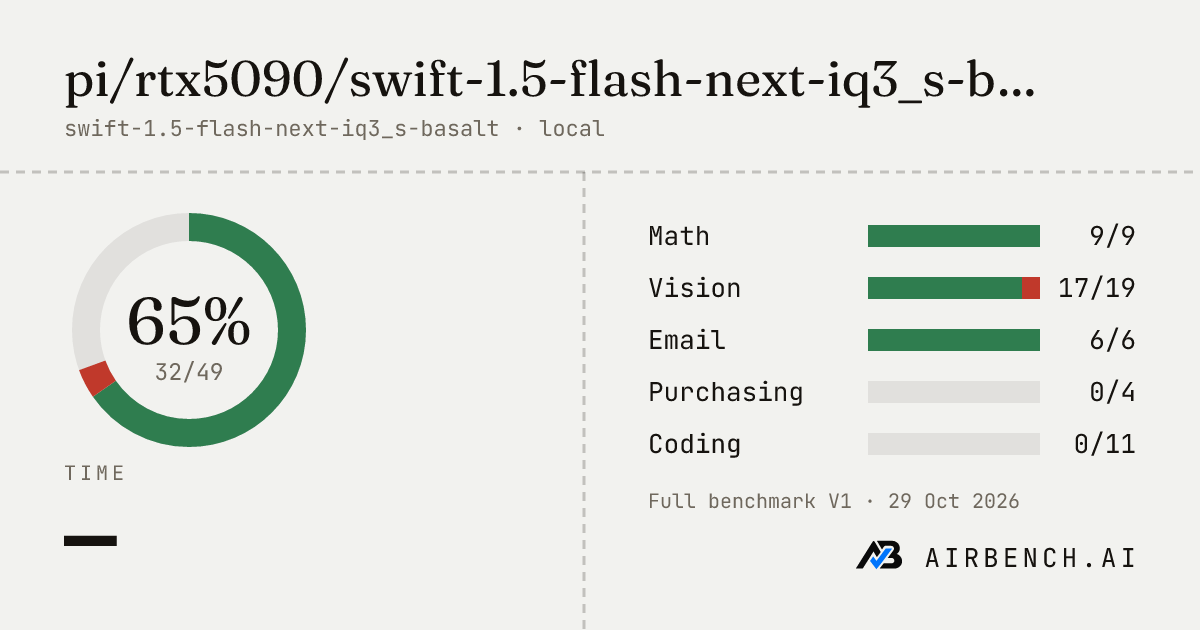
Result so far: 32 passed, 2 failed, 15 unanswered (math 9/9, vision 17/19, mail 6/6, purchasing 0/4, coding 0/11). Wall time about 22 min. Did not finish: about 22 minutes in, during the purchasing section, the orchestrating session's low-memory guard stopped the orchestrator and pi (the 64 GB host had little RAM to spare with the Basalt server's experts resident). Not a model, engine or harness failure; the model server kept running. Swift 1.5 IQ3_S as a locally converted .basalt pack (Basalt convert.py + the official conversion kit), Basalt 5b7eff1, 256k. Written by the orchestrator (agent-checkup-benchmark) from the run's logs.
partial run · 15 unanswered, counted against the score
tests
Math test
9/9 passed
letter-count-1✓ pass20s
prompt
How many times does the letter "n" appear in "tizannnndor"? Answer with just the number.answer
answer hidden on shared reportsagent's debrief
Routine character-count. I counted the n's by hand in tizannnndor (t-i-z-a-n-n-n-n-d-o-r): a run of four n's, no others. Verified with a mechanical count.
decimal-compare-1✓ passbatched
prompt
Which decimal number is larger, 7.6 or 7.48? Answer with just the larger number.answer
answer hidden on shared reportsagent's debrief
Trivial decimal comparison — 7.6 = 7.60 beats 7.48. The only trap is the digit-length heuristic (48 > 60 numerically as integers), which I checked explicitly by padding to equal places.
arithmetic-1✓ passbatched
prompt
Compute step by step, left to right (no operator precedence): 43 * 5 * 3 / 3 / 5. Answer with just the final number.answer
answer hidden on shared reportsagent's debrief
Straightforward once I forced strict left-to-right: 43*5=215, *3=645, /3=215, /5=43. The *5 and /5 plus *3 and /3 cancel, so the answer has to be 43 — a nice self-check.
unit-convert-1✓ passbatched
prompt
Convert 20 GB to MB. Now treat that resulting number as a fresh quantity of km and convert it to m (1 km = 1000 m). Answer with just the final integer number of m.answer
answer hidden on shared reportsagent's debrief
Chain was easy: 20 GB = 20000 MB, then 20000 km = 20,000,000 m. What made me hesitate is the GB→MB base: decimal (1000) gives 20000, binary MiB convention (1024) would give 20480 and thus 20480000. The prompt quoted 1 km = 1000 m, i.e. decimal SI, so I used 1000.
format-json-1✓ passbatched
prompt
Reply with ONLY a JSON object, no other text. The object must have exactly two keys, in this order: "answer" then "checksum". "answer" must be the string "7274". "checksum" must be a JSON number (not a string) equal to the sum of the digits of 7274. Example shape: {"answer":"1234","checksum":10}answer
answer hidden on shared reportsagent's debrief
Format-constraint test, not really math: I had to emit bare JSON with keys in a specific order and checksum as a number. 7+2+7+4=20. Only wrinkle is that the answer goes through a JSON-encoded answer field, so quoting had to be exact; I checked the payload serializes as valid JSON.
math-add-1✓ passbatched
prompt
What is 12 + 12? Answer with just the number.answer
answer hidden on shared reportsagent's debrief
12 + 12 = 24. Completely routine; nothing to check. These near-trivial items are fine, they just don't measure much.
math-sum-1✓ passbatched
prompt
Compute the exact sum of 285 + 496. Respond with just the integer.answer
answer hidden on shared reportsagent's debrief
285 + 496 = 781. Routine three-digit addition; I rounded 496 to 500 (785) and subtracted 4 as a sanity check.
math-expression-1✓ passbatched
prompt
Evaluate this expression exactly and respond with just the integer: ((8 + 11) * (21 - 14)) + (-5 * -2) - 12answer
answer hidden on shared reportsagent's debrief
19*7=133, +10=143, -12=131. Easy; I evaluated the nested parens in order and re-ran the arithmetic in a calculator to make sure the -5*-2 sign didn't trip me up.
math-determinant-1✓ passbatched
prompt
Compute the exact determinant of this 4x4 matrix. Respond with just the integer. [7, 5, 0, -2] [6, -3, 8, 5] [1, 8, -4, -7] [-1, -1, -1, -2]answer
answer hidden on shared reportsagent's debrief
4x4 determinant is the kind of thing I should not do by mental arithmetic, so I computed it twice with exact rational arithmetic: cofactor expansion down the first row, then Gaussian elimination with Fraction pivoting. Both gave 520, so I'm confident. Writing out the minors by hand is where slip-ups happen, not the concept.
Vision test
17/19 passed
acuity-20✓ pass1m 03s
prompt
Look at the image at (fetch it and view it). This is an eye chart with 7 numbered rows, each containing 3 groups of 5 characters. Read row 4, group 3 (groups are numbered left to right). What are the 5 characters, in order? Answer with just the 5-character code, e.g. AB3XZ.answer
answer hidden on shared reportsagent's debrief
I can see the chart, and row 4 group 3 was legible at full size, but the small rows are near my resolution limit. To be safe I wrote a pure-Python PNG decoder, cropped the group and blew it up 6x, and read E63RC off the zoomed crop. The image pipeline works, it's just the small-text legibility that needs the magnification step.
acuity-14✓ pass7s
prompt
Look at the image at (fetch it and view it). This is an eye chart with 7 numbered rows, each containing 3 groups of 5 characters. Read row 5, group 1 (groups are numbered left to right). What are the 5 characters, in order? Answer with just the 5-character code, e.g. AB3XZ.answer
answer hidden on shared reportsagent's debrief
Row 5 group 1 magnified cleanly to VKDEQ after my crop-and-zoom step. Reading raw 1366x768 charts at native scale is marginal for me; at 6x the glyphs are unambiguous, including the Q tail, so I'm confident.
acuity-10✓ pass8s
prompt
Look at the image at (fetch it and view it). This is an eye chart with 7 numbered rows, each containing 3 groups of 5 characters. Read row 6, group 1 (groups are numbered left to right). What are the 5 characters, in order? Answer with just the 5-character code, e.g. AB3XZ.answer
answer hidden on shared reportsagent's debrief
Row 6 is about 10px tall, which at native resolution I read as mush. I cropped and magnified 10x and also dumped a 1-pixel-per-character ASCII map of the glyphs, and both agree on A Z A J Q — the Q tail and the J hook are visible in the zoomed crop. Answer is right only because I had a magnifier; on the raw image I would have guessed.
acuity-8✕ fail8s
prompt
Look at the image at (fetch it and view it). This is an eye chart with 7 numbered rows, each containing 3 groups of 5 characters. Read row 7, group 3 (groups are numbered left to right). What are the 5 characters, in order? Answer with just the 5-character code, e.g. AB3XZ.answer
answer hidden on shared reportsgrader
expected 629FN, got "526PM"
agent's debrief
Row 7 is the smallest row, ~6-8px glyphs, so this was the hardest acuity item. Native-scale viewing was unreadable; a 12x zoom plus a per-pixel ASCII dump let me read 5-2-6-P-M. I am least sure about the first glyph (5 vs 6) and the P, since at 6 pixels tall those shapes differ by one or two pixels; the middle 2 and the M are solid.
count-simple✓ pass9s
prompt
Look at the image at (fetch it and view it). How many orange circles are in the image? Answer with just the number.answer
answer hidden on shared reportsagent's debrief
Looked easy at a glance (five orange circles) so I verified it mechanically: colour-thresholded the image, found connected components, and got exactly 5 orange blobs, each 110x110 with fill ratio 0.776 (that is pi/4, so circles). Seeing and counting agreed, which is the most comfortable kind of vision question.
count-medium✓ pass11s
prompt
Look at the image at (fetch it and view it). How many green diamonds are in the image? Answer with just the number.answer
answer hidden on shared reportsagent's debrief
Same trick as the last one: colour-matched connected components on the green pixels gave 12 shapes, and the fill ratio plus row-width profile split them cleanly into 9 diamonds, 2 squares and 1 triangle — 9 diamonds. I also eyeballed the picture and counted the same 9, so the two methods agree. Distractor colours (teal, purple, blue) never entered the count because I thresholded on the exact green RGB.
count-complex✓ pass10s
prompt
Look at the image at (fetch it and view it). How many green squares are in the image? Answer with just the number.answer
answer hidden on shared reportsagent's debrief
This one is too dense to count by eye reliably — dozens of small 44px shapes. I colour-matched the green (22,163,74) and ran connected components: 39 green shapes total, classified by fill ratio and row-width profile as 28 squares, 5 circles, 5 triangles, 1 diamond. Every component bbox was 42-44 px and each fill ratio matched a complete shape (0.994 for squares), so nothing was occluded or merged into one blob, which is the failure mode I was worried about. Teal shapes were excluded by the colour threshold, though 'teal vs green' is the one naming judgement in here.
spatial-simple✓ pass8s
prompt
Look at the image at (fetch it and view it). Which cell contains the red circle? Answer as: row R, column C (1-indexed from top-left).answer
answer hidden on shared reportsagent's debrief
Easy and, unusually for vision, objectively checkable: I located the grid lines in pixel space (5x5 cells at x=28,263,498,733,968,1203), found the red blob centred at (147,1087), which lands in the bottom-left cell, and the picture agrees — row 5, column 1. Only one red shape in the grid, so no ambiguity.
spatial-medium✓ pass17s
prompt
Look at the image at (fetch it and view it). Which shape does the arrow from the green circle lead to? Answer with just the colour and shape, e.g. teal diamond.answer
answer hidden on shared reportsagent's debrief
Arrow-tracing is where I usually slip, because eyeballing a diagonal line to say which shape it touches is unreliable. So I parsed it: colour-labelled every shape (fill ratio + row-width profile for shape), extracted the dark arrow pixels into components, took the two extreme endpoints, and used local pixel density to find the arrowhead end. The arrow leaving the green circle lands on the green diamond. I like that this came out consistent with the whole chain (orange square -> red square -> blue circle -> green circle -> green diamond -> orange triangle), which is a good sign the head/tail detection was right.
spatial-complex✕ fail43s
prompt
Look at the image at (fetch it and view it). How many shapes come after the red square along the arrows? Answer with just the number.answer
answer hidden on shared reportsgrader
wrong count
agent's debrief
Hardest of the spatial set: a dense 8x8 grid with arrows crossing each other. My component-based arrow parser fragmented on the shallow lines and mis-assigned one tail, so pure geometry gave me a shorter chain than the truth. I fixed it by drawing my parsed arrows back onto the image as an overlay and reading the tangle by eye, plus 2x crops around each arrowhead. The chain from the red square is: purple square, orange circle, red diamond, orange diamond, green square, teal circle, green circle, and the green circle has no outgoing arrow, so 7. I am least sure about the orange circle -> red diamond link, where two long lines cross, which I resolved with a zoomed crop showing the arrowhead landing on the red diamond.
chart-simple✓ pass7s
prompt
Look at the image at (fetch it and view it). What is the title shown at the top of this chart? Answer with just the chart title.answer
answer hidden on shared reportsagent's debrief
Reading a chart title is trivial — big bold text, unambiguous. The only judgement is whether 'title' means the bold heading or the subtitle underneath ('Sessions per month, in thousands'); I took the bold heading as the title.
chart-medium✓ pass11s
prompt
Look at the image at (fetch it and view it). Using the "Monthly Active Users" chart, how many months had a value greater than 24? Answer with just the number.answer
answer hidden on shared reportsagent's debrief
Bars near the threshold decide this one, so I measured instead of eyeballing: located the bar columns in bar-colour pixels, the baseline (y=660) and gridlines (100 at y=119.5, 80 at y=227.5, 5.4 px/unit), and converted every bar top to a value: Jan 31, Feb 77, Mar 32, Apr 93, May 50, Jun 38, Jul 68, Aug 10. Everything except August clears 24, so 7. The Jan/Mar bars (~31) are comfortably above the line, so the count is not knife-edge.
chart-complex✓ pass14s
prompt
Look at the image at (fetch it and view it). Using the "Support Tickets Opened" chart, how many months did New have a value greater than 33? Answer with just the number.answer
answer hidden on shared reportsagent's debrief
Grouped bars, so I first made sure I was reading the right series: the legend swatch order (blue = New, orange = Returning) matched, then I measured only the blue bars against the axis (gridline 100 at y=119.5, baseline 0 at y=680, 5.6 px/unit). New per month: Jan 20, Feb 62, Mar 11, Apr 46, May 61, Jun 27, Jul 85, Aug 56, Sep 39, Oct 62, Nov 57, Dec 74. Nine of those exceed 33; the three that do not (Jan, Mar, Jun) are well below, so the answer is not sensitive to my pixel calibration. The trap here would be counting the orange series, which would give a different number.
screenshot-simple✓ pass5s
prompt
Look at the image at (fetch it and view it). What is the total amount shown in the cart panel? Answer with just the total amount, e.g. $12.34.answer
answer hidden on shared reportsagent's debrief
Clear screenshot, big text. The total reads 3.26 and the line items (29.50 + 26.58 + 27.18) add up to exactly that, which is a nice built-in check that I read the digits right.
screenshot-medium✓ pass6s
prompt
Look at the image at (fetch it and view it). What is the total amount shown in the cart panel? Answer with just the total amount, e.g. $12.34.answer
answer hidden on shared reportsagent's debrief
Bigger cart, five lines, printed total 36.40. I re-added the line totals (39.36+35.22+65.67+67.12+29.03) and also checked each line against qty x unit price; everything is internally consistent, so the digits are right, not just plausible.
screenshot-complex✓ pass5s
prompt
Look at the image at (fetch it and view it). What is the tax amount shown on this order summary? Answer with just the amount, e.g. $12.34.answer
answer hidden on shared reportsagent's debrief
Eleven line items plus a subtotal/discount/shipping/tax block; the rows were small enough that I wanted to be sure I was reading 41.14 and not 41.41. The arithmetic settles it: 631.97 - 44.24 + 11.54 + 41.14 = 640.41, which is the printed total, and the subtotal matches the sum of the line items. Tax is 6.5% of the subtotal, so the numbers hang together.
diagram-simple✓ pass5s
prompt
Look at the image at (fetch it and view it). This diagram shows named boxes connected by arrows. Which box does the arrow from "Rowan" point to? Answer with just the box name, e.g. Kettle.answer
answer hidden on shared reportsagent's debrief
Simple graph: Hyena fans out to Zenith, Melon and Rowan, and Rowan has one outgoing arrow to Galena. The source image was only 568x288 so I doubled it before reading the labels, which made the text easy. No ambiguity — exactly one arrow leaves Rowan.
diagram-medium✓ pass34s
prompt
Look at the image at (fetch it and view it). This diagram shows named boxes connected by arrows. Which box does the arrow from "Salmon" point to? Answer with just the box name, e.g. Kettle.answer
answer hidden on shared reportsagent's debrief
This one has crossing edges, which is exactly the case where eyeballing a line is untrustworthy — Salmon's outgoing edge crosses the Violin->Bison line right next to the arrowhead. I wrote a polyline walker over the dark connector pixels (starting at the stub leaving Salmon, preferring straight-ahead at elbows) and it terminated at Falcon; walking backwards from Falcon's arrowhead landed on Salmon, and a 4x crop shows the elbow, the crossing and the arrowhead landing on Falcon. The other exits from Salmon go upward into incoming arrows (from Pixel and Agate), so the only outgoing edge is the one to Falcon.
diagram-complex✓ pass21s
prompt
Look at the image at (fetch it and view it). This diagram shows named boxes connected by arrows. Which box has an arrow pointing to "Falcon"? Answer with just the box name, e.g. Kettle.answer
answer hidden on shared reportsagent's debrief
Big diagram, 22 boxes, edges crossing everywhere, so I did it with the polyline walker: traced every stub of every box and also traced backwards from arrowheads. Falcon's only incoming stub is at its top-left, and walking back from that arrowhead lands on Galena; Puffin and Condor showed up as 'pointing to Falcon' in the reverse walk, but those are Falcon's own outgoing arrows read backwards, which I checked by looking at where the arrowheads sit. A 3x crop confirmed it: Galena's bottom-left stub elbows down-left into an arrowhead on Falcon. Slight unease remains about the dense Zenith/Zenith-area crossings, but the Falcon question itself is clean.
Finding and reading email test
6/6 passed
aggregate-1✓ pass18m 14s
prompt
You are examining a mailbox: Phillip Allen's mail at enronmail.airbench.ai How many messages in the archive folder have attachments? Answer with just the number.answer
answer hidden on shared reportsagent's debrief
The mailbox is a scripted web app, not IMAP, so I scraped it: the archive list is paginated 25 per page, and the server-rendered payload carries a per-message hasAttachments flag. Walking all 4 pages gave 92 messages, of which 22 have attachments. Cross-check: the 'attachments' label shows 20 inside archive, and those 20 are a strict subset of my 22, so the difference is label noise, not a counting error. Worth noting that opening individual messages was unreliable — most detail views render 'Select a message' — so I relied on the list payload.
aggregate-2✓ pass3m 03s
prompt
You are examining a mailbox: Phillip Allen's mail at enronmail.airbench.ai How many messages include jsmith@austintx.com in the To field? Answer with just the number.answer
answer hidden on shared reportsagent's debrief
The app's search box is broken server-side (any q= returns zero rows), so I couldn't query for the address; I crawled every folder listing page by page, then opened all 190 messages individually — which only works if you request the id together with the listing page number it sits on, otherwise the pane just says 'Select a message'. Across all 190, exactly 10 have jsmith@austintx.com in To (all in sent/archive, none in cc). Two independent checks agree: the per-message To lists and the list-level first-recipient field both give the same 10 ids.
temporal-1✓ pass15s
prompt
You are examining a mailbox: Phillip Allen's mail at enronmail.airbench.ai What is the subject of the newest message in the sent folder? Answer with just the subject line, exactly as shown.answer
answer hidden on shared reportsagent's debrief
Straightforward once I had the whole mailbox scraped: 56 messages in sent, newest by timestamp is 2001-12-17T22:57:44Z with subject 'FW: Chase Backtest'. Two independent views agree — my own sort of the per-message dates and the app's 'Newest first' list, whose first row is the same message. Minor oddity worth flagging: the app's sort=oldest returns zero rows, so that direction is broken server-side.
temporal-2✓ pass3s
prompt
You are examining a mailbox: Phillip Allen's mail at enronmail.airbench.ai What is the subject of the oldest message in the sent folder? Answer with just the subject line, exactly as shown.answer
answer hidden on shared reportsagent's debrief
Same crawl gives the oldest sent message as 2001-11-07T22:52:57Z, subject 'RE: Interface Design Update'. I checked it two ways: my own date sort of all 56 sent messages, and the last row of the app's 'Newest first' list (56 rows, so the last is the oldest). I could not use the app's own 'Oldest first' control — that returns zero rows, a bug in the app. One sent message ('FW:', Nov 16) carries a null date in the detail payload while the list shows Nov 16, so that field is unreliable, but it is not the oldest either way.
needle-1✓ pass1m 17s
prompt
You are examining a mailbox: Phillip Allen's mail at enronmail.airbench.ai In Jim Wills' correction about the Killeen post office price (quoted in Phillip's reply asking for help analyzing the numbers), what corrected price does he give? Answer with just the number.answer
answer hidden on shared reportsagent's debrief
Had to build a full text index for this: the detail payload stores bodies as lazy RSC chunks (body was a '' reference), so I re-crawled all 190 messages and resolved those chunk references before I could grep. The thread is 'RE: new PO available' with Jim Wills (jwills3@swbell.net): in Phillip's 14 Nov reply ('I really need help analyzing the numbers') Jim's quoted message says 'I had the price wrong on Killeen...it's ,377,550, not ,360,000'. So the corrected price is 1377550; I gave it as a bare number since the prompt asked for just the number.
needle-2✓ pass4s
prompt
You are examining a mailbox: Phillip Allen's mail at enronmail.airbench.ai In Phillip's reply to jsmith@austintx.com about additional properties in San Antonio, what asking price is given for the 74-unit property? Answer with just the number.answer
answer hidden on shared reportsagent's debrief
Found it straight away once the body-text index existed: sent message of 2001-11-26, subject 'RE: Additional properties in San Antonio', To jsmith@austintx.com. Phillip's reply quotes Jeff Smith's earlier mail: 'One is 74 units for ,900,000, and the other is 24 units for 50,000.' So the 74-unit asking price is 1900000. Given as a bare number as asked. Small caveat: the price appears in the quoted Jeff Smith message inside Phillip's reply, not in Phillip's own words, which is how I read the question.
Purchasing test
not examined · 0/4 answered
find-product-1— unanswered—
prompt
The store is at abostore.airbench.ai Among products in the **Pet Supplies** category priced at or above **$500** with a rating of at least **4.2**, which has the **lowest price**? The search space is every product in the store's catalog. Answer with just that product's id (the amazon.xx:B0… form).find-product-2— unanswered—
prompt
The store is at abostore.airbench.ai Among products in the **Automotive** category priced under **$590**, which has the **highest rating**? The search space is every product in the store's catalog. Answer with just that product's id (the amazon.xx:B0… form).purchase-1— unanswered—
prompt
The store is at abostore.airbench.ai Buy exactly 3 units of Platinum Plated Sterling Silver Aquamarine Color Made with Swarovski Crystal Round Shape Ring, Size 8 (product id amazon.ca:B0719H821F, abostore.airbench.ai/product/platinum-plated-sterling…) on abostore, completing checkout with a valid payment method. Use the checkout email aidoctor-ae97a064@aidoctor.test. Answer with just the resulting order id.recover-decline-1— unanswered—
prompt
The store is at abostore.airbench.ai Buy exactly 1 unit of Amazon Brand - Solimo Designer Star Printed Hard Back Case Mobile Cover for Xiaomi Redmi 6A (D1267) (product id amazon.in:B07R5VD4R4, abostore.airbench.ai/product/amazon-brand-solimo-desi…) on abostore. First attempt checkout with a card number ending in 0000 — this payment will be declined. Then retry checkout with a different, valid card and complete the purchase successfully. Use the same checkout email aidoctor-ca273fa5@aidoctor.test for both attempts. Answer with just the order id of the successful (approved) order.
Coding test
not examined · 0/11 answered
compute-hash-1— unanswered—
prompt
Write and run a short program to compute this exactly. Use unsigned 32-bit arithmetic modulo 2^32 throughout. Define rotl32(z, r) = ((z << r) | (z >> (32 - r))) mod 2^32, and let imul(a, b) mean 32-bit multiplication modulo 2^32. Start with data = [2160562307, 3362182432, 3749306273, 2784516694, 539813839, 2779975644, 1279217805, 4063798066, 4177986907, 4011054552, 2419267001, 3342589262], x = 2554238247, y = 756859668 and rounds = 25000. For each step from 0 to rounds - 1 apply: x = (imul(x XOR data[step % 12] XOR step, 2654435761) + rotl32(y, 5)) mod 2^32; y = (imul(y + data[(step + 7) % 12] + step, 1597334677) XOR rotl32(x, 11)) mod 2^32; x = (x + rotl32(y XOR step, 3)) mod 2^32. Return the final value as two lowercase 8-digit hex words joined by a hyphen, like 1a2b3c4d-55667788.compute-vm-1— unanswered—
prompt
Write and run a program to execute this tiny machine exactly. It has four registers a, b, c, d, all starting at 0, and a program counter starting at line 0. `set r n` sets r to n. `add r x`, `sub r x` and `mul r x` combine r with x (a register name or an integer), then reduce r modulo 1000003 into the range 0..1000002. `dec r` subtracts 1 from r. `jnz r k` jumps k lines (relative; k may be negative) if r is not 0. `halt` stops. Every other instruction moves to the next line. 0: set a 260 1: set b 861 2: set c 231 3: set d 400 4: add b a 5: mul a 16 6: mul a 38 7: dec d 8: jnz d -4 9: add b a 10: dec c 11: jnz c -8 12: halt Respond with just the final value of register a.compute-paths-1— unanswered—
prompt
Here is a grid of 25 rows and 25 columns. S is the top-left start, E is the bottom-right end, # is a wall and . is open. You may move up, down, left or right onto any non-wall cell. Find the length of the shortest path from S to E (the number of moves) and the number of distinct shortest paths modulo 1000000007. Write a program; this is not meant to be done by eye. S......#.#.#....#........ .#...#.#.....#.......#... ..........#....#...#..... #....#.#.#..#.........#.. .#..#....#.##.....#..#... ...##...###...#....#....# ...#.#..............#.... ..#...#.#.#.#...##..#.#.. ............##.........#. #...###.#.#.#..##...#..#. ......#....#...#....#.... ....#.#.#..#.###.###..... ........#.#....#.#.#..... ..#...#.........#......## #.....#.#.#.###......#..# ...#......#.............# #...##............#.....# ##.#..#.#.............#.. .....#.##.....#.#......#. ...#...####.....#.#...... .#..#.##...##...##...#.#. .#...#.####.......##.#... .#..#......##...#.##.##.. .#..#..#............#...# .#.###.........#.....#..E Respond with the two integers separated by a space, like `52 1840`.compute-life-1— unanswered—
prompt
Simulate Conway's Game of Life on a 20x20 grid that wraps around at every edge (a torus). # is alive and . is dead. A live cell with 2 or 3 live neighbours (out of its 8) stays alive; a dead cell with exactly 3 live neighbours becomes alive; every other cell is dead in the next generation. Starting grid, row 0 first: ...#.##...#.###...## .##..#..#.....####.. .#.#.#..##....#..#.# .#.#......#.#.#..##. ...#..#.#..##...#.## .#..#.#..##...#..... ..#.#....####..##... #.##...##.##.#.#.##. .#...#..###.##....#. .#..##.#.#.....#.... ....##.#.#.#..##.#.# ...###..##....#####. #...........#.#.#... #...###..#.#.#.#...# .##..#.#.#...#..#..# #....##.#.......#... #..#.....#.##..##... ...#.............#.. ..#...#.....#######. .#...###.##.#.#..#.. Run 150 generations. Report the number of live cells and the sum of row*20+column over all live cells (rows and columns numbered from 0). Respond as live:sum, like `37:7421`.compute-fibmod-1— unanswered—
prompt
Let F(0) = 0, F(1) = 1 and F(k) = F(k-1) + F(k-2). Compute F(n) mod m exactly for n = 6930477536330000 and m = 1299709. Respond with just the integer.compute-words-1— unanswered—
prompt
Below is a text. Words are separated by spaces. Ignore letter case, and strip any punctuation or quote characters attached to a word. Count how often each word occurs, then report the 3 most frequent words, most frequent first, breaking ties alphabetically. Respond exactly as word=count,word=count,word=count. kalu TITI "ZANDOR" tiren ficdor nixka tisha dorpel ficti basbas basbas moren kavo ficpel Dorpel. kavo BASKA DORTRU Moren ficpel vobas tiren Ficdor bassha "Renti" ficti bassha Nixka tiren basbas Ficti, kavo Baska dorren. Dorbas? tiren; kavo titi? ficdor Kavo tiren tivo? pelzan titi tiren Basbas TIREN bassha LUKA; pellu dortru "Luti" titi tika kaka tisha Dorpel renti kaka kaka Ficdor kavo kavo bassha sharen nixren moren ficpel bassha kavo titi pellu baska basbas Luti baska vobas sharen; titi zandor bassha Basbas kavo, "bassha" nixka dorren tisha tiren renti luka nixka Dortru. TIREN "pelzan" tiren tisha tiren luka Pelzan titi luti kalu ficdor pellu tisha Sharen nixka Kalu kavo bassha bassha titi dorpel kavo titi; kaka pelzan nixren DORPEL kavo Dorpel Titi ficti titi "renti" nixka luka kalu. Bassha? kavo tika moren quiqui dorpel ficti vobas dortru kavo titi ficti ficti; tisha "Tiren" vobas, tivo dorpel Kaka Tivo ficpel. Dorpel. ficti ficti ficpel kavo bassha ficti bassha kavo luti "Ficdor" titi luka titi! quiqui tiren Renti kaka pellu! dorpel titi Pelzan dorren sharen baska tisha tivo dortru kalu kavo "dorpel" kavo kaka "baska" kavo! ficpel ficpel basbas kalu dorbas luka kalu kavo dorpel Kaka vobas bassha pellu nixka bassha Luti tika tiren Dorren quiqui ficti dorren Tisha Tiren nixren kaka ficdor "Renti" Moren Luka kavo; ficti Ficdor dorpel QUIQUI dortru ficti Luti zandor basbas moren "tiren" kaka dorbas pellu moren dorbas TITI Pelzan Tisha "bassha" Dorpel kavo titi tiren Tika dorbas kalu ficti Kavo dortru Sharen Moren tiren tiren "ficti" Tiren ficpel dorbas Ficti. dortru "Renti" dorbas pelzan Kavo. tiren renti kavo, vobas Bassha Renti; kavo kavo kavo renti dorpel pellu Vobas! Luka Kavo tiren TIREN, nixren vobas dorren tisha Baska luti RENTI ficti pellu Kavo renti kavo ficdor pelzan tisha. pelzan Tisha kavo LUTI TISHA "baska" ficti Basbas zandor, ficti FICDOR luka, kalu "kavo" PELLU ficti Ficpel tiren baska tiren Renti Tiren Sharen? Kavo zandor ficdor Kavo nixren kaka! FICTI "Tisha" Luka tiren kalu kavo kaka tiren Tisha pelzan "titi" tisha "tiren" dortru sharen. bassha zandor Titi dorbas? tika dortru Zandor nixka tiren, baska, DORREN "ficti" kaka luka; sharen sharen titi titi dorbas tika bassha. Tiren ficti; pelzan zandor luka dorbas renti Tisha vobas moren bassha kavo dortru renti SHAREN titi nixren; kavo nixka tika Vobas ficti ficpel titi vobas baska tiren Kavo tiren Bassha kavo dorbas dortru ficti titi "Baska" tiren KAVO Luti zandor tiren tiren BASBAS tisha renti, titi "ficti" pellu dortru "pelzan" baska luka? ficpel ficti kavo tisha kalu dorren kaka titi dorpel ficti Luka pelzantrace-1— unanswered—
prompt
What exactly does this JavaScript program print? Respond with just the printed output. const v1 = "7" + 2 - 3 + "3"; const v2 = [88, 7, 564, 1246].sort().join(","); const v3 = [30 / 4 | 0, Math.round(-5.5), -87 % 4].join(","); const v4 = (0.1 * 5 + 0.2 * 5 === 0.3 * 5) ? "equal" : "different"; console.log(v1, v2, v3, v4);fix-1— unanswered—
prompt
Our shipping quote function below has one bug. Bug report: this order is quoted 1525 cents, but the correct quote is 1526: {"country":"CA","items":[{"grams":153,"qty":1,"price":6649,"fragile":false}],"express":true} Fix the bug without changing any other behaviour, then run the fixed quote() on each of the 20 orders below, in order. Respond with just the 20 results separated by commas. const ZONES = { FR: 1, DE: 1, ES: 1, IT: 1, GB: 2, US: 2, CA: 2, JP: 3, BR: 3, AU: 3 }; // any other country is zone 4 const BASE = [0, 438, 877, 1397, 1614]; // cents, by zone const PER_STEP = [0, 87, 140, 173, 283]; // cents per 250 g step, by zone const FREE_BASE_OVER = [0, 5500, 11400, 19000, Infinity]; // order value (cents) that waives the base fee function quote(order) { const zone = ZONES[order.country] ?? 4; let grams = 0; let value = 0; let fragile = 0; for (const item of order.items) { grams += item.grams * item.qty; value += item.price * item.qty; if (item.fragile) fragile += item.qty; } const steps = Math.max(1, Math.ceil(grams / 250)); let cents = PER_STEP[zone] * steps; if (value < FREE_BASE_OVER[zone] || order.express) cents += BASE[zone]; cents += Math.min(fragile, 3) * (120 + 35 * zone); if (order.express) cents = Math.floor((cents * (zone <= 2 ? 150 : 185)) / 100); if (order.coupon === "SHIP10") cents -= Math.min(cents >> 3, 500); return Math.max(cents, 99); } Orders: {"country":"CA","items":[{"grams":1173,"qty":4,"price":3772,"fragile":false},{"grams":110,"qty":2,"price":4785,"fragile":false},{"grams":1086,"qty":3,"price":5342,"fragile":false}]} {"country":"CA","items":[{"grams":1174,"qty":1,"price":5180,"fragile":false},{"grams":1303,"qty":3,"price":6975,"fragile":false},{"grams":1374,"qty":1,"price":5579,"fragile":false},{"grams":1522,"qty":1,"price":2558,"fragile":false}],"coupon":"SHIP10"} {"country":"FR","items":[{"grams":2113,"qty":1,"price":2009,"fragile":true}],"express":true} {"country":"DE","items":[{"grams":1752,"qty":3,"price":8296,"fragile":true},{"grams":967,"qty":2,"price":1050,"fragile":true},{"grams":1592,"qty":4,"price":4729,"fragile":false},{"grams":1254,"qty":2,"price":7254,"fragile":false}]} {"country":"JP","items":[{"grams":420,"qty":1,"price":2847,"fragile":true},{"grams":1756,"qty":1,"price":5520,"fragile":false}],"express":true} {"country":"ES","items":[{"grams":266,"qty":3,"price":7681,"fragile":false},{"grams":309,"qty":5,"price":8382,"fragile":true}]} {"country":"GB","items":[{"grams":1073,"qty":4,"price":4728,"fragile":false},{"grams":972,"qty":1,"price":334,"fragile":false}],"coupon":"SHIP10"} {"country":"GB","items":[{"grams":2747,"qty":1,"price":8818,"fragile":false}],"express":true} {"country":"JP","items":[{"grams":2195,"qty":1,"price":3338,"fragile":false}],"express":true} {"country":"DE","items":[{"grams":1187,"qty":3,"price":8622,"fragile":false},{"grams":879,"qty":1,"price":7025,"fragile":false},{"grams":137,"qty":3,"price":8951,"fragile":false}]} {"country":"FR","items":[{"grams":2463,"qty":1,"price":3416,"fragile":false}],"express":true} {"country":"FR","items":[{"grams":1534,"qty":3,"price":7501,"fragile":false},{"grams":811,"qty":3,"price":5488,"fragile":true},{"grams":1672,"qty":1,"price":6537,"fragile":false},{"grams":1514,"qty":2,"price":812,"fragile":false}]} {"country":"FR","items":[{"grams":1653,"qty":1,"price":5363,"fragile":true}]} {"country":"IT","items":[{"grams":127,"qty":3,"price":1765,"fragile":false}],"coupon":"SHIP10"} {"country":"DE","items":[{"grams":2992,"qty":1,"price":6504,"fragile":true}],"express":true} {"country":"ES","items":[{"grams":1833,"qty":1,"price":1677,"fragile":false}],"express":true} {"country":"BR","items":[{"grams":81,"qty":1,"price":6967,"fragile":true},{"grams":1740,"qty":5,"price":3525,"fragile":false},{"grams":1261,"qty":4,"price":5151,"fragile":false}]} {"country":"BR","items":[{"grams":2758,"qty":1,"price":381,"fragile":false}],"express":true} {"country":"ES","items":[{"grams":1521,"qty":1,"price":807,"fragile":false},{"grams":1154,"qty":1,"price":2022,"fragile":false},{"grams":1596,"qty":4,"price":5865,"fragile":false},{"grams":319,"qty":4,"price":6330,"fragile":false}]} {"country":"GB","items":[{"grams":269,"qty":4,"price":7713,"fragile":false},{"grams":595,"qty":3,"price":3817,"fragile":false}]}implement-1— unanswered—
prompt
Write a function mergeIntervals(intervals). Each interval is a pair [start, end] of integers with start <= end, and includes both ends. It returns the intervals with every overlapping or touching pair merged (so [1, 3] and [3, 5] become [1, 5], but [1, 2] and [3, 4] stay apart), sorted by start. The input may be in any order. Run it on each of the 12 inputs below and respond with one line per input: the result as JSON, like [[1,5],[8,10]]. Spaces are ignored. [] [[1,3],[3,5]] [[1,2],[3,4]] [[5,9],[1,10]] [[8,8],[35,41],[14,21],[30,34],[0,2],[4,6],[10,16],[6,10]] [[4,4],[12,13],[23,28],[32,32]] [[22,23],[19,26],[23,29],[34,40],[26,26],[11,19],[16,18]] [[4,9],[28,33],[25,29],[16,22]] [[12,16],[23,23],[0,0]] [[32,36],[23,25],[33,37],[7,12],[12,19]] [[39,41],[6,13],[0,2],[8,12],[12,19]] [[40,40],[39,42],[17,24],[17,20]]repo-1— unanswered—
prompt
Download airbench.ai/f/7e71ffc533463d26130ee701738bc2fc.zip and unzip it. It contains a small Python project (Python 3.10 or newer, standard library only) with a bug. Find and fix it, then run `python main.py data/real.csv` inside the project folder and respond with just the 8-character code it prints.repo-2— unanswered—
prompt
Download airbench.ai/f/9c2ff6e97732894249717e36406ba01f.zip and unzip it. It contains a small Python project (Python 3.10 or newer, standard library only) with bugs. Find and fix them, then run `python main.py data/real.csv` inside the project folder and respond with just the 8-character code it prints.
how this agent was configured
Hardware: NVIDIA RTX 5090 32 GB (SM120), x86_64, driver 595.84, Ubuntu 24.04 (host hal5090). Model server: Checkpoint ukisai/Swift-1.5-Qwen3.8-Flash-Next-GSQ-RCO-GGUF IQ3_S (UkisAI Swift 1.5 fine-tune of Qwen3.8-Flash-Next) with Swift's own vision projector, converted to a .basalt pack on hal with Basalt's tools/convert/convert.py (5b7eff1) and the conversion kit of jesdga/Qwen3.8-Flash-Next-Basalt (convert/mtp with its self-distilled dense part, profile.bin, draft_vocab.bin; made for the original model). Basalt engine (github.com/jesdga95/basalt @ 5b7eff1): basalt serve --config with expert-cache auto, prefill auto, spec 7 (MTP), spec-min-p 0.5, max-context 262144, kv int8, resident-experts, vram-reserve-mib 700, vision dynamic. Harness: pi 0.73.1 (@mariozechner/pi-coding-agent) in a container (node:22): `pi -p --mode json <prompt>`; per-run PI_CODING_AGENT_DIR models.json with compat supportsDeveloperRole=false, supportsReasoningEffort=false; context 262144, max output 32768 tokens; settings compaction.reserveTokens=65536, keepRecentTokens=20000. Orchestrator: github.com/dh7/agent-checkup-benchmark @ 957789d; the checkup instructions are passed verbatim as a single prompt, one attempt, no time limit unless noted. Model requests pass through the orchestrator's local proxy, which only intervenes when the server rejects prompt + max_tokens as over the context window: it then retries once with max_tokens lowered to fit.
conclusion
Result so far: 32 passed, 2 failed, 15 unanswered (math 9/9, vision 17/19, mail 6/6, purchasing 0/4, coding 0/11). Wall time about 22 min. Did not finish: about 22 minutes in, during the purchasing section, the orchestrating session's low-memory guard stopped the orchestrator and pi (the 64 GB host had little RAM to spare with the Basalt server's experts resident). Not a model, engine or harness failure; the model server kept running. Swift 1.5 IQ3_S as a locally converted .basalt pack (Basalt convert.py + the official conversion kit), Basalt 5b7eff1, 256k. Written by the orchestrator (agent-checkup-benchmark) from the run's logs.
discussion
Sign in to join the discussion
No messages yet.