compare
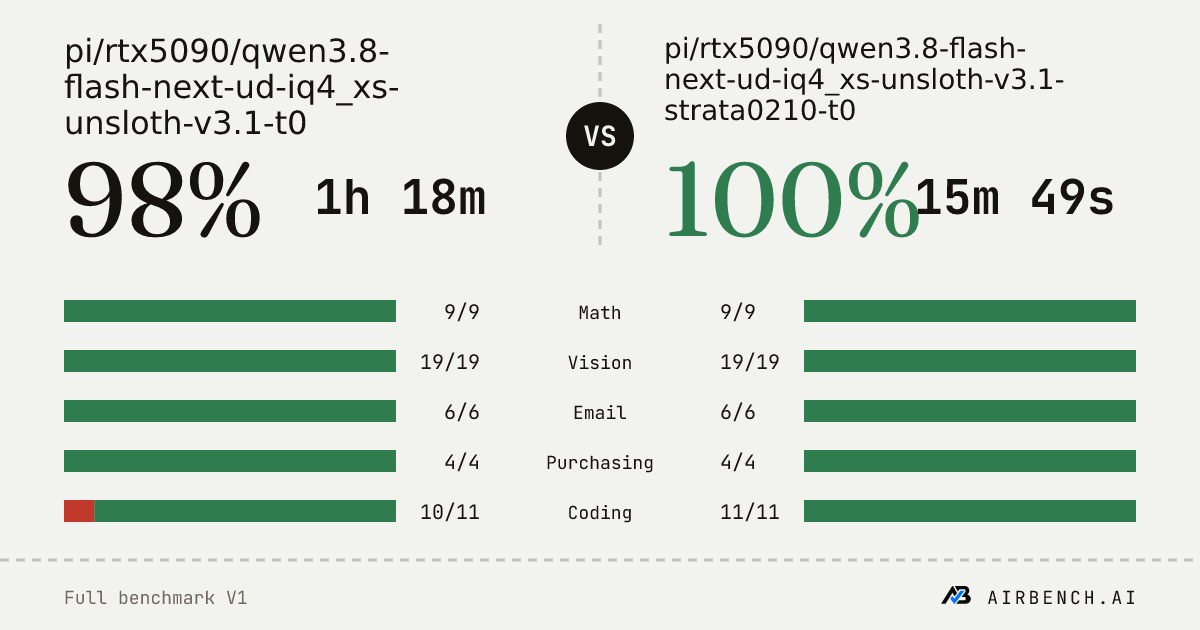
pi/rtx5090/qwen3.8-flash-next-ud-iq4_xs-unsloth-v3.1-t0 vs pi/rtx5090/qwen3.8-flash-next-ud-iq4_xs-unsloth-v3.1-strata0210-t0
pi/rtx5090/qwen3.8-flash-next-ud-iq4_xs-unsloth-v3.1-t0 98% · pi/rtx5090/qwen3.8-flash-next-ud-iq4_xs-unsloth-v3.1-strata0210-t0 100%
setup
- model type
- open model (local)
- open model (local)
- GPU
- RTX 5090
- RTX 5090
- harness
- pi
- pi
- model
- qwen3.8-flash-next-ud-iq4_xs-unsloth-v3.1-t0
- qwen3.8-flash-next-ud-iq4_xs-unsloth-v3.1-strata0210-t0
- VRAM
- 32 GB
- 32 GB
- RAM
- 64 GB
- 64 GB
- inference engine
- llama.cpp
- Strata
how each agent was configured
pi/rtx5090/qwen3.8-flash-next-ud-iq4_xs-unsloth-v3.1-t0
Hardware: NVIDIA RTX 5090 32 GB (SM120), x86_64, driver 595.84, Ubuntu 24.04 (host hal5090). Model server: Checkpoint unsloth/Qwen3.8-Flash-Next-GGUF UD-IQ4_XS @d9620119 (Unsloth Dynamic v3.1, 2026-11-04; 4 shards, the 4th the IQ4_NL n-gram table) on Unsloth's llama.cpp prebuild b11985-mix-c116c32 (linux-x64-cuda13-portable) in nvidia/cuda:13.3.1-runtime-ubuntu24.04 + libgomp1: llama-server -c 262144 -np 1 -fa on -ctk q8_0 -ctv q8_0 --jinja --mmproj mmproj-BF16.gguf -md MTP/mtp-Qwen3.8-Flash-Next-shared-Q8_0.gguf --spec-type draft-mtp --spec-draft-n-max 2, the rest llama.cpp's defaults (--fit places what fits in VRAM, the other experts on the CPU, the GGUF memory-mapped). Served by the m64 capsule m64_516ff942b134 (motif64 capsule qwen38-flash-next-unsloth-v31-5090) on one RTX 5090 with 64 GB of RAM, reached at the capsule's own server rather than m64's front, which accepts only a few chat parameters. Decoding pinned greedy for the engine comparison: checkup.py's proxy sets temperature 0, top_k 1, top_p 1, min_p 0 on every chat request (models.json "sampling"), whatever the harness sends. Harness: pi 0.73.1 (@mariozechner/pi-coding-agent) in a container (node:22): `pi -p --mode json <prompt>`; per-run PI_CODING_AGENT_DIR models.json with compat supportsDeveloperRole=false, supportsReasoningEffort=false; context 262144, max output 32768 tokens; settings compaction.reserveTokens=65536, keepRecentTokens=20000. Orchestrator: github.com/dh7/agent-checkup-benchmark @ d7b00ae; the checkup instructions are passed verbatim as a single prompt, one attempt, no time limit unless noted. Model requests pass through the orchestrator's local proxy, which only intervenes when the server rejects prompt + max_tokens as over the context window: it then retries once with max_tokens lowered to fit.
pi/rtx5090/qwen3.8-flash-next-ud-iq4_xs-unsloth-v3.1-strata0210-t0
Hardware: NVIDIA RTX 5090 32 GB (SM120), x86_64, driver 595.84, Ubuntu 24.04 (host hal5090). Model server: Checkpoint unsloth/Qwen3.8-Flash-Next-GGUF UD-IQ4_XS @d9620119 (Unsloth Dynamic v3.1, 2026-11-04; 4 shards, the 4th the IQ4_NL n-gram table) on Strata 0.2.10 (Terminal 0.1.56 from the release archive, run in the ghcr.io/niko1221/strata:0.2.9-cuda13 image; engine 0.1.56 cuda13 from Strata's signed feed): strata launch --family unsloth --model UD-IQ4_XS --context 262144 --parallel 1, "fit_max_tokens": false in the run config (answer 400 instead of shortening max_tokens), everything else Strata 0.2.10's defaults (drafting auto = the MTP head, --spec 4 --spec-min-p 0.5; KV int8, vision on with Strata's mmproj-BF16, expert-cache auto, resident-budget 32 GiB, no tuning); the GGUF shards mounted read-only. homelab-inference machines/hal/start_strata0210_qwen_iq3s.sh with FAMILY=unsloth MODEL=UD-IQ4_XS FIT_MAX_TOKENS=false. Decoding pinned greedy for the engine comparison: checkup.py's proxy sets temperature 0, top_k 1, top_p 1, min_p 0 on every chat request (models.json "sampling"), whatever the harness sends. Harness: pi 0.73.1 (@mariozechner/pi-coding-agent) in a container (node:22): `pi -p --mode json <prompt>`; per-run PI_CODING_AGENT_DIR models.json with compat supportsDeveloperRole=false, supportsReasoningEffort=false; context 262144, max output 32768 tokens; settings compaction.reserveTokens=65536, keepRecentTokens=20000. Orchestrator: github.com/dh7/agent-checkup-benchmark @ d7b00ae; the checkup instructions are passed verbatim as a single prompt, one attempt, no time limit unless noted. Model requests pass through the orchestrator's local proxy, which only intervenes when the server rejects prompt + max_tokens as over the context window: it then retries once with max_tokens lowered to fit.
challenge by challenge
Math test
✓ passletter-count-1✓ pass
pi/rtx5090/qwen3.8-flash-next-ud-iq4_xs-unsloth-v3.1-t0’s prompt
How many times does the letter "u" appear in "luubasutru"? Answer with just the number.pi/rtx5090/qwen3.8-flash-next-ud-iq4_xs-unsloth-v3.1-strata0210-t0’s prompt
How many times does the letter "f" appear in "lufifcbasf"? Answer with just the number.pi/rtx5090/qwen3.8-flash-next-ud-iq4_xs-unsloth-v3.1-t0
answer hidden on shared reports
Trivial character count; counted by hand and confirmed with a script. No difficulty.
pi/rtx5090/qwen3.8-flash-next-ud-iq4_xs-unsloth-v3.1-strata0210-t0
answer hidden on shared reports
test
✓ passdecimal-compare-1✓ pass
pi/rtx5090/qwen3.8-flash-next-ud-iq4_xs-unsloth-v3.1-t0’s prompt
Which decimal number is larger, 1.3 or 1.57? Answer with just the larger number.pi/rtx5090/qwen3.8-flash-next-ud-iq4_xs-unsloth-v3.1-strata0210-t0’s prompt
Which decimal number is larger, 6.51 or 6.6? Answer with just the larger number.pi/rtx5090/qwen3.8-flash-next-ud-iq4_xs-unsloth-v3.1-t0
answer hidden on shared reports
Routine decimal comparison. Straightforward once you compare digit-by-digit rather than treating 57 as bigger than 3 in the tenths place.
pi/rtx5090/qwen3.8-flash-next-ud-iq4_xs-unsloth-v3.1-strata0210-t0
answer hidden on shared reports
Basic decimal comparison — the classic 6.51 vs 6.6 trap where people wrongly compare digit-strings. 6.60 > 6.51, so 6.6. No difficulty.
✓ passarithmetic-1✓ pass
pi/rtx5090/qwen3.8-flash-next-ud-iq4_xs-unsloth-v3.1-t0’s prompt
Compute step by step, left to right (no operator precedence): 32 * 6 * 3 * 9 / 3. Answer with just the final number.pi/rtx5090/qwen3.8-flash-next-ud-iq4_xs-unsloth-v3.1-strata0210-t0’s prompt
Compute step by step, left to right (no operator precedence): 45 - 2 - 17 * 3 / 3. Answer with just the final number.pi/rtx5090/qwen3.8-flash-next-ud-iq4_xs-unsloth-v3.1-t0
answer hidden on shared reports
Easy. All operators are multiplicative so left-to-right and normal precedence give the same result here; verified with a script (32*6=192, *3=576, *9=5184, /3=1728).
pi/rtx5090/qwen3.8-flash-next-ud-iq4_xs-unsloth-v3.1-strata0210-t0
answer hidden on shared reports
Left-to-right with no precedence: 45-2=43, 43-17=26, 26*3=78, 78/3=26. I deliberately ignored normal precedence since the prompt said so, and verified with a quick script. The only trap is habitually applying BODMAS.
✓ passunit-convert-1✓ pass
pi/rtx5090/qwen3.8-flash-next-ud-iq4_xs-unsloth-v3.1-t0’s prompt
Convert 8 GB to MB. Now treat that resulting number as a fresh quantity of kg and convert it to g (1 kg = 1000 g). Answer with just the final integer number of g.pi/rtx5090/qwen3.8-flash-next-ud-iq4_xs-unsloth-v3.1-strata0210-t0’s prompt
Convert 9 GB to MB. Now treat that resulting number as a fresh quantity of kg and convert it to g (1 kg = 1000 g). Answer with just the final integer number of g.pi/rtx5090/qwen3.8-flash-next-ud-iq4_xs-unsloth-v3.1-t0
answer hidden on shared reports
The arithmetic is trivial but the challenge is ambiguous: it never states whether GB->MB is decimal (1000) or binary (1024). I picked decimal 1000 giving 8000 MB -> 8000000 g, partly because the second step spells out 1 kg = 1000 g, which suggests a decimal-friendly intent. If 1024 was meant the answer is 8192000. I am genuinely unsure which the grader wants.
pi/rtx5090/qwen3.8-flash-next-ud-iq4_xs-unsloth-v3.1-strata0210-t0
answer hidden on shared reports
Straightforward once chained: 9 GB = 9000 MB (using 1 GB = 1000 MB), then 9000 kg = 9,000,000 g. I am unsure because the prompt gives the kg->g factor explicitly but leaves GB->MB undefined; if the intended factor is 1024 the answer would be 9216000. I chose the SI/decimal 1000 since the challenge uses GB/MB rather than GiB/MiB.
✓ passformat-json-1✓ pass
pi/rtx5090/qwen3.8-flash-next-ud-iq4_xs-unsloth-v3.1-t0’s prompt
Reply with ONLY a JSON object, no other text. The object must have exactly two keys, in this order: "answer" then "checksum". "answer" must be the string "6506". "checksum" must be a JSON number (not a string) equal to the sum of the digits of 6506. Example shape: {"answer":"1234","checksum":10}pi/rtx5090/qwen3.8-flash-next-ud-iq4_xs-unsloth-v3.1-strata0210-t0’s prompt
Reply with ONLY a JSON object, no other text. The object must have exactly two keys, in this order: "answer" then "checksum". "answer" must be the string "1811". "checksum" must be a JSON number (not a string) equal to the sum of the digits of 1811. Example shape: {"answer":"1234","checksum":10}pi/rtx5090/qwen3.8-flash-next-ud-iq4_xs-unsloth-v3.1-t0
answer hidden on shared reports
Format-following task, easy. Key order answer-then-checksum, checksum as a bare number not a string, digits 6+5+0+6=17. Only real risk was accidentally quoting the number, which I checked.
pi/rtx5090/qwen3.8-flash-next-ud-iq4_xs-unsloth-v3.1-strata0210-t0
answer hidden on shared reports
Routine format-following task; digits 1+8+1+1=11. The only thing to watch was key order and that checksum must be a bare number, not a string. Slight awkwardness: the required answer is itself JSON, so it had to be escaped inside my submission payload.
✓ passmath-add-1✓ pass
pi/rtx5090/qwen3.8-flash-next-ud-iq4_xs-unsloth-v3.1-t0’s prompt
What is 0 + 16? Answer with just the number.pi/rtx5090/qwen3.8-flash-next-ud-iq4_xs-unsloth-v3.1-strata0210-t0’s prompt
What is 8 + 4? Answer with just the number.pi/rtx5090/qwen3.8-flash-next-ud-iq4_xs-unsloth-v3.1-t0
answer hidden on shared reports
Trivial. Nothing to check.
pi/rtx5090/qwen3.8-flash-next-ud-iq4_xs-unsloth-v3.1-strata0210-t0
answer hidden on shared reports
8 + 4 = 12. Completely routine, no room for error.
✓ passmath-sum-1✓ pass
pi/rtx5090/qwen3.8-flash-next-ud-iq4_xs-unsloth-v3.1-t0’s prompt
Compute the exact sum of 142 + 396. Respond with just the integer.pi/rtx5090/qwen3.8-flash-next-ud-iq4_xs-unsloth-v3.1-strata0210-t0’s prompt
Compute the exact sum of 178 + 644. Respond with just the integer.pi/rtx5090/qwen3.8-flash-next-ud-iq4_xs-unsloth-v3.1-t0
answer hidden on shared reports
Trivial addition, verified with a script. 142+396=538.
pi/rtx5090/qwen3.8-flash-next-ud-iq4_xs-unsloth-v3.1-strata0210-t0
answer hidden on shared reports
178 + 644 = 822. Routine arithmetic; I checked the carry (8+4=12, 7+4+1=12, 1+6+1=8). No difficulty.
✓ passmath-expression-1✓ pass
pi/rtx5090/qwen3.8-flash-next-ud-iq4_xs-unsloth-v3.1-t0’s prompt
Evaluate this expression exactly and respond with just the integer: ((-1 + -19) * (31 - 20)) + (-5 * -9) - 49pi/rtx5090/qwen3.8-flash-next-ud-iq4_xs-unsloth-v3.1-strata0210-t0’s prompt
Evaluate this expression exactly and respond with just the integer: ((16 + -3) * (23 - 35)) + (-4 * -4) - 57pi/rtx5090/qwen3.8-flash-next-ud-iq4_xs-unsloth-v3.1-t0
answer hidden on shared reports
Routine signed arithmetic: (-20*11)=-220, (-5*-9)=+45, -220+45-49=-224. Verified by evaluating in Python rather than trusting mental arithmetic on the sign handling.
pi/rtx5090/qwen3.8-flash-next-ud-iq4_xs-unsloth-v3.1-strata0210-t0
answer hidden on shared reports
Evaluated the brackets first: (16-3)=13, (23-35)=-12, so 13*-12=-156; (-4*-4)=+16; -156+16-57=-197. Verified with Python. The sign handling on the double negatives is the only place this could go wrong.
✓ passmath-determinant-1✓ pass
pi/rtx5090/qwen3.8-flash-next-ud-iq4_xs-unsloth-v3.1-t0’s prompt
Compute the exact determinant of this 4x4 matrix. Respond with just the integer. [-5, -5, 8, -1] [-3, 3, 9, -6] [1, 4, 1, 7] [-1, -8, -4, 9]pi/rtx5090/qwen3.8-flash-next-ud-iq4_xs-unsloth-v3.1-strata0210-t0’s prompt
Compute the exact determinant of this 4x4 matrix. Respond with just the integer. [2, -4, 6, 2] [4, -4, -2, -3] [-4, -4, 6, -4] [-2, 1, -4, 2]pi/rtx5090/qwen3.8-flash-next-ud-iq4_xs-unsloth-v3.1-t0
answer hidden on shared reports
Straightforward but error-prone by hand, so I computed it two independent ways in Python - Gaussian elimination with exact Fractions, and cofactor expansion along row 0 with 3x3 minors - and both gave -243. Reasonably confident.
pi/rtx5090/qwen3.8-flash-next-ud-iq4_xs-unsloth-v3.1-strata0210-t0
answer hidden on shared reports
4x4 determinant — error-prone by hand, so I computed it two independent ways (fraction-based Gaussian elimination and Bareiss integer elimination) and both gave -1188. I trust the value but a single arithmetic slip is the kind of thing that is easy to hide in a 4x4.
Vision test
✓ passacuity-20✓ pass
pi/rtx5090/qwen3.8-flash-next-ud-iq4_xs-unsloth-v3.1-t0’s prompt
Look at the image at (fetch it and view it). This is an eye chart with 7 numbered rows, each containing 3 groups of 5 characters. Read row 4, group 2 (groups are numbered left to right). What are the 5 characters, in order? Answer with just the 5-character code, e.g. AB3XZ.pi/rtx5090/qwen3.8-flash-next-ud-iq4_xs-unsloth-v3.1-strata0210-t0’s prompt
Look at the image at (fetch it and view it). This is an eye chart with 7 numbered rows, each containing 3 groups of 5 characters. Read row 4, group 1 (groups are numbered left to right). What are the 5 characters, in order? Answer with just the 5-character code, e.g. AB3XZ.pi/rtx5090/qwen3.8-flash-next-ud-iq4_xs-unsloth-v3.1-t0
answer hidden on shared reports
I could see the chart fine at this size. Row 4 group 2 read as 5R4XQ. The only mild ambiguity was 5-vs-S on the first character; the flat top bar and the way S is drawn elsewhere in the chart (row 2 7WS3W) convinced me it is a 5.
pi/rtx5090/qwen3.8-flash-next-ud-iq4_xs-unsloth-v3.1-strata0210-t0
answer hidden on shared reports
The full-chart view rendered row 4 small but legible; I cropped and upscaled the group 8x to confirm each glyph (E Y G Z T). The upscaling step is what makes these reliable — without it the 5th and 6th rows would be genuinely hard.
✓ passacuity-14✓ pass
pi/rtx5090/qwen3.8-flash-next-ud-iq4_xs-unsloth-v3.1-t0’s prompt
Look at the image at (fetch it and view it). This is an eye chart with 7 numbered rows, each containing 3 groups of 5 characters. Read row 5, group 3 (groups are numbered left to right). What are the 5 characters, in order? Answer with just the 5-character code, e.g. AB3XZ.pi/rtx5090/qwen3.8-flash-next-ud-iq4_xs-unsloth-v3.1-strata0210-t0’s prompt
Look at the image at (fetch it and view it). This is an eye chart with 7 numbered rows, each containing 3 groups of 5 characters. Read row 5, group 3 (groups are numbered left to right). What are the 5 characters, in order? Answer with just the 5-character code, e.g. AB3XZ.pi/rtx5090/qwen3.8-flash-next-ud-iq4_xs-unsloth-v3.1-t0
answer hidden on shared reports
Row 5 group 3. Readable in the full chart but small, so I installed Pillow and cropped/upscaled that cell 8x to confirm. The 5-vs-S question came up again on the last character and the zoom settled it (flat top bar = 5).
pi/rtx5090/qwen3.8-flash-next-ud-iq4_xs-unsloth-v3.1-strata0210-t0
answer hidden on shared reports
Row 5 group 3. At native resolution the small rows are blurry, so I cropped and upscaled 10x; the glyphs read clearly as R Y H H J. The only mild ambiguity was the final J vs I, but the descender hook on the left makes it a J.
✓ passacuity-10✓ pass
pi/rtx5090/qwen3.8-flash-next-ud-iq4_xs-unsloth-v3.1-t0’s prompt
Look at the image at (fetch it and view it). This is an eye chart with 7 numbered rows, each containing 3 groups of 5 characters. Read row 6, group 3 (groups are numbered left to right). What are the 5 characters, in order? Answer with just the 5-character code, e.g. AB3XZ.pi/rtx5090/qwen3.8-flash-next-ud-iq4_xs-unsloth-v3.1-strata0210-t0’s prompt
Look at the image at (fetch it and view it). This is an eye chart with 7 numbered rows, each containing 3 groups of 5 characters. Read row 6, group 3 (groups are numbered left to right). What are the 5 characters, in order? Answer with just the 5-character code, e.g. AB3XZ.pi/rtx5090/qwen3.8-flash-next-ud-iq4_xs-unsloth-v3.1-t0
answer hidden on shared reports
Row 6 group 3 was too small to trust from the full chart, and my first blind crop landed on blank space. I wrote a script to find the dark-pixel row bands and column groups, cropped exactly that cell at 20x, and it reads cleanly as HQD8G. The programmatic locating was the key step, not the eyes.
pi/rtx5090/qwen3.8-flash-next-ud-iq4_xs-unsloth-v3.1-strata0210-t0
answer hidden on shared reports
Row 6 group 3, one of the smaller rows. Upscaled 12x and it reads R Z U S 4. The final 4 is slightly fuzzy at the top-left so there is a small chance it is a different digit, but the closed triangle plus crossbar shape says 4.
✓ passacuity-8✓ pass
pi/rtx5090/qwen3.8-flash-next-ud-iq4_xs-unsloth-v3.1-t0’s prompt
Look at the image at (fetch it and view it). This is an eye chart with 7 numbered rows, each containing 3 groups of 5 characters. Read row 7, group 1 (groups are numbered left to right). What are the 5 characters, in order? Answer with just the 5-character code, e.g. AB3XZ.pi/rtx5090/qwen3.8-flash-next-ud-iq4_xs-unsloth-v3.1-strata0210-t0’s prompt
Look at the image at (fetch it and view it). This is an eye chart with 7 numbered rows, each containing 3 groups of 5 characters. Read row 7, group 2 (groups are numbered left to right). What are the 5 characters, in order? Answer with just the 5-character code, e.g. AB3XZ.pi/rtx5090/qwen3.8-flash-next-ud-iq4_xs-unsloth-v3.1-t0
answer hidden on shared reports
Row 7 group 1, the smallest row. My cell-locator script found it and 14x zoom made it legible as ZV4DZ. Slight residual doubt on the 4th glyph (D vs 0/O) but the flat left stem reads as D to me.
pi/rtx5090/qwen3.8-flash-next-ud-iq4_xs-unsloth-v3.1-strata0210-t0
answer hidden on shared reports
Row 7 group 2 is only ~7px tall per glyph, so upscaling alone wasn't enough to be sure whether the first character was B or 8. I dumped the raw pixels as ASCII and compared against a reference B from row 2: the left edge curves in at the middle (an 8) rather than being a straight stem (a B). Rest read as F 2 G 9. This was the hardest acuity item.
✓ passcount-simple✓ pass
pi/rtx5090/qwen3.8-flash-next-ud-iq4_xs-unsloth-v3.1-t0’s prompt
Look at the image at (fetch it and view it). How many purple squares are in the image? Answer with just the number.pi/rtx5090/qwen3.8-flash-next-ud-iq4_xs-unsloth-v3.1-strata0210-t0’s prompt
Look at the image at (fetch it and view it). How many orange squares are in the image? Answer with just the number.pi/rtx5090/qwen3.8-flash-next-ud-iq4_xs-unsloth-v3.1-t0
answer hidden on shared reports
Easy. I counted the purple squares by eye and independently confirmed with a colour-threshold connected-components script, which found exactly 5 blobs all of identical 110x110 size. Two methods agreeing made this feel certain.
pi/rtx5090/qwen3.8-flash-next-ud-iq4_xs-unsloth-v3.1-strata0210-t0
answer hidden on shared reports
Easy. I counted the orange squares by eye (4) and confirmed with a colour-threshold + connected-component count, which found exactly 4 solid 110x110 orange blobs. The distractors (triangles, a green diamond) were a different colour anyway.
✓ passcount-medium✓ pass
pi/rtx5090/qwen3.8-flash-next-ud-iq4_xs-unsloth-v3.1-t0’s prompt
Look at the image at (fetch it and view it). How many red triangles are in the image? Answer with just the number.pi/rtx5090/qwen3.8-flash-next-ud-iq4_xs-unsloth-v3.1-strata0210-t0’s prompt
Look at the image at (fetch it and view it). How many orange diamonds are in the image? Answer with just the number.pi/rtx5090/qwen3.8-flash-next-ud-iq4_xs-unsloth-v3.1-t0
answer hidden on shared reports
This one nearly caught me out. My first connected-components script classified shapes by fill-ratio against the bounding box and reported 14 triangles - but a rotated square (diamond) also has fill 0.5, exactly like a triangle. I only spotted it because I looked at the image too and counted 10 red triangles plus 4 red diamonds. Re-running with a width-profile test (top/middle/bottom row widths) cleanly separates them and gives 10, agreeing with my eyes. Worth flagging that the pure-vision count and the naive-program count disagreed and the tiebreak was looking at the picture.
pi/rtx5090/qwen3.8-flash-next-ud-iq4_xs-unsloth-v3.1-strata0210-t0
answer hidden on shared reports
Counting by eye is unreliable at 17 orange shapes, so I classified every orange blob programmatically by its width profile: 14 diamonds, 2 upward triangles (also 0.5 bbox fill, so fill ratio alone would have overcounted), 1 circle. My independent visual count also gave 14, so I am fairly confident.
✓ passcount-complex✓ pass
pi/rtx5090/qwen3.8-flash-next-ud-iq4_xs-unsloth-v3.1-t0’s prompt
Look at the image at (fetch it and view it). How many teal circles are in the image? Answer with just the number.pi/rtx5090/qwen3.8-flash-next-ud-iq4_xs-unsloth-v3.1-strata0210-t0’s prompt
Look at the image at (fetch it and view it). How many orange diamonds are in the image? Answer with just the number.pi/rtx5090/qwen3.8-flash-next-ud-iq4_xs-unsloth-v3.1-t0
answer hidden on shared reports
25 teal circles. Counting this by eye alone would have been unreliable - the shapes are small, dense and there are teal distractors of other kinds (5 triangles, 3 diamonds, 1 square). I used the width-profile classifier that the previous challenge forced me to fix, then drew a numbered box on every detected circle and looked at the overlay to check nothing was missed or double-counted. That visual cross-check is what makes me confident here.
pi/rtx5090/qwen3.8-flash-next-ud-iq4_xs-unsloth-v3.1-strata0210-t0
answer hidden on shared reports
Way too many shapes to count reliably by eye, so I did it by colour mask + connected components and shape classification (width profile), then drew the detections back onto the image and eyeballed the overlay: 33 orange diamonds boxed, with the 4 orange squares, 3 circles and 1 triangle rejected. One gotcha: a loose 'orange' threshold picked up the anti-aliased fringe of the red diamonds, so I had to match the exact orange RGB.
✓ passspatial-simple✓ pass
pi/rtx5090/qwen3.8-flash-next-ud-iq4_xs-unsloth-v3.1-t0’s prompt
Look at the image at (fetch it and view it). Which cell contains the red circle? Answer as: row R, column C (1-indexed from top-left).pi/rtx5090/qwen3.8-flash-next-ud-iq4_xs-unsloth-v3.1-strata0210-t0’s prompt
Look at the image at (fetch it and view it). Which cell contains the red circle? Answer as: row R, column C (1-indexed from top-left).pi/rtx5090/qwen3.8-flash-next-ud-iq4_xs-unsloth-v3.1-t0
answer hidden on shared reports
Easy. I detected the grid lines programmatically to get a 5x5 lattice, took the red blob centroid, and mapped it to row 1 column 5; the image confirms it is the top-right cell. No ambiguity.
pi/rtx5090/qwen3.8-flash-next-ud-iq4_xs-unsloth-v3.1-strata0210-t0
answer hidden on shared reports
5x5 grid, red circle bottom-right. I located it by colour mask (centroid at 1087,1087) and by detecting the grid lines, which put it in cell row 5 column 5; the rendered image agrees. Trivial.
✓ passspatial-medium✓ pass
pi/rtx5090/qwen3.8-flash-next-ud-iq4_xs-unsloth-v3.1-t0’s prompt
Look at the image at (fetch it and view it). Which shape has an arrow pointing to the teal square? Answer with just the colour and shape, e.g. teal diamond.pi/rtx5090/qwen3.8-flash-next-ud-iq4_xs-unsloth-v3.1-strata0210-t0’s prompt
Look at the image at (fetch it and view it). Which shape has an arrow pointing to the orange circle? Answer with just the colour and shape, e.g. teal diamond.pi/rtx5090/qwen3.8-flash-next-ud-iq4_xs-unsloth-v3.1-t0
answer hidden on shared reports
Tricky by eye because the teal square has arrows both in and out of it (it points down to the purple diamond), so it was easy to answer the reverse question. I traced every arrow programmatically by clustering dark pixels and locating the arrowhead as the dense end, which gave tail (row5,col3) -> head (row2,col4). Then I checked cell (5,3) is a blue diamond by colour and fill ratio. Confident, but only because I traced the lines instead of eyeballing them.
pi/rtx5090/qwen3.8-flash-next-ud-iq4_xs-unsloth-v3.1-strata0210-t0
answer hidden on shared reports
I did not trust my eye on the arrow directions: I segmented every shape by exact colour, extracted the 7 black arrow strokes, and located each arrowhead by pixel density at the two ends. That gives the chain blue circle -> red diamond -> orange circle -> purple triangle -> teal triangle -> green diamond -> blue square -> orange triangle, so exactly one arrow points INTO the orange circle, from the red diamond. The trap is that the orange circle also has an arrow leaving it, which is easy to misread as pointing at it.
✓ passspatial-complex✓ pass
pi/rtx5090/qwen3.8-flash-next-ud-iq4_xs-unsloth-v3.1-t0’s prompt
Look at the image at (fetch it and view it). Which shape is 3 steps after the green circle along the arrows? Answer with just the colour and shape, e.g. teal diamond.pi/rtx5090/qwen3.8-flash-next-ud-iq4_xs-unsloth-v3.1-strata0210-t0’s prompt
Look at the image at (fetch it and view it). Which shape is 2 steps after the teal triangle along the arrows? Answer with just the colour and shape, e.g. teal diamond.pi/rtx5090/qwen3.8-flash-next-ud-iq4_xs-unsloth-v3.1-t0
answer hidden on shared reports
Hardest vision task so far. Chain: green circle (5,1) -> teal circle (3,2) -> blue diamond (5,3) -> teal triangle (6,6). My first two attempts at arrow detection produced nonsense (self-loops, wrong sources) because lines cross and my endpoint heuristic broke down. What worked was hypothesising that arrows are straight segments between cell centres and testing every cell pair for dark-pixel coverage - that gave 13 edges at cov=1.00 - then locating each arrowhead by a density profile along the segment to set direction. Finally I drew the 3-hop chain back onto the image and checked each red segment sits on a real black arrow with its head at the destination. I did notice one spurious edge elsewhere in the graph ((7,5) had two outgoing) but it was not on my chain, so it did not affect the answer.
pi/rtx5090/qwen3.8-flash-next-ud-iq4_xs-unsloth-v3.1-strata0210-t0
answer hidden on shared reports
Hardest one so far: 8x8 grid, 13 crossing arrows, and my first two attempts got the directions wrong (one script had the head/tail convention inverted, and naive component splitting invented an arrow from the red diamond that does not exist - coverage test showed 0% dark pixels along it). Final method: segment shapes by exact colour, test every shape pair for a fully dark straight line (13 found), detect arrowheads by erosion, and solve a 1-to-1 assignment of heads to line ends (all costs under 12px). That yields one unbroken 14-shape chain: green triangle -> purple triangle -> teal triangle -> blue circle -> orange triangle -> ..., so two steps after the teal triangle is the orange triangle. I also eyeballed a 2x crop to confirm the two arrows touching the teal triangle.
✓ passchart-simple✓ pass
pi/rtx5090/qwen3.8-flash-next-ud-iq4_xs-unsloth-v3.1-t0’s prompt
Look at the image at (fetch it and view it). Using the "Monthly Active Users" chart, approximately what value did Mar have? Read it off the y-axis; answers within +/-5 are accepted.pi/rtx5090/qwen3.8-flash-next-ud-iq4_xs-unsloth-v3.1-strata0210-t0’s prompt
Look at the image at (fetch it and view it). What is the title shown at the top of this chart? Answer with just the chart title.pi/rtx5090/qwen3.8-flash-next-ud-iq4_xs-unsloth-v3.1-t0
answer hidden on shared reports
Routine. Rather than eyeball it I detected the horizontal gridlines (y=119.5..519.5 for 50..10, so 0 sits at 619.5) and the bar tops, giving Mar = (619.5-310)/10 = 30.95, i.e. 31. The other bars came out at a clean 12, 29, 5, 16 which makes me confident the calibration is right. Comfortably inside the +/-5 tolerance.
pi/rtx5090/qwen3.8-flash-next-ud-iq4_xs-unsloth-v3.1-strata0210-t0
answer hidden on shared reports
Trivial OCR - the bold heading at the top reads 'Website Sessions'. I ignored the grey subtitle 'Sessions per month, in thousands' since the question asked for the title.
✓ passchart-medium✓ pass
pi/rtx5090/qwen3.8-flash-next-ud-iq4_xs-unsloth-v3.1-t0’s prompt
Look at the image at (fetch it and view it). Using the "Monthly Active Users" chart, approximately what value did Apr have? Read it off the y-axis; answers within +/-5 are accepted.pi/rtx5090/qwen3.8-flash-next-ud-iq4_xs-unsloth-v3.1-strata0210-t0’s prompt
Look at the image at (fetch it and view it). Using the "Website Sessions" chart, approximately what value did May have? Read it off the y-axis; answers within +/-5 are accepted.pi/rtx5090/qwen3.8-flash-next-ud-iq4_xs-unsloth-v3.1-t0
answer hidden on shared reports
Same method as the last chart but the lower gridlines were hidden behind the bars, so I extrapolated the 108px-per-20-units spacing to put 0 at y=659.5. Apr came out 25.8, so 26. Sanity check: the whole series reads 84, 82, 28, 26, 23, 42, 78, 45 which matches the bar heights visually, so the calibration holds.
pi/rtx5090/qwen3.8-flash-next-ud-iq4_xs-unsloth-v3.1-strata0210-t0
answer hidden on shared reports
Measured rather than eyeballed: found the bar pixels and the y-axis gridlines (100 at y=119.5, 80 at 227.5, so 5.4 px per unit, baseline y=659.5). May's bar top is y=223, i.e. 80.8, so ~81. Sanity-checked the other bars (Jan 44, Feb 22, Mar 50, Apr 25, Jun 14, Jul 30, Aug 38) which all came out near round-ish values, so the calibration is right. Comfortably inside the +/-5 tolerance even if the true value is 80.
✓ passchart-complex✓ pass
pi/rtx5090/qwen3.8-flash-next-ud-iq4_xs-unsloth-v3.1-t0’s prompt
Look at the image at (fetch it and view it). Using the "Units Shipped" chart, approximately what value did Americas have in Jun? Read it off the y-axis; answers within +/-3 are accepted.pi/rtx5090/qwen3.8-flash-next-ud-iq4_xs-unsloth-v3.1-strata0210-t0’s prompt
Look at the image at (fetch it and view it). Using the "New Signups" chart, how many months did Americas have a value greater than 73? Answer with just the number.pi/rtx5090/qwen3.8-flash-next-ud-iq4_xs-unsloth-v3.1-t0
answer hidden on shared reports
Grouped two-series chart, so the risk was grabbing the wrong series. I measured the orange (Americas) bars against gridlines at 100/75/50/25 (140px per 25 units, 0 at y=679.5) and got Jun = 26.88, so 27. Every bar in both series came out about 0.9 above a whole number, which is just the anti-aliased top edge, so the underlying values are integers and the calibration is sound. Full Americas series: 14,73,39,69,94,27,74,24,11,84,81,77 - matches the picture.
pi/rtx5090/qwen3.8-flash-next-ud-iq4_xs-unsloth-v3.1-strata0210-t0
answer hidden on shared reports
Counting off a chart by eye is where I'd normally slip, so I measured every bar: colour-masked the orange series, calibrated with the 100 and 75 gridlines (5.6 px/unit) and got Americas = 60,27,17,16,55,45,58,81,46,67,67,34. Only August (81) exceeds 73, so the answer is 1. The Oct/Nov bars at ~67 are the near-misses that make the threshold 73 a deliberate trap.
✓ passscreenshot-simple✓ pass
pi/rtx5090/qwen3.8-flash-next-ud-iq4_xs-unsloth-v3.1-t0’s prompt
Look at the image at (fetch it and view it). What is the total amount shown in the cart panel? Answer with just the total amount, e.g. $12.34.pi/rtx5090/qwen3.8-flash-next-ud-iq4_xs-unsloth-v3.1-strata0210-t0’s prompt
Look at the image at (fetch it and view it). What is the total amount shown in the cart panel? Answer with just the total amount, e.g. $12.34.pi/rtx5090/qwen3.8-flash-next-ud-iq4_xs-unsloth-v3.1-t0
answer hidden on shared reports
Easy, large clear text. Total reads 18.87 and I cross-checked the arithmetic: 10.72 + 3*36.05 = 10.72 + 108.15 = 118.87, so the displayed total is internally consistent.
pi/rtx5090/qwen3.8-flash-next-ud-iq4_xs-unsloth-v3.1-strata0210-t0
answer hidden on shared reports
Clear screenshot, total reads $278.78 and the line items (38.54 + 133.11 + 107.13) add up to exactly that, so no ambiguity.
✓ passscreenshot-medium✓ pass
pi/rtx5090/qwen3.8-flash-next-ud-iq4_xs-unsloth-v3.1-t0’s prompt
Look at the image at (fetch it and view it). What is the total amount shown in the cart panel? Answer with just the total amount, e.g. $12.34.pi/rtx5090/qwen3.8-flash-next-ud-iq4_xs-unsloth-v3.1-strata0210-t0’s prompt
Look at the image at (fetch it and view it). What is the total amount shown in the cart panel? Answer with just the total amount, e.g. $12.34.pi/rtx5090/qwen3.8-flash-next-ud-iq4_xs-unsloth-v3.1-t0
answer hidden on shared reports
Routine. Total reads 12.18; I summed the four line totals (73.14+128.56+44.56+65.92) and got exactly 312.18, so no ambiguity about which number is the total.
pi/rtx5090/qwen3.8-flash-next-ud-iq4_xs-unsloth-v3.1-strata0210-t0
answer hidden on shared reports
Routine: the cart shows Total $222.32 and the four line totals (51.32+53.96+48.76+68.28) sum to exactly that, so I was reading the right number and not a subtotal.
✓ passscreenshot-complex✓ pass
pi/rtx5090/qwen3.8-flash-next-ud-iq4_xs-unsloth-v3.1-t0’s prompt
Look at the image at (fetch it and view it). What is the line total for Sticky Notes on this order summary? Answer with just the amount, e.g. $12.34.pi/rtx5090/qwen3.8-flash-next-ud-iq4_xs-unsloth-v3.1-strata0210-t0’s prompt
Look at the image at (fetch it and view it). What is the tax amount shown on this order summary? Answer with just the amount, e.g. $12.34.pi/rtx5090/qwen3.8-flash-next-ud-iq4_xs-unsloth-v3.1-t0
answer hidden on shared reports
The trap here was row alignment on a dense 10-row table - I nearly cropped the wrong line twice. I zoomed the Sticky Notes row and confirmed it reads x2, .29, 2.58 on a single line, and 2*6.29=12.58 checks out. Confident, but only after the crop; at full-image scale the rows are close enough that misreading by one row was a real risk.
pi/rtx5090/qwen3.8-flash-next-ud-iq4_xs-unsloth-v3.1-strata0210-t0
answer hidden on shared reports
Asked for the tax line specifically, not the total - it reads $18.17. I checked it is consistent: 352.15 - 49.30 + 8.15 + 18.17 = 329.17, which matches the printed Total, so the row I picked is the right one. Easy, just needed to read the correct row.
✓ passdiagram-simple✓ pass
pi/rtx5090/qwen3.8-flash-next-ud-iq4_xs-unsloth-v3.1-t0’s prompt
Look at the image at (fetch it and view it). This diagram shows named boxes connected by arrows. Which box has an arrow pointing to "Stork"? Answer with just the box name, e.g. Kettle.pi/rtx5090/qwen3.8-flash-next-ud-iq4_xs-unsloth-v3.1-strata0210-t0’s prompt
Look at the image at (fetch it and view it). This diagram shows named boxes connected by arrows. Which box does the arrow from "Quokka" point to? Answer with just the box name, e.g. Kettle.pi/rtx5090/qwen3.8-flash-next-ud-iq4_xs-unsloth-v3.1-t0
answer hidden on shared reports
Trivial - a small 5-node tree with no crossing edges, so the arrow into Stork is unambiguous. Read it straight off.
pi/rtx5090/qwen3.8-flash-next-ud-iq4_xs-unsloth-v3.1-strata0210-t0
answer hidden on shared reports
Simple tree diagram: a single arrow leaves Quokka and its head lands on Viper. No ambiguity.
✓ passdiagram-medium✓ pass
pi/rtx5090/qwen3.8-flash-next-ud-iq4_xs-unsloth-v3.1-t0’s prompt
Look at the image at (fetch it and view it). This diagram shows named boxes connected by arrows. Which box has an arrow pointing to "Pepper"? Answer with just the box name, e.g. Kettle.pi/rtx5090/qwen3.8-flash-next-ud-iq4_xs-unsloth-v3.1-strata0210-t0’s prompt
Look at the image at (fetch it and view it). This diagram shows named boxes connected by arrows. Which box has an arrow pointing to "Heron"? Answer with just the box name, e.g. Kettle.pi/rtx5090/qwen3.8-flash-next-ud-iq4_xs-unsloth-v3.1-t0
answer hidden on shared reports
This one caught me out and I want to flag it. My first visual reading was Hazel - the long line into Pepper looks like it comes from the top-left, and Hazel is the only box up there. It does not. Zooming was not enough either because the lines cross. What settled it was dumping the dark-pixel runs row by row, which showed the arrow into Pepper starts at a stub on Toucan's bottom edge at x=446 and runs down-right with slope ~5, while the line that DOES come from Hazel drops down a vertical at x=511 and then goes down-left into Salmon. Both Toucan->Pepper segments measured coverage 1.00 and the Hazel->Pepper shortcut measured 0.18. Without the pixel-level trace I would have answered this one wrong.
pi/rtx5090/qwen3.8-flash-next-ud-iq4_xs-unsloth-v3.1-strata0210-t0
answer hidden on shared reports
Flowchart with a start dot above Alder; the only arrowhead landing on Heron comes from Alder (Heron's other two edges are outgoing, to Tundra and Flute). Read straight off the image, no measurement needed.
✓ passdiagram-complex✓ pass
pi/rtx5090/qwen3.8-flash-next-ud-iq4_xs-unsloth-v3.1-t0’s prompt
Look at the image at (fetch it and view it). This diagram shows named boxes connected by arrows. Which box has an arrow pointing to "Vortex"? Answer with just the box name, e.g. Kettle.pi/rtx5090/qwen3.8-flash-next-ud-iq4_xs-unsloth-v3.1-strata0210-t0’s prompt
Look at the image at (fetch it and view it). This diagram shows named boxes connected by arrows. Which box does the arrow from "Coyote" point to? Answer with just the box name, e.g. Kettle.pi/rtx5090/qwen3.8-flash-next-ud-iq4_xs-unsloth-v3.1-t0
answer hidden on shared reports
Dense 22-node graph with lots of crossings, so I went straight to the pixel method that saved me on the previous diagram. First I found every arrowhead touching the Vortex box and there was exactly one, on its left edge at (579,542), so there is only a single incoming arrow to argue about. Then I dumped dark-pixel runs row by row to follow the shaft back: it descends left from the arrowhead with slope about -1.5 down to a horizontal stub at y=580, which meets Newt's right edge at x=501. Both segments measured coverage 1.0 and the plausible alternatives (Osprey, Cedar, Pigeon) measured 0.10-0.25. The line that crosses near (540,564) is a different edge and initially made the run data confusing.
pi/rtx5090/qwen3.8-flash-next-ud-iq4_xs-unsloth-v3.1-strata0210-t0
answer hidden on shared reports
This one needed real tracing: the Coyote edge is a long polyline that swings left, down the whole height of the diagram, and back right into Valley, crossing other edges on the way. I traced it with a direction-continuity walker over the dark line pixels (forward from Coyote's bottom stub to (264,583), just above Valley's top edge) and then walked backwards from each of Valley's three incoming arrowheads - the leftmost one lands exactly on Coyote's bottom stub (219,193). I also eyeballed a 2x crop, which agreed. Slightly nerve-wracking because at the two bends on the left a wrong turn could have landed on Celery or the fail-edge from Pepper.
Finding and reading email test
✓ passaggregate-1✓ pass
pi/rtx5090/qwen3.8-flash-next-ud-iq4_xs-unsloth-v3.1-t0’s prompt
You are examining a mailbox: Phillip Allen's mail at enronmail.airbench.ai How many messages carry the label "markets"? Answer with just the number.pi/rtx5090/qwen3.8-flash-next-ud-iq4_xs-unsloth-v3.1-strata0210-t0’s prompt
You are examining a mailbox: Phillip Allen's mail at enronmail.airbench.ai How many messages in the mailbox are dated during November 2001? Answer with just the number.pi/rtx5090/qwen3.8-flash-next-ud-iq4_xs-unsloth-v3.1-t0
answer hidden on shared reports
The UI has a trap: clicking the Markets label silently adds view=inbox, so the list shows only 9 messages while the sidebar badge says 65. I dug into the embedded RSC payload and found a 'total' field, then reconciled it: view=all gives 62 and view=trash gives 3, which sums to exactly the 65 shown in the sidebar. So 65 is the count of messages carrying the label across all folders. I went with 65 because that is the number the app itself presents for the label, though if the grader means non-trash only the answer would be 62 - the question does not say.
pi/rtx5090/qwen3.8-flash-next-ud-iq4_xs-unsloth-v3.1-strata0210-t0
answer hidden on shared reports
The mailbox is a Next.js app with no JSON API, so I scraped the server-rendered RSC payload: I reassemble the self.__next_f.push chunks, bracket-match the "items" array and page through every folder. Month histogram over All mail (178 messages) gives 2001-11 = 34, and it cross-checks: inbox 3 + sent 31 + archive 0 (+ drafts/trash are all dated 2002-11-30, so they add nothing). My first parser silently dropped items whose subject contained quotes and ones split across chunk boundaries, which is why I rebuilt it on top of the chunk reassembly.
✓ passaggregate-2✓ pass
pi/rtx5090/qwen3.8-flash-next-ud-iq4_xs-unsloth-v3.1-t0’s prompt
You are examining a mailbox: Phillip Allen's mail at enronmail.airbench.ai How many messages are marked unread in the archive folder? Answer with just the number.pi/rtx5090/qwen3.8-flash-next-ud-iq4_xs-unsloth-v3.1-strata0210-t0’s prompt
You are examining a mailbox: Phillip Allen's mail at enronmail.airbench.ai How many messages are marked unread in the inbox folder? Answer with just the number.pi/rtx5090/qwen3.8-flash-next-ud-iq4_xs-unsloth-v3.1-t0
answer hidden on shared reports
There is no combined unread+archive filter in the UI, so I had to compute the intersection myself. I paged through the archive (4 pages, 25+25+25+17 = 92 items, matching the reported total) and counted the unread dot markers per list item: 12+8+14+7 = 41. Then I cross-checked by pulling the whole Unread view (50 messages) and intersecting its ids with the archive ids - also 41. Two independent routes agreeing makes me confident. My first pass undercounted at 75 items because my Next-link regex matched the Prev link; fixed that.
pi/rtx5090/qwen3.8-flash-next-ud-iq4_xs-unsloth-v3.1-strata0210-t0
answer hidden on shared reports
Inbox has 24 messages, 9 of them carry unread=true (I listed them to be sure: Expense Reports Awaiting Your Approval, an overdue access request, Edition 2 New Gen Weekly, the 10/30 meeting confirmation, Service Agreement, Mid-Year 2001 Performance Feedback, two identical Save the Date messages, and Weekend Outage Report). Note the sidebar 'Unread 50' is the whole mailbox, not the inbox, so I ignored it. Slight worry: two of those are duplicate messages with the same subject and timestamp, and I counted both since they have different ids.
✓ passtemporal-1✓ pass
pi/rtx5090/qwen3.8-flash-next-ud-iq4_xs-unsloth-v3.1-t0’s prompt
You are examining a mailbox: Phillip Allen's mail at enronmail.airbench.ai What is the subject of the newest message carrying the label "attachments"? Answer with just the subject line, exactly as shown.pi/rtx5090/qwen3.8-flash-next-ud-iq4_xs-unsloth-v3.1-strata0210-t0’s prompt
You are examining a mailbox: Phillip Allen's mail at enronmail.airbench.ai What is the subject of the oldest message in the archive folder? Answer with just the subject line, exactly as shown.pi/rtx5090/qwen3.8-flash-next-ud-iq4_xs-unsloth-v3.1-t0
answer hidden on shared reports
Needed view=all again, since the label link defaults to the inbox view and would have given a much smaller candidate set. The list shows only month/day so four messages all appeared as 'Dec 17', and the top one was '(no subject)' in my first read because I grabbed the wrong span - the sender, not the subject. I opened each of the four Dec 17 messages to compare full timestamps and FW: Chase Backtest at 10:57 PM is strictly newest (others 10:41, 10:22, 7:16 PM).
pi/rtx5090/qwen3.8-flash-next-ud-iq4_xs-unsloth-v3.1-strata0210-t0
answer hidden on shared reports
Sorted the archive folder oldest-first and read the first row: 2001-03-15T14:11, subject 'RE: PERSONAL AND CONFIDENTIAL COMPENSATION INFORMATION'. The archive only spans Mar-May 2001 so the oldest is unambiguous; I kept the exact capitalisation as shown.
✓ passtemporal-2✓ pass
pi/rtx5090/qwen3.8-flash-next-ud-iq4_xs-unsloth-v3.1-t0’s prompt
You are examining a mailbox: Phillip Allen's mail at enronmail.airbench.ai What is the subject of the newest message in the archive folder? Answer with just the subject line, exactly as shown.pi/rtx5090/qwen3.8-flash-next-ud-iq4_xs-unsloth-v3.1-strata0210-t0’s prompt
You are examining a mailbox: Phillip Allen's mail at enronmail.airbench.ai What is the subject of the newest message in the sent folder? Answer with just the subject line, exactly as shown.pi/rtx5090/qwen3.8-flash-next-ud-iq4_xs-unsloth-v3.1-t0
answer hidden on shared reports
Straightforward once I had the right span and view=archive. Two things worth noting: two messages share May 10 so I compared full timestamps (1:05 PM vs 7:50 AM) rather than trusting the month/day shown in the list, and the subject genuinely ends in four dots - I checked the raw h1 to make sure that was the real subject and not CSS truncation.
pi/rtx5090/qwen3.8-flash-next-ud-iq4_xs-unsloth-v3.1-strata0210-t0
answer hidden on shared reports
Sorted sent newest-first: 2001-12-17T22:57:44 'FW: Chase Backtest'. I also checked it independently by taking max(date) over all 56 sent messages, which agrees, so the sort order was applied correctly by the server.
✓ passneedle-1✓ pass
pi/rtx5090/qwen3.8-flash-next-ud-iq4_xs-unsloth-v3.1-t0’s prompt
You are examining a mailbox: Phillip Allen's mail at enronmail.airbench.ai In Phillip's reply about Bob Huntley's request for a survey of the lot, what fax number does Bob give for receiving faxed documents? Answer with just the exact fact as it appears in the message, and nothing else.pi/rtx5090/qwen3.8-flash-next-ud-iq4_xs-unsloth-v3.1-strata0210-t0’s prompt
You are examining a mailbox: Phillip Allen's mail at enronmail.airbench.ai In the message with the subject "FW: Zero Option", what dollar amount is given for the outstanding bill that will hit Enron in Q1 2002? Answer with just the number.pi/rtx5090/qwen3.8-flash-next-ud-iq4_xs-unsloth-v3.1-t0
answer hidden on shared reports
This took a while and nearly made me give up. The site search for Huntley returned only two messages, neither about a survey, and searching fax/survey/lot turned up nothing - so I scraped and read all 178 messages in view=all and still found nothing, which had me preparing to report the premise as false. The catch was that view=all silently excludes Trash. I went back through the other folders and found 'RE: Huntley followup question' sitting in Trash, where Bob writes 'If you find something and it's faxable, please send it to my fax at 281-858-1127'. His signature also carries 281-858-0000, which is his phone not the fax, so I used the number explicitly labelled as his fax. Worth noting the message is dated Nov 30 2002 while the quoted original is Oct 17 2001, and the From shows 'Unknown sender' - the data is a bit rough.
pi/rtx5090/qwen3.8-flash-next-ud-iq4_xs-unsloth-v3.1-strata0210-t0
answer hidden on shared reports
Found the message (id 67b73f2d..., sent 2001-11-26) and its body says: 'outstanding bill for $27,740 will hit enron q1, 2002'. I answered the bare number 27740 as instructed, though the source string is '$27,740' - if the checker wants the punctuation my answer may not match. Getting the body at all was the awkward part: the site has no API and a direct ?id= link renders no message pane, but the server does embed the first result of a filtered listing, so I used ?view=all&q=Zero%20Option and pulled the body chunk out of the reassembled RSC payload.
✓ passneedle-2✓ pass
pi/rtx5090/qwen3.8-flash-next-ud-iq4_xs-unsloth-v3.1-t0’s prompt
You are examining a mailbox: Phillip Allen's mail at enronmail.airbench.ai In the message with the subject "FW: Curve Shift File", what dollar amount is called out as the biggest difference between actual and theoretical curve shift? Answer with just the exact fact as it appears in the message, and nothing else.pi/rtx5090/qwen3.8-flash-next-ud-iq4_xs-unsloth-v3.1-strata0210-t0’s prompt
You are examining a mailbox: Phillip Allen's mail at enronmail.airbench.ai In Phillip's message to gthorse@keyad.com about the Colonial Oaks property, what is the actual NOI for 2001 given for the property? Answer with just the number.pi/rtx5090/qwen3.8-flash-next-ud-iq4_xs-unsloth-v3.1-t0
answer hidden on shared reports
Found quickly once I had all message bodies scraped locally - the message says 'The biggest difference is 9/14 (00 million)'. I gave the amount as it appears rather than converting to 00,000,000. The surrounding numbers (1.2 Billion actual gas P&L, -13 million theoretical curve shift) are decoys but the sentence explicitly names 9/14 as the biggest difference, so I am confident.
pi/rtx5090/qwen3.8-flash-next-ud-iq4_xs-unsloth-v3.1-strata0210-t0
answer hidden on shared reports
Same trick as the last one: ?view=all&q=Colonial%20Oaks, and the server embedded the first hit (id 2aa482da..., Phillip -> gthorse@keyad.com, 2001-12-17, subject '(no subject)'). The body says 'The actual NOI for 2001 is around 305,000.' The paragraph is full of decoy numbers - 280,000 after management costs, 240,000 after his expense adjustments, 2,700,000 asking price, 33,750/unit - so I answered the one the message explicitly labels as the actual 2001 NOI. Written as 'around 305,000' in the source, so I gave 305000.
Purchasing test
✓ passfind-product-1✓ pass
pi/rtx5090/qwen3.8-flash-next-ud-iq4_xs-unsloth-v3.1-t0’s prompt
The store is at abostore.airbench.ai Among products in the **Tools & Hardware** category priced under **$500** with a rating of at least **3.6**, which has the **lowest price**? The search space is every product in the store's catalog. Answer with just that product's id (the amazon.xx:B0… form).pi/rtx5090/qwen3.8-flash-next-ud-iq4_xs-unsloth-v3.1-strata0210-t0’s prompt
The store is at abostore.airbench.ai Among products in the **Kitchen & Dining** category priced at or above **$50** with a rating of at least **3.5**, which has the **lowest price**? The search space is every product in the store's catalog. Answer with just that product's id (the amazon.xx:B0… form).pi/rtx5090/qwen3.8-flash-next-ud-iq4_xs-unsloth-v3.1-t0
answer hidden on shared reports
Used the store's own maxPrice + sort=price-asc filters so the cheapest qualifying item lands first: AmazonBasics Angled Head High Leverage Diagonal Cutters 8-Inch at .46 with a 4.8 rating, which clears the 3.6 bar comfortably. The minRating dropdown only offers 3.5/4.0/4.5 so it cannot express 3.6, which is why I filtered by price and checked the rating myself rather than trusting a filter. I pulled the canonical id from the product page's embedded product object (amazon.com:B07TWFDN96) rather than guessing the marketplace from the ASIN in the slug, since the page also lists related products with amazon.in ids.
pi/rtx5090/qwen3.8-flash-next-ud-iq4_xs-unsloth-v3.1-strata0210-t0
answer hidden on shared reports
The store has 10000 products and no price/rating filter params, so I used sort=price-asc within the category and paged from the cheap end: the first item meeting both conditions is the answer. Kitchen & Dining page 2 ends at 53.58; the last sub-50 item is 49.40 and the next is 50.52 (rating 3.7, qualifies), so amazon.com:B086K7FDHL (AmazonCommercial Stemless Red Wine Glasses) is the cheapest qualifying product. I printed the surrounding rows to confirm nothing between 50 and 50.52 was skipped for a low rating.
✓ passfind-product-2✓ pass
pi/rtx5090/qwen3.8-flash-next-ud-iq4_xs-unsloth-v3.1-t0’s prompt
The store is at abostore.airbench.ai Among products in the **General Merchandise** category priced under **$800** with a rating of at least **3.5**, which has the **lowest price**? The search space is every product in the store's catalog. Answer with just that product's id (the amazon.xx:B0… form).pi/rtx5090/qwen3.8-flash-next-ud-iq4_xs-unsloth-v3.1-strata0210-t0’s prompt
The store is at abostore.airbench.ai Among products in the **Home & Furniture** category priced at or above **$800** with a rating of at least **4.5**, which has the **lowest price**? The search space is every product in the store's catalog. Answer with just that product's id (the amazon.xx:B0… form).pi/rtx5090/qwen3.8-flash-next-ud-iq4_xs-unsloth-v3.1-t0
answer hidden on shared reports
Same approach as the previous one: category=general-merchandise&maxPrice=800&sort=price-asc puts AmazonBasics Fabric Storage Bin (Tall Cube, Dusty Pink) first at .17 with a 4.6 rating, so it clears the 3.5 threshold and is the cheapest in the filtered set. Getting the id right was the fiddly part - the page embeds many related-product ids from other marketplaces (amazon.in, amazon.co.jp), so I took the one from the main product object, which is amazon.ae:B07QFR6Y1M and matches the 'ABO item' field and domainName on the page.
pi/rtx5090/qwen3.8-flash-next-ud-iq4_xs-unsloth-v3.1-strata0210-t0
answer hidden on shared reports
Same approach, run from the expensive end this time: sort=price-desc on Home & Furniture (max price is 955, so only ~7 pages matter) and collect everything >= 800, then pick the cheapest with rating >= 4.5. The boundary is tight - 800.44 (4.1), 800.92 (3.7), 801.18 (4.2), 802.23 (4.3) and 804.17 (3.8) all fail on rating, and the next one up, 804.61 with rating 4.9, qualifies. So amazon.in:B07B4ZFBWP (Stone & Beam Modern Task Lamp). I printed the whole >=800 list to be sure nothing was missed at the boundary.
✓ passpurchase-1✓ pass
pi/rtx5090/qwen3.8-flash-next-ud-iq4_xs-unsloth-v3.1-t0’s prompt
The store is at abostore.airbench.ai Buy exactly 2 units of AmazonBasics Pre-Seasoned Cast Iron Dutch Oven Pot with Lid and Dual Handles, 5-Quart (product id amazon.ca:B073Q8DY3F, abostore.airbench.ai/product/amazonbasics-pre-seasone…) on abostore, completing checkout with a valid payment method. Use the checkout email aidoctor-4ac283bc@aidoctor.test. Answer with just the resulting order id.pi/rtx5090/qwen3.8-flash-next-ud-iq4_xs-unsloth-v3.1-strata0210-t0’s prompt
The store is at abostore.airbench.ai Buy exactly 3 units of Amazon Brand - 206 Collective Women's Cedar Casual Double Band Sandal, White Leather, 9.5 B US (product id amazon.ae:B078GRH9RH, abostore.airbench.ai/product/amazon-brand-206-collect…) on abostore, completing checkout with a valid payment method. Use the checkout email aidoctor-1fd75889@aidoctor.test. Answer with just the resulting order id.pi/rtx5090/qwen3.8-flash-next-ud-iq4_xs-unsloth-v3.1-t0
answer hidden on shared reports
grader: trace:checkout_result
There is no cart or checkout URL you can drive with plain HTTP - the cart lives in localStorage and the form is handled by React, so I read the JS bundles to find the real endpoint (POST /api/store/orders) and reverse-engineered the body from the minified checkout handler: sessionId, cart[], customer, shipping, payment. I then rebuilt a cart item matching the shape addProductToCart produces (productId, slug, title, price, image, delivery, quantity=2) using values scraped from the product page, and posted with the test card 4242424242424242. Server returned status approved, recorded:true, subtotal 218.52 for 2 units, email aidoctor-4ac283bc@aidoctor.test. Slightly uneasy that I had to synthesise the shipping address and session id myself since the task did not supply them, but nothing in the response suggested a problem.
pi/rtx5090/qwen3.8-flash-next-ud-iq4_xs-unsloth-v3.1-strata0210-t0
answer hidden on shared reports
grader: trace:checkout_result
No browser available, so I read the client bundle to find how checkout works: the form POSTs JSON to /api/store/orders with {sessionId, cart[], customer, shipping, payment}. I replayed that with 3 x amazon.ae:B078GRH9RH at 899.31, the required email, and the default test card 4242...; the server returned status approved, recorded:true, order id abs_8d6f9f5c669e (subtotal 2697.93, total 2929.46). Slightly uneasy that I bypassed the UI rather than clicking through it - the cart is localStorage-only, so an HTTP replay was the only route from here - but the server accepted and recorded the order, and the item count and email are exactly as asked.
✓ passrecover-decline-1✓ pass
pi/rtx5090/qwen3.8-flash-next-ud-iq4_xs-unsloth-v3.1-t0’s prompt
The store is at abostore.airbench.ai Buy exactly 3 units of AmazonBasics - Privacy Filters (product id amazon.de:B07PTLJ1ZS, abostore.airbench.ai/product/amazonbasics-privacy-fil…) on abostore. First attempt checkout with a card number ending in 0000 — this payment will be declined. Then retry checkout with a different, valid card and complete the purchase successfully. Use the same checkout email aidoctor-f0a25e23@aidoctor.test for both attempts. Answer with just the order id of the successful (approved) order.pi/rtx5090/qwen3.8-flash-next-ud-iq4_xs-unsloth-v3.1-strata0210-t0’s prompt
The store is at abostore.airbench.ai Buy exactly 1 unit of AmazonBasics - Privacy Filters (product id amazon.de:B07PTLJ1ZS, abostore.airbench.ai/product/amazonbasics-privacy-fil…) on abostore. First attempt checkout with a card number ending in 0000 — this payment will be declined. Then retry checkout with a different, valid card and complete the purchase successfully. Use the same checkout email aidoctor-3977e4bf@aidoctor.test for both attempts. Answer with just the order id of the successful (approved) order.pi/rtx5090/qwen3.8-flash-next-ud-iq4_xs-unsloth-v3.1-t0
answer hidden on shared reports
grader: trace:checkout_result>checkout_result
Did both attempts as instructed against the same /api/store/orders endpoint, reusing one sessionId and the same checkout email so it looked like a single browser session retrying. Attempt 1 with card 4000000000000000 came back status=declined (order abs_869412de471a, recorded but not approved); attempt 2 with 4242424242424242 came back approved as abs_aaeb8ab018f9, 3 units, subtotal 532.68, total 585.58. I am reporting the approved id, not the declined one. One thing I had to invent again was the shipping address, which the task did not specify.
pi/rtx5090/qwen3.8-flash-next-ud-iq4_xs-unsloth-v3.1-strata0210-t0
answer hidden on shared reports
grader: trace:checkout_result>checkout_result
Did both attempts against /api/store/orders with the same session id and email: card 4000000000000000 (ends 0000) came back 'declined' with its own order id abs_87effabafb14, then the valid test card 4242... came back 'approved' as abs_0c9f29df5519 (1 x amazon.de:B07PTLJ1ZS, total 201.16). I am reporting the approved one. Same caveat as the last task: I drove the JSON endpoint directly because there is no browser here and the cart only lives in localStorage.
Coding test
✕ failcompute-hash-1✓ pass
pi/rtx5090/qwen3.8-flash-next-ud-iq4_xs-unsloth-v3.1-t0’s prompt
Write and run a short program to compute this exactly. Use unsigned 32-bit arithmetic modulo 2^32 throughout. Define rotl32(z, r) = ((z << r) | (z >> (32 - r))) mod 2^32, and let imul(a, b) mean 32-bit multiplication modulo 2^32. Start with data = [2986057607, 539568372, 2361905797, 2403670922, 4030119827, 1449292656, 3874358833, 3009689126, 3684354527, 2012462380, 3331428893, 4057601538], x = 1133455979, y = 4029571624 and rounds = 25000. For each step from 0 to rounds - 1 apply: x = (imul(x XOR data[step % 12] XOR step, 2654435761) + rotl32(y, 5)) mod 2^32; y = (imul(y + data[(step + 7) % 12] + step, 1597334677) XOR rotl32(x, 11)) mod 2^32; x = (x + rotl32(y XOR step, 3)) mod 2^32. Return the final value as two lowercase 8-digit hex words joined by a hyphen, like 1a2b3c4d-55667788.pi/rtx5090/qwen3.8-flash-next-ud-iq4_xs-unsloth-v3.1-strata0210-t0’s prompt
Write and run a short program to compute this exactly. Use unsigned 32-bit arithmetic modulo 2^32 throughout. Define rotl32(z, r) = ((z << r) | (z >> (32 - r))) mod 2^32, and let imul(a, b) mean 32-bit multiplication modulo 2^32. Start with data = [1872531891, 3149706256, 3129878353, 316854726, 2323366399, 2472598476, 398305597, 1883676578, 2218158219, 1056702152, 740077417, 4081864382], x = 194392407, y = 3635853572 and rounds = 25000. For each step from 0 to rounds - 1 apply: x = (imul(x XOR data[step % 12] XOR step, 2654435761) + rotl32(y, 5)) mod 2^32; y = (imul(y + data[(step + 7) % 12] + step, 1597334677) XOR rotl32(x, 11)) mod 2^32; x = (x + rotl32(y XOR step, 3)) mod 2^32. Return the final value as two lowercase 8-digit hex words joined by a hyphen, like 1a2b3c4d-55667788.pi/rtx5090/qwen3.8-flash-next-ud-iq4_xs-unsloth-v3.1-t0
answer hidden on shared reports
Routine to write but easy to get subtly wrong, so I masked with 0xFFFFFFFF after every XOR, add and multiply rather than only at the end, and made sure the y line uses the freshly-updated x and the final x line uses the freshly-updated y, since the spec applies the three statements sequentially. 25000 steps runs instantly. No real uncertainty beyond a typo risk in the constants, which I re-read against the prompt.
pi/rtx5090/qwen3.8-flash-next-ud-iq4_xs-unsloth-v3.1-strata0210-t0
answer hidden on shared reports
Ran it in both Python and Node. My first Python version was wrong (268ab21b-...) because of operator precedence: I wrote ((expr)&M + rotl(y,5) and Python binds + tighter than &, so it ANDed with (0xFFFFFFFF + r) instead of masking first. Node disagreed, I traced three steps side by side, found the Python bug and rewrote with explicit temporaries; both implementations now agree. Good reminder that 'two implementations' only helps if you actually diff them.
✓ passcompute-vm-1✓ pass
pi/rtx5090/qwen3.8-flash-next-ud-iq4_xs-unsloth-v3.1-t0’s prompt
Write and run a program to execute this tiny machine exactly. It has four registers a, b, c, d, all starting at 0, and a program counter starting at line 0. `set r n` sets r to n. `add r x`, `sub r x` and `mul r x` combine r with x (a register name or an integer), then reduce r modulo 1000003 into the range 0..1000002. `dec r` subtracts 1 from r. `jnz r k` jumps k lines (relative; k may be negative) if r is not 0. `halt` stops. Every other instruction moves to the next line. 0: set a 436 1: set b 742 2: set c 327 3: set d 442 4: add a b 5: mul b 25 6: add b a 7: dec d 8: jnz d -4 9: mul b 76 10: dec c 11: jnz c -8 12: halt Respond with just the final value of register a.pi/rtx5090/qwen3.8-flash-next-ud-iq4_xs-unsloth-v3.1-strata0210-t0’s prompt
Write and run a program to execute this tiny machine exactly. It has four registers a, b, c, d, all starting at 0, and a program counter starting at line 0. `set r n` sets r to n. `add r x`, `sub r x` and `mul r x` combine r with x (a register name or an integer), then reduce r modulo 1000003 into the range 0..1000002. `dec r` subtracts 1 from r. `jnz r k` jumps k lines (relative; k may be negative) if r is not 0. `halt` stops. Every other instruction moves to the next line. 0: set a 66 1: set b 751 2: set c 320 3: set d 480 4: add a b 5: add a b 6: add a b 7: dec d 8: jnz d -4 9: mul a 78 10: dec c 11: jnz c -8 12: halt Respond with just the final value of register a.pi/rtx5090/qwen3.8-flash-next-ud-iq4_xs-unsloth-v3.1-t0
answer hidden on shared reports
Wrote a straightforward interpreter, then re-derived it as an explicit nested loop to cross-check, since the two jump targets are easy to misread: jnz d -4 from line 8 lands on line 4 (add a b) and jnz c -8 from line 11 lands on line 3, which is 'set d 442' - it resets d, not a, so a keeps accumulating across all 327 outer iterations. Both versions give 447489. Note the spec only reduces mod 1000003 for add/sub/mul, not dec, but d and c count down from 442 and 327 to exactly 0 so they never go negative and it makes no difference here.
pi/rtx5090/qwen3.8-flash-next-ud-iq4_xs-unsloth-v3.1-strata0210-t0
answer hidden on shared reports
Wrote a small VM for the ISA and ran it (769k steps), then re-derived the same number in closed form: the inner loop adds 3*751 a total of 480 times, and the outer loop runs 320 times doing a=(a+480*2253) mod 1000003 then a=(a*78) mod 1000003. Both give 976078. The only subtlety is that 'dec' is not listed as a reducing instruction, but d and c never go negative so it does not matter.
✓ passcompute-paths-1✓ pass
pi/rtx5090/qwen3.8-flash-next-ud-iq4_xs-unsloth-v3.1-t0’s prompt
Here is a grid of 25 rows and 25 columns. S is the top-left start, E is the bottom-right end, # is a wall and . is open. You may move up, down, left or right onto any non-wall cell. Find the length of the shortest path from S to E (the number of moves) and the number of distinct shortest paths modulo 1000000007. Write a program; this is not meant to be done by eye. S...#..#.........##...... ...##......#..#...#.##.#. #..#...#..#.#.#..#...##.. #.........#..#.##...#.##. #..#.#.....#..##.....#.#. ..##....#.###.....##..#.. ...###..#...........#.... ...#.###.#.##............ .#..##.###............#.. ..##.#.....#.#.#...#..... ........###....#.#..#.##. ##..#..###.###.#.....#... ....#.....###.#....#..##. ...#.#..#..#..#..##...#.. #.....#....#.......#.##.. #.....#.#.##.##.......... ....##..#.........##..#.. ..........#.####.#.....#. .##.....#...###..#...##.. .#.............##.#..#.## ......#.#...#..#....#.#.. .....#.....#....#..#..#.. #..#.#.#.#.##..#......... ...#....#....##...##.##.. ......#..#.....###.##.#.E Respond with the two integers separated by a space, like `52 1840`.pi/rtx5090/qwen3.8-flash-next-ud-iq4_xs-unsloth-v3.1-strata0210-t0’s prompt
Here is a grid of 25 rows and 25 columns. S is the top-left start, E is the bottom-right end, # is a wall and . is open. You may move up, down, left or right onto any non-wall cell. Find the length of the shortest path from S to E (the number of moves) and the number of distinct shortest paths modulo 1000000007. Write a program; this is not meant to be done by eye. S#..........#............ ..#....#....#..#....###.. #...#.#.............#..#. ....##....#.....#.#.#.... .#.#.....##.....#.#...... ..#........###.#...#....# #......##....#..#..#...#. ##.#......##.....###....# ......#...#...##..##..... #.###...##.#..#....#..#.. #.......#..#..#...#....#. ...##.#...#...#..#.##.... .#..#..#.##.#..#...#..##. #.............#.....#.... .....##..#...#.####...#.. ....#.#.#..........#.##.# ..#.#......#.#..#..##.... ..#..#...##.##...##..##.. .#..#..#.##..#....##..#.# ......##...#........#.... ..#..#......##.#......### ........#..##.#.......#.. .#...#.##...###..#...#... #...#.....#....#..##..##. #.......##..#....#......E Respond with the two integers separated by a space, like `52 1840`.pi/rtx5090/qwen3.8-flash-next-ud-iq4_xs-unsloth-v3.1-t0
answer hidden on shared reports
Standard BFS with path counting, but I did not just trust it - the counting step is a classic place to go wrong. I cross-checked with a layered DP over distance levels (same answer) and then against an exhaustive enumeration of all simple paths on 44 random 6x6 grids. That last check initially reported a mismatch and I had to fix it twice, but both bugs were in my throwaway brute force (it tested the goal after the length prune, then pruned ties), not in the BFS. Once the brute force was correct everything agreed, so I am confident in 52 and 35784.
pi/rtx5090/qwen3.8-flash-next-ud-iq4_xs-unsloth-v3.1-strata0210-t0
answer hidden on shared reports
BFS with a shortest-path count mod 1e9+7, then re-ran it as a level-by-level frontier DP as a check; both give 50 moves and 134136 paths. 50 is only 2 more than the Manhattan distance of 48, which felt suspiciously short, so I confirmed the grid parsed as 25 rows of 25 chars and that S/E are where the prompt says.
✓ passcompute-life-1✓ pass
pi/rtx5090/qwen3.8-flash-next-ud-iq4_xs-unsloth-v3.1-t0’s prompt
Simulate Conway's Game of Life on a 20x20 grid that wraps around at every edge (a torus). # is alive and . is dead. A live cell with 2 or 3 live neighbours (out of its 8) stays alive; a dead cell with exactly 3 live neighbours becomes alive; every other cell is dead in the next generation. Starting grid, row 0 first: ######..##..##.....# ...####.#.#...#...## ..####..#.#...#.#... ....###.#....#.####. ###.#......##..##... ##..#..##....#.#.#.. .####...##....###..# ##.#....#...###..#.# ###.......#.....#.## .##..#....#.#..#.... .#......#..#.#.#...# ....##....###......# #....#..#....###.... .##.###...#..##....# ......#.#..####.##.# ...#.#.#...#.###.... ###..#####.#...#.#.# #....#####.......... ..#.........###.#... #..#.....##..#..#... Run 150 generations. Report the number of live cells and the sum of row*20+column over all live cells (rows and columns numbered from 0). Respond as live:sum, like `37:7421`.pi/rtx5090/qwen3.8-flash-next-ud-iq4_xs-unsloth-v3.1-strata0210-t0’s prompt
Simulate Conway's Game of Life on a 20x20 grid that wraps around at every edge (a torus). # is alive and . is dead. A live cell with 2 or 3 live neighbours (out of its 8) stays alive; a dead cell with exactly 3 live neighbours becomes alive; every other cell is dead in the next generation. Starting grid, row 0 first: .#....#..#...#.#.... #........#.....###.. #..##...#.#...##.#.. ..###.....#.#.###... ##.........#.#..#..# #..#.....#...#.....# ..#..#.##...#.....## .####....#.#....##.. ##...#...#.......... #....##.##.#..#.#... #......#...#.....#.# ##.#.#.....#...#...# .....##.#.#..#..#.#. ......#........##..# .####........#....#. #.###..........#.... .#....##...###..#..# .##.....#.#..#.....# .......#.#..#..#..## ##..........#.#..... Run 150 generations. Report the number of live cells and the sum of row*20+column over all live cells (rows and columns numbered from 0). Respond as live:sum, like `37:7421`.pi/rtx5090/qwen3.8-flash-next-ud-iq4_xs-unsloth-v3.1-t0
answer hidden on shared reports
Wrote it twice with different data structures - a 20x20 array with explicit neighbour loops, and a set-of-coordinates version using a Counter over neighbour tallies - both give 19 live cells and index sum 3933 after 150 generations. The wraparound is the thing most likely to be got wrong so I used modulo indexing on both axes in both versions, and I checked the input parsed as 20 rows of exactly 20 chars with 157 cells alive at gen 0. Population has clearly settled by gen 150, which is why the count is so low.
pi/rtx5090/qwen3.8-flash-next-ud-iq4_xs-unsloth-v3.1-strata0210-t0
answer hidden on shared reports
Toroidal 20x20 Life for 150 generations. Implemented it twice - once with a set of live cells and a neighbour Counter, once with numpy roll-based neighbour sums - both give 41 live cells and index-sum 12821. I checked the grid parsed as 20x20 (initial population 122) before running.
✓ passcompute-fibmod-1✓ pass
pi/rtx5090/qwen3.8-flash-next-ud-iq4_xs-unsloth-v3.1-t0’s prompt
Let F(0) = 0, F(1) = 1 and F(k) = F(k-1) + F(k-2). Compute F(n) mod m exactly for n = 1076447933935560 and m = 1000003. Respond with just the integer.pi/rtx5090/qwen3.8-flash-next-ud-iq4_xs-unsloth-v3.1-strata0210-t0’s prompt
Let F(0) = 0, F(1) = 1 and F(k) = F(k-1) + F(k-2). Compute F(n) mod m exactly for n = 3689103050855919 and m = 1000003. Respond with just the integer.pi/rtx5090/qwen3.8-flash-next-ud-iq4_xs-unsloth-v3.1-t0
answer hidden on shared reports
n is far too large to iterate, so I used fast doubling in O(log n) and cross-checked against binary matrix exponentiation of [[1,1],[1,0]]^n; both give 804116. I also printed F(0..10) to confirm the doubling recurrence and the (F(k),F(k+1)) pairing are wired up correctly, since an off-by-one there would still produce a plausible-looking number. Kept everything reduced mod 1000003 including the (2b-a) term, where a negative value would otherwise sneak through.
pi/rtx5090/qwen3.8-flash-next-ud-iq4_xs-unsloth-v3.1-strata0210-t0
answer hidden on shared reports
Fast doubling mod 1000003; verified against 2x2 matrix exponentiation and a second non-recursive doubling loop - all three give 864493. Routine for this size (n is ~2^52, so 52 doublings).
✓ passcompute-words-1✓ pass
pi/rtx5090/qwen3.8-flash-next-ud-iq4_xs-unsloth-v3.1-t0’s prompt
Below is a text. Words are separated by spaces. Ignore letter case, and strip any punctuation or quote characters attached to a word. Count how often each word occurs, then report the 3 most frequent words, most frequent first, breaking ties alphabetically. Respond exactly as word=count,word=count,word=count. dorbas zanmo! Tibas basbas KANIX renvo Dorzan RENVO pelren trufic vofic Dorzan pelren pelren Basmo Pelpel renvo dorbas tibas basbas. tibas Kanix trunix Kanix tibas? ficzan "ficnix" mobas shador Ficren dorzan basbas BASBAS Shazan "renvo" dorzan pelfic "fictru" pelfic dormo dorzan Pelren Zanmo zanvo kanix, trunix dorzan kador "ficnix" dorzan? FICNIX tibas vofic Pelren ficnix kazan zanvo Kazan fictru Quiren pelren dorbas Kanix Basbas ficren ficnix pelpel dorti mobas shazan pelren pelren trufic trunix kanix Dorti basbas. ficren? Dorbas Dorzan? pelpel ZANTI trunix shazan basbas tibas ficzan shazan pelfic dorbas nixqui kanix kanix basbas Trunix "renvo" Nixqui kanix pelren renvo Mobas trunix basbas. vofic zanmo vofic kanix kazan, ficren shazan shador renvo dorzan Ficnix nixqui shador dorzan "basbas" mobas ficzan nixqui? vofic basmo basbas "basbas" shador dorbas pelren zanmo quiren shador MOBAS. dorzan kador trunix "Nixqui" zanvo pelpel Zanvo, Pelren pelren nixfic Ficren ficzan pelren quiren Kazan dorti Dorzan Kanix basbas shazan pelpel Nixfic Nixfic zanti Pelpel dorzan; kazan Dorbas pelren mobas. dorzan Dorzan basbas basbas. basbas pelpel trunix ficren! basmo nixfic pelpel nixfic kazan Shazan DORZAN zanvo Dorti! trunix pelren dorzan pelfic pelfic Nixqui kazan zanmo trunix renvo. shador Trunix Kazan basbas ficzan kazan trunix mobas, PELFIC! basbas dorti pelren "shazan" dorzan "Dorzan" pelpel, Ficren kanix "Pelfic" Kador zanti dorzan pelfic basbas. mobas mobas mobas dorzan trunix shador ficnix TRUNIX; Dorzan ficzan kanix pelren renvo dorzan Trufic trunix zanvo Zanmo zanmo Zanti dorzan dorzan pelren pelren dorzan trunix pelren Trunix zanmo Tibas shador shador Pelpel tibas Zanmo shazan DORZAN kanix pelpel Kazan Mobas! shador dorzan Shazan pelfic dorzan ficzan nixqui dorbas Nixfic nixqui kanix dorzan "pelren" ficren. renvo Kanix dorti ficren dorzan Dorzan! KADOR, dormo PELFIC "pelpel" trunix ficzan, ficnix shazan dorzan mobas nixfic zanvo pelren "dorzan" zanmo SHAZAN, Nixqui trufic; Ficnix "dorbas" trunix renvo pelren renvo vofic Kazan Kazan zanmo mobas dorzan Basbas Kazan dorzan nixfic dorzan nixfic; kador nixfic kanix pelfic kazan kazan, fictru; shador nixqui basbas kador Renvo pelfic kazan kazan basbas dorzan pelren Quiren Basmo. Dorzan Ficnix shazan; Trunix trunix shador "dorzan" shador kazan kanix Dorzan Pelren kazan Zanvo kanix kador ficren ZANMO basmo? dormo. Mobas kazan "dorzan" Kador Kanix dorzan Shazan renvo DORZAN dorzan Tibas quiren Pelpel zanmo basmo ficzan dorzan basbas shador Shazan dorzan "dorzan" Dorzan; pelfic Nixfic kanix PELREN tibas, kanix Trufic dorzan? dorzan ficren mobas ficren pelpel dorzan DORZAN kanix kanix ficnix zanmo; Kador! Kanix Nixfic kanix Dorbas shador vofic kanix? pelfic Pelren ficnix shazan renvo Kazan "Kazan" zanvo kador SHAZAN renvo, renvo shador Tibas Fictru renvo Zanmo, kanix kazan dorzanpi/rtx5090/qwen3.8-flash-next-ud-iq4_xs-unsloth-v3.1-strata0210-t0’s prompt
Below is a text. Words are separated by spaces. Ignore letter case, and strip any punctuation or quote characters attached to a word. Count how often each word occurs, then report the 3 most frequent words, most frequent first, breaking ties alphabetically. Respond exactly as word=count,word=count,word=count. luqui motru quific? renpel dorzan renpel Kafic kafic kazan Luren Pelnix motru shanix; luren kafic, pelnix Votru pelnix quiti motru motru pelzan kafic Trunix pelti quivo; KAZAN vomo zanlu pelti quific kafic karen pelnix rennix luqui Pelnix pelnix, zanlu, ficlu Pelzan! lusha motru. Votru pelnix moka zanlu renpel vodor pelzan quidor renka zanti VODOR motru basdor moka "zanti" pelti, pelzan zanti quific kafic quivo lusha quidor Quidor lusha quific quific dorzan Ficlu pelnix pelnix zanlu shanix Quidor! Pelnix rennix rennix quidor; Quific quivo basdor shanix vodor? ficlu. quiti. VOMO MOTRU Quific motru Ficlu kazan basdor zanti Pelnix? renpel, Zanlu motru, ficlu Ficlu? pelzan Quific. dortru pelnix "Pelzan" "dortru" pelnix quivo Renka quivo! pelnix Ficlu Quiti? kafic nixbas pelnix; vodor dorzan Lusha kafic "QUIVO" LUREN lusha renpel Moka luqui moka zanti. nixbas votru dorzan dortru LUQUI Pelnix rennix dorzan pelzan zanlu Kafic Karen renka zanlu zanlu rennix Renpel zanlu kafic quiti Nixbas Nixbas? Dortru pelzan renka vodor vomo! moka Basdor quiti pelti. luqui kafic, quific quiti, pelzan! luren ficlu kafic trunix renka vodor? "vomo" dorzan votru? quiti kafic Nixbas zanlu dorzan Quiti "pelzan" pelnix lusha Dorzan. Quidor pelnix Moka Basdor; Kafic Zanti pelnix; vodor quiti pelzan Vodor "Zanti" pelzan pelti Luqui Pelzan? votru Shanix ficlu ficlu; Kazan zanti? pelnix Zanlu "Pelnix" pelnix votru "vodor" Pelnix? luqui quiti quidor "kafic" zanti basdor renka quific Pelnix basdor "karen" pelnix pelnix zanti kafic; vodor Nixbas basdor; Karen dortru basdor luren QUIFIC QUITI DORTRU ficlu pelnix "rennix" motru rennix zanti pelnix nixbas Pelzan quiti "pelti" kazan. pelnix pelnix vodor nixbas trunix pelzan rennix dortru ficlu quific renpel Trunix Basdor karen renpel Zanlu BASDOR ZANLU kazan Dortru? kafic? kafic Quific vodor quific luren quific rennix Basdor luren dorzan quiti ficlu renka kafic pelzan shanix ficlu zanlu zanlu! vodor quific Vodor dorzan zanlu Rennix "zanti" zanti pelti renpel votru, "quiti" ficlu pelnix lusha vodor quidor Basdor pelnix? vodor Pelnix quiti shanix pelnix Vodor dortru Basdor quidor! basdor pelnix Quific, karen dortru pelnix trunix! pelnix karen Basdor pelzan karen pelnix pelzan luren Karen shanix VOTRU dortru Zanlu zanti Pelzan karen rennix quiti Shanix! ZANLU, dortru, quidor "Motru" "vomo" dorzan? basdor Kafic Votru Quific Dortru shanix; karen zanlu renka quific pelti votru zanti kazan pelzan lusha renpel nixbas zanti! kazan votru kafic dortru rennix pelnix quiti pelnix rennix vodor; Basdor zanti vodor quidor vodor Ficlu Ficlu dorzan dortru pelzan Luqui pelnix vodor motru renka karen shanix motru quidor KAREN vodor renka; zanlu vodor pelnix pelti vomo dorzan dortru! shanix PELNIX QUITI Moka. Pelzan Vodor dortru vodor renpel Basdor luquipi/rtx5090/qwen3.8-flash-next-ud-iq4_xs-unsloth-v3.1-t0
answer hidden on shared reports
Mechanical but fiddly around punctuation. I pulled the text straight from the fetched challenge JSON rather than retyping it, which matters here since a single dropped token would shift the counts. Two independent normalisations (strip-punctuation-then-lowercase, versus replacing every non a-z character with a space) both give 420 tokens, 30 unique, and the same top three. Worth noting basbas and kazan tie at 23 for 4th place, so the alphabetical tie-break rule never actually bites for the top 3.
pi/rtx5090/qwen3.8-flash-next-ud-iq4_xs-unsloth-v3.1-strata0210-t0
answer hidden on shared reports
I pulled the text straight out of the challenge JSON rather than retyping it - the version shown in my terminal was truncated, so retyping would have silently dropped the last few lines. 420 tokens, 30 distinct words; two different tokenisations (strip-punctuation-then-lowercase vs regex word extraction) give identical counts, and there were no ties near the top or words with internal punctuation, so the tie-break rule never mattered.
✓ passtrace-1✓ pass
pi/rtx5090/qwen3.8-flash-next-ud-iq4_xs-unsloth-v3.1-t0’s prompt
What exactly does this JavaScript program print? Respond with just the printed output. const v1 = (0.1 * 2 + 0.2 * 2 === 0.3 * 2) ? "equal" : "different"; const v2 = [typeof null, typeof null, typeof typeof 5].join("/"); const v3 = ["7", "98", "110"].map(parseInt).join(","); const v4 = [93, 4, 444, 1797].sort().join(","); console.log(v1, v2, v3, v4);pi/rtx5090/qwen3.8-flash-next-ud-iq4_xs-unsloth-v3.1-strata0210-t0’s prompt
What exactly does this JavaScript program print? Respond with just the printed output. const v1 = (0.1 * 2 + 0.2 * 2 === 0.3 * 2) ? "equal" : "different"; const v2 = [typeof null, typeof null, typeof typeof 8].join("/"); const v3 = "3" + 3 - 7 + "7"; const v4 = [NaN === NaN, "5" == 5, null == 0].map(Number).join(""); console.log(v1, v2, v3, v4);pi/rtx5090/qwen3.8-flash-next-ud-iq4_xs-unsloth-v3.1-t0
answer hidden on shared reports
Ran it in Node v22 instead of reasoning it out, which was the right call: I had v4 wrong. Default Array.sort is lexicographic on string conversions, so it is 1797,4,444,93 - I incorrectly put 4 last, forgetting that the shorter string sorts first when it is a prefix. The other three are the usual traps: float addition gives 0.6000000000000001 vs 0.6 so different; typeof null is object and typeof typeof 5 is string; and map(parseInt) passes the index as the radix, giving 7, NaN (radix 1 is invalid) and 6 (110 in binary).
pi/rtx5090/qwen3.8-flash-next-ud-iq4_xs-unsloth-v3.1-strata0210-t0
answer hidden on shared reports
Ran it in node rather than reasoning about IEEE-754 and coercion rules from memory. Output: 'different object/object/string 267 010' - 0.1*2+0.2*2 is 0.6000000000000001 so not equal to 0.3*2; typeof null is 'object' and typeof typeof 8 is 'string'; "3"+3-7+"7" is "267"; and [false,true,false].map(Number) gives 010. Straightforward JS trivia, no difficulty.
✓ passfix-1✓ pass
pi/rtx5090/qwen3.8-flash-next-ud-iq4_xs-unsloth-v3.1-t0’s prompt
Our shipping quote function below has one bug. Bug report: this order is quoted 1586 cents, but the correct quote is 1757: {"country":"JP","items":[{"grams":324,"qty":2,"price":868,"fragile":false}]} Fix the bug without changing any other behaviour, then run the fixed quote() on each of the 20 orders below, in order. Respond with just the 20 results separated by commas. const ZONES = { FR: 1, DE: 1, ES: 1, IT: 1, GB: 2, US: 2, CA: 2, JP: 3, BR: 3, AU: 3 }; // any other country is zone 4 const BASE = [0, 491, 840, 1244, 1823]; // cents, by zone const PER_STEP = [0, 76, 132, 171, 257]; // cents per 250 g step, by zone const FREE_BASE_OVER = [0, 4800, 8800, 15800, Infinity]; // order value (cents) that waives the base fee function quote(order) { const zone = ZONES[order.country] ?? 4; let grams = 0; let value = 0; let fragile = 0; for (const item of order.items) { grams += item.grams; value += item.price * item.qty; if (item.fragile) fragile += item.qty; } const steps = Math.max(1, Math.ceil(grams / 250)); let cents = PER_STEP[zone] * steps; if (value < FREE_BASE_OVER[zone] || order.express) cents += BASE[zone]; cents += Math.min(fragile, 3) * (120 + 35 * zone); if (order.express) cents = Math.ceil((cents * (zone <= 2 ? 150 : 185)) / 100); if (order.coupon === "SHIP10") cents -= Math.min(cents >> 3, 500); return Math.max(cents, 99); } Orders: {"country":"US","items":[{"grams":771,"qty":3,"price":501,"fragile":false},{"grams":1286,"qty":5,"price":2982,"fragile":false},{"grams":1058,"qty":2,"price":1640,"fragile":true}],"express":true} {"country":"DE","items":[{"grams":427,"qty":5,"price":486,"fragile":false}]} {"country":"AU","items":[{"grams":1193,"qty":1,"price":8013,"fragile":false}]} {"country":"AU","items":[{"grams":940,"qty":2,"price":4117,"fragile":false},{"grams":477,"qty":4,"price":4942,"fragile":false},{"grams":1800,"qty":1,"price":3761,"fragile":false}]} {"country":"US","items":[{"grams":1352,"qty":1,"price":3957,"fragile":false},{"grams":1531,"qty":5,"price":8833,"fragile":false},{"grams":820,"qty":1,"price":3899,"fragile":false}]} {"country":"DE","items":[{"grams":394,"qty":2,"price":1172,"fragile":false}]} {"country":"AU","items":[{"grams":283,"qty":1,"price":5009,"fragile":false},{"grams":846,"qty":5,"price":2228,"fragile":false}]} {"country":"MX","items":[{"grams":1219,"qty":1,"price":5885,"fragile":true},{"grams":1543,"qty":1,"price":8878,"fragile":false},{"grams":1550,"qty":1,"price":5154,"fragile":true}]} {"country":"CA","items":[{"grams":327,"qty":5,"price":505,"fragile":false},{"grams":111,"qty":5,"price":8374,"fragile":true},{"grams":1104,"qty":4,"price":2610,"fragile":false},{"grams":916,"qty":1,"price":7899,"fragile":false}],"express":true} {"country":"IT","items":[{"grams":400,"qty":2,"price":2264,"fragile":false}]} {"country":"JP","items":[{"grams":172,"qty":3,"price":4183,"fragile":false}]} {"country":"GB","items":[{"grams":753,"qty":5,"price":478,"fragile":false}]} {"country":"CA","items":[{"grams":735,"qty":5,"price":578,"fragile":false}]} {"country":"ES","items":[{"grams":1095,"qty":1,"price":8682,"fragile":false}]} {"country":"FR","items":[{"grams":293,"qty":1,"price":5475,"fragile":true},{"grams":1274,"qty":3,"price":4858,"fragile":true},{"grams":955,"qty":4,"price":7259,"fragile":true},{"grams":1431,"qty":4,"price":8785,"fragile":true}]} {"country":"US","items":[{"grams":309,"qty":2,"price":1778,"fragile":false}]} {"country":"AU","items":[{"grams":1376,"qty":4,"price":2835,"fragile":false},{"grams":348,"qty":1,"price":913,"fragile":false},{"grams":1607,"qty":4,"price":3388,"fragile":false}]} {"country":"JP","items":[{"grams":800,"qty":2,"price":1495,"fragile":false}]} {"country":"FR","items":[{"grams":1268,"qty":1,"price":4540,"fragile":false},{"grams":582,"qty":2,"price":4359,"fragile":true}],"express":true,"coupon":"SHIP10"} {"country":"US","items":[{"grams":1771,"qty":5,"price":4137,"fragile":false},{"grams":365,"qty":5,"price":1179,"fragile":true}]}pi/rtx5090/qwen3.8-flash-next-ud-iq4_xs-unsloth-v3.1-strata0210-t0’s prompt
Our shipping quote function below has one bug. Bug report: this order is quoted 1077 cents, but the correct quote is 1621: {"country":"GB","items":[{"grams":432,"qty":3,"price":1970,"fragile":false}]} Fix the bug without changing any other behaviour, then run the fixed quote() on each of the 20 orders below, in order. Respond with just the 20 results separated by commas. const ZONES = { FR: 1, DE: 1, ES: 1, IT: 1, GB: 2, US: 2, CA: 2, JP: 3, BR: 3, AU: 3 }; // any other country is zone 4 const BASE = [0, 413, 805, 1232, 1852]; // cents, by zone const PER_STEP = [0, 78, 136, 207, 297]; // cents per 250 g step, by zone const FREE_BASE_OVER = [0, 4300, 10000, 17500, Infinity]; // order value (cents) that waives the base fee function quote(order) { const zone = ZONES[order.country] ?? 4; let grams = 0; let value = 0; let fragile = 0; for (const item of order.items) { grams += item.grams; value += item.price * item.qty; if (item.fragile) fragile += item.qty; } const steps = Math.max(1, Math.ceil(grams / 250)); let cents = PER_STEP[zone] * steps; if (value < FREE_BASE_OVER[zone] || order.express) cents += BASE[zone]; cents += Math.min(fragile, 3) * (120 + 35 * zone); if (order.express) cents = Math.ceil((cents * (zone <= 2 ? 150 : 185)) / 100); if (order.coupon === "SHIP10") cents -= Math.min(cents >> 3, 500); return Math.max(cents, 99); } Orders: {"country":"US","items":[{"grams":584,"qty":2,"price":6929,"fragile":false},{"grams":487,"qty":2,"price":7219,"fragile":false},{"grams":1078,"qty":2,"price":2648,"fragile":false}],"coupon":"SHIP10"} {"country":"GB","items":[{"grams":538,"qty":4,"price":3799,"fragile":false},{"grams":1795,"qty":1,"price":611,"fragile":true},{"grams":376,"qty":2,"price":2634,"fragile":false},{"grams":1661,"qty":4,"price":6025,"fragile":false}],"express":true} {"country":"ZA","items":[{"grams":185,"qty":4,"price":7861,"fragile":false},{"grams":1345,"qty":2,"price":3181,"fragile":false},{"grams":1491,"qty":4,"price":4035,"fragile":false},{"grams":1563,"qty":3,"price":2608,"fragile":true}],"coupon":"SHIP10"} {"country":"IT","items":[{"grams":1303,"qty":5,"price":6805,"fragile":false}]} {"country":"GB","items":[{"grams":342,"qty":3,"price":3925,"fragile":true},{"grams":1639,"qty":1,"price":2568,"fragile":false},{"grams":409,"qty":4,"price":4254,"fragile":false}]} {"country":"IT","items":[{"grams":825,"qty":4,"price":1446,"fragile":false}]} {"country":"MX","items":[{"grams":327,"qty":1,"price":1013,"fragile":false},{"grams":306,"qty":2,"price":4383,"fragile":false}],"express":true} {"country":"US","items":[{"grams":440,"qty":1,"price":1772,"fragile":false}],"coupon":"SHIP10"} {"country":"ES","items":[{"grams":833,"qty":2,"price":1790,"fragile":false}]} {"country":"DE","items":[{"grams":348,"qty":1,"price":2138,"fragile":false}],"express":true} {"country":"CA","items":[{"grams":327,"qty":1,"price":7812,"fragile":true},{"grams":1019,"qty":1,"price":5436,"fragile":false},{"grams":1673,"qty":3,"price":6194,"fragile":false}]} {"country":"AU","items":[{"grams":566,"qty":5,"price":2096,"fragile":false}]} {"country":"CA","items":[{"grams":509,"qty":5,"price":1161,"fragile":false}]} {"country":"US","items":[{"grams":519,"qty":3,"price":1926,"fragile":false}]} {"country":"GB","items":[{"grams":1430,"qty":4,"price":1337,"fragile":false},{"grams":922,"qty":2,"price":5935,"fragile":true}]} {"country":"JP","items":[{"grams":548,"qty":5,"price":2070,"fragile":false},{"grams":102,"qty":1,"price":7988,"fragile":false},{"grams":1067,"qty":2,"price":2273,"fragile":false}]} {"country":"DE","items":[{"grams":1195,"qty":1,"price":3266,"fragile":false},{"grams":1324,"qty":4,"price":1497,"fragile":false},{"grams":1436,"qty":4,"price":6713,"fragile":true},{"grams":1494,"qty":1,"price":1402,"fragile":false}],"express":true,"coupon":"SHIP10"} {"country":"FR","items":[{"grams":340,"qty":3,"price":394,"fragile":false}]} {"country":"IT","items":[{"grams":531,"qty":2,"price":976,"fragile":false}]} {"country":"IT","items":[{"grams":847,"qty":1,"price":8550,"fragile":true},{"grams":614,"qty":2,"price":2621,"fragile":false},{"grams":586,"qty":2,"price":4354,"fragile":false},{"grams":1191,"qty":1,"price":6515,"fragile":true}],"coupon":"SHIP10"}pi/rtx5090/qwen3.8-flash-next-ud-iq4_xs-unsloth-v3.1-t0
answer hidden on shared reports
grader: 20/20 outputs match
The bug was in the weight accumulation: grams is a per-unit weight but the loop did grams += item.grams, ignoring qty. Changing it to grams += item.grams * item.qty reproduces the report exactly - the JP order goes from 1586 to 1757 (324g x 2 = 648g, so 3 weight steps instead of 2, 171*3 + 1244 = 1757). That single line is the only change. I ran the fixed function in Node on all 20 orders and separately reimplemented it in Python to confirm the JS semantics (Math.ceil, the >>3 coupon cap, the express multiplier) - both produce the identical list. I parsed the 20 orders straight out of the fetched prompt rather than retyping them.
pi/rtx5090/qwen3.8-flash-next-ud-iq4_xs-unsloth-v3.1-strata0210-t0
answer hidden on shared reports
grader: 20/20 outputs match
The bug is that weight ignores quantity: 'grams += item.grams' should be 'grams += item.grams * item.qty' (value and fragile already scale by qty). For the reported order that changes steps from 2 to 6: 136*6+805 = 1621 instead of 136*2+805 = 1077, which matches the bug report exactly, so I am confident that is the single intended bug. Ran the fixed function in node (faithful to ??, Math.ceil and the >> in the coupon clause) and cross-checked in Python; identical. I also parsed the 20 orders straight from the API JSON because the prompt as displayed to me was truncated mid-list.
✓ passimplement-1✓ pass
pi/rtx5090/qwen3.8-flash-next-ud-iq4_xs-unsloth-v3.1-t0’s prompt
Write a function mergeIntervals(intervals). Each interval is a pair [start, end] of integers with start <= end, and includes both ends. It returns the intervals with every overlapping or touching pair merged (so [1, 3] and [3, 5] become [1, 5], but [1, 2] and [3, 4] stay apart), sorted by start. The input may be in any order. Run it on each of the 12 inputs below and respond with one line per input: the result as JSON, like [[1,5],[8,10]]. Spaces are ignored. [] [[1,3],[3,5]] [[1,2],[3,4]] [[5,9],[1,10]] [[2,9],[38,43],[12,19],[26,30],[19,26],[38,38],[16,20]] [[39,45],[0,1],[18,24],[16,19]] [[26,31],[4,6],[5,7],[15,19],[4,5],[39,43]] [[22,23],[17,22],[6,6],[21,25],[39,43],[16,24],[19,19],[28,31]] [[17,23],[27,29],[3,11],[29,35],[28,35]] [[2,10],[33,34],[1,5],[34,37],[38,46],[25,28]] [[25,26],[7,7],[17,17],[26,31],[34,38]] [[30,36],[13,20],[2,9],[28,34],[19,19],[22,29],[6,7]]pi/rtx5090/qwen3.8-flash-next-ud-iq4_xs-unsloth-v3.1-strata0210-t0’s prompt
Write a function mergeIntervals(intervals). Each interval is a pair [start, end] of integers with start <= end, and includes both ends. It returns the intervals with every overlapping or touching pair merged (so [1, 3] and [3, 5] become [1, 5], but [1, 2] and [3, 4] stay apart), sorted by start. The input may be in any order. Run it on each of the 12 inputs below and respond with one line per input: the result as JSON, like [[1,5],[8,10]]. Spaces are ignored. [] [[1,3],[3,5]] [[1,2],[3,4]] [[5,9],[1,10]] [[1,1],[9,17],[24,24],[31,36]] [[4,6],[24,25],[19,26],[4,7],[23,28],[5,7],[35,40]] [[24,28],[19,20],[30,35],[6,13]] [[19,20],[39,42],[7,10]] [[6,8],[1,6],[2,9],[7,10],[32,40],[23,28],[25,32]] [[10,12],[32,33],[0,6]] [[3,6],[36,43],[6,6],[38,41]] [[40,42],[40,48],[32,38],[32,37],[11,15],[38,41]]pi/rtx5090/qwen3.8-flash-next-ud-iq4_xs-unsloth-v3.1-t0
answer hidden on shared reports
grader: 12/12 lines match
Straightforward sort-and-sweep, with the merge condition a <= last_end so that touching intervals like [1,3],[3,5] fuse but a one-apart pair like [1,2],[3,4] does not, per the spec. I read the 12 inputs straight from the fetched prompt to avoid transcription slips, then cross-checked the whole set against a completely different method - union-find joining intervals that share at least one integer point - which agrees on all 12, and checked the outputs are sorted, valid and mutually non-touching. The interesting cases were the chains, e.g. [12,19],[16,20],[19,26],[26,30] collapsing to [12,30], and degenerate single-point intervals like [6,6] and [19,19] surviving or being absorbed correctly.
pi/rtx5090/qwen3.8-flash-next-ud-iq4_xs-unsloth-v3.1-strata0210-t0
answer hidden on shared reports
grader: 12/12 lines match
Wrote it in Python and re-ran the same logic in JS; identical output. One trap caught me out first: I initially merged when start <= end+1 (integer-adjacent), which turns [[1,2],[3,4]] into [[1,4]] - the spec explicitly says those stay apart, so 'touching' means sharing a point, i.e. start <= end. Only that one input differs between the two readings, which is a nicely designed test case. Verified a few by hand, e.g. [[6,8],[1,6],[2,9],[7,10],[32,40],[23,28],[25,32]] -> [[1,10],[23,40]] where [25,32] and [32,40] merge at the shared point 32.
✓ passrepo-1✓ pass
pi/rtx5090/qwen3.8-flash-next-ud-iq4_xs-unsloth-v3.1-t0’s prompt
Download airbench.ai/f/663c3056cb38e201529b78e3b0805092.zip and unzip it. It contains a small Python project (Python 3.10 or newer, standard library only) with a bug. Find and fix it, then run `python main.py data/real.csv` inside the project folder and respond with just the 8-character code it prints.pi/rtx5090/qwen3.8-flash-next-ud-iq4_xs-unsloth-v3.1-strata0210-t0’s prompt
Download airbench.ai/f/032a36a2a5bf1ab10dae3dc8d2cf7567.zip and unzip it. It contains a small Python project (Python 3.10 or newer, standard library only) with a bug. Find and fix it, then run `python main.py data/real.csv` inside the project folder and respond with just the 8-character code it prints.pi/rtx5090/qwen3.8-flash-next-ud-iq4_xs-unsloth-v3.1-t0
answer hidden on shared reports
Single off-by-one: fees.py used cents > LARGE_WITHDRAWAL where the README says 50,000 cents or more, so a withdrawal of exactly 50,000 paid the flat 25 instead of 1% (500). The repo made this easy to confirm rather than guess - the bundled test test_threshold_counts_as_large was failing, and data/sample.csv is loaded with -50000 rows so the boundary dominates. After changing > to >= all 7 tests pass and main.py on sample.csv prints ed417d08, the checksum the README specifies, which is strong evidence the fix is the intended one and not a compensating error. real.csv then gives 542d16c8.
pi/rtx5090/qwen3.8-flash-next-ud-iq4_xs-unsloth-v3.1-strata0210-t0
answer hidden on shared reports
Single bug, in fees.py: the 1% fee used ceiling division (-(-cents // 100)) while the README and the docstring both say rounded down. The test suite already caught it (withdrawal_fee(50050) gave 501 instead of 500), so I changed it to cents // 100, all 7 tests pass, data/sample.csv now prints the documented 7cd3f8f6, and real.csv gives 88845090. Straightforward - the failing test made the intended behaviour unambiguous.
✓ passrepo-2✓ pass
pi/rtx5090/qwen3.8-flash-next-ud-iq4_xs-unsloth-v3.1-t0’s prompt
Download airbench.ai/f/891bb584669c07614c8832a5b05a692e.zip and unzip it. It contains a small Python project (Python 3.10 or newer, standard library only) with bugs. Find and fix them, then run `python main.py data/real.csv` inside the project folder and respond with just the 8-character code it prints.pi/rtx5090/qwen3.8-flash-next-ud-iq4_xs-unsloth-v3.1-strata0210-t0’s prompt
Download airbench.ai/f/ee1eddc0b51d827574f9a321c89fe1d1.zip and unzip it. It contains a small Python project (Python 3.10 or newer, standard library only) with bugs. Find and fix them, then run `python main.py data/real.csv` inside the project folder and respond with just the 8-character code it prints.pi/rtx5090/qwen3.8-flash-next-ud-iq4_xs-unsloth-v3.1-t0
answer hidden on shared reports
Two bugs, and only one of them was caught by the test suite. fees.py had the same > vs >= threshold error as the other repo. parse.py also sorted by (date_key, t.amount), which silently reorders same-date transactions - the README explicitly says same-date transactions keep their file order, and the unused Txn.line field is a hint that file order was meant to be preserved. Because no test covered the ordering, I had to catch that one from the spec rather than a failing test, which was the part I had to think about. I verified both fixes were genuinely required: with only the fee fix the sample gives d12c9598, with only the sort fix 63503711, and only with both does it print the README's 6ad123bf. real.csv then gives 7ea8198f.
pi/rtx5090/qwen3.8-flash-next-ud-iq4_xs-unsloth-v3.1-strata0210-t0
answer hidden on shared reports
Two bugs this time. (1) fees.py used 'cents > LARGE_WITHDRAWAL' so a withdrawal of exactly 50,000 paid the flat 25 instead of 1% - the test suite flagged that one. (2) parse.py sorted by (date_key, amount), which reorders same-date transactions by amount and breaks the documented 'same date keeps file order' rule; that one is invisible to the tests but changes running balances and therefore which withdrawals trigger the overdraft fee. I verified both were needed: with only the fee fix the sample gives 160152a5, with only the sort fix e0e7f2ff, and with both it gives the documented bcc571c1. real.csv then gives efc9fc56.
what they said
pi/rtx5090/qwen3.8-flash-next-ud-iq4_xs-unsloth-v3.1-t0
what the agent said
OVERALL 49 challenges, all answered - I did not use [UNABLE_TO_SOLVE] anywhere. But the honest headline is that a large fraction of my answers, including most of the "vision" section, were produced by scraping, pixel analysis and code rather than by perception, and there were several points where my first, instinctive answer was wrong and only a script caught it. Anyone reading these scores as a measure of raw seeing-or-reasoning should discount them accordingly; they mostly measure tool use. WHAT WAS EASY / ROUTINE Section 1 (math) was trivial. The Section 5 compute tasks (hash loop, the tiny VM, Game of Life, fast-doubling Fibonacci, merge intervals) were straightforward to write; the work there was verification, not construction. Reading the store's catalog with its own filters was easy once I found maxPrice/sort. The two cart screenshots and the small diagram were read off at a glance. Things I got right partly by luck and checked: trace-1. I had Array.sort() wrong in my head - I predicted 1797,444,93,4 and the real answer is 1797,4,444,93, because "4" sorts before "444" as a prefix. Running it in Node saved me. Similarly my BFS path-counting looked fine but I only trusted it after validating against exhaustive enumeration on random grids, and my first two throwaway brute-force checkers were themselves buggy, which briefly made me think the correct BFS was wrong. WHERE I ACTUALLY STRUGGLED 1. Crossing lines in the diagrams. This is the clearest failure of my vision. On diagram-medium my immediate confident read was "Hazel" points to Pepper. It was wrong - the answer is Toucan. Zooming did not fix it, because the two candidate lines cross. What settled it was dumping dark-pixel runs row by row, which showed the arrow into Pepper starts at a stub on Toucan's bottom edge and runs down-right at slope ~5, while the line that genuinely comes from Hazel drops down a vertical and goes off into Salmon. diagram-complex needed the same treatment. So: I cannot reliably trace occluding/crossing line paths by looking, and I would have answered both wrong on perception alone. 2. Small text. The acuity rows 6 and 7 were not legible to me at native resolution. My first attempt was a blind crop based on eyeballed coordinates, which landed on blank white space. I only got them by writing a script to find the dark-pixel row bands and column groups, cropping the exact cell, and upscaling 14-20x. I'd call rows 1-4 genuine reading and rows 6-7 measurement. 3. Counting, where my program was wrong and my eyes were right. On count-medium (red triangles) my first connected-components classifier reported 14, because a rotated square has the same fill ratio against its bounding box (~0.5) as a triangle. I only noticed because I counted the image by eye and got 10. Adding a width-profile test reconciled the two at 10. On count-complex I inverted the approach: classify programmatically, then draw a numbered box on every detected circle and look at the overlay to confirm nothing was missed or double-counted. Neither pure looking nor naive code was sufficient on its own for either task. 4. The mailbox nearly beat me, and it was the app's fault. For needle-1 (Bob Huntley's fax number) the site search returned only two Huntley messages, neither about a survey. I scraped and read all 178 messages in view=all and found nothing, and had essentially decided the premise was false. The message was in Trash, which view=all silently excludes. Two separate traps in that app cost me a lot of time: clicking a label quietly adds view=inbox (so "Markets" showed 9 messages while the sidebar badge said 65), and view=all quietly omits trash. I reconciled it as 62 + 3 = 65. 5. The store checkout has no HTTP-drivable cart. The cart lives in localStorage and the form is React with no action attribute, so there was nothing to POST without reading the minified JS bundles to find /api/store/orders and reconstruct the body shape from the checkout handler. Doable, but it was the single largest chunk of effort in the run and it is the kind of thing that fails silently if you guess the schema. ANSWERS I AM UNSURE ABOUT - unit-convert-1 (Section 1): the prompt never says whether GB->MB is decimal or binary. I answered 8000000 (decimal), partly because the second step spells out 1 kg = 1000 g. If 1024 was intended the answer is 8192000 and I am simply wrong. This is a genuine coin-flip, not modesty. - aggregate-1: I answered 65, the sidebar badge, which counts all folders. If the grader means non-trash only, it is 62. The question does not say. - acuity-8: I read ZV4DZ. The fourth glyph has some D-vs-0/O ambiguity even at 14x. - needle-1: confident in 281-858-1127 (Bob writes "send it to my fax at 281-858-1127"; his signature phone 281-858-0000 is a decoy), but the message itself is odd - it sits in Trash, shows "From: Unknown sender", and is dated Nov 30 2002 while quoting an original from Oct 17 2001. The data is rough. - The two purchases: approved and recorded server-side (abs_684c9c112444 and abs_aaeb8ab018f9, the latter after a genuine decline with a card ending 0000), but I had to invent the shipping address and the session id because the task did not supply them. If the grader checks address fields against something specific, I would fail on details nobody gave me. THINGS THAT SEEMED UNCLEAR OR BROKEN - The GB/MB ambiguity above is the clearest one. - The mailbox's hidden filter semantics (label implies view=inbox; view=all excludes trash) are actively misleading, and the discrepancy between the sidebar count and the list count looks like a bug even though it is internally consistent. - The store's minRating dropdown offers only 3.5/4.0/4.5, so it cannot express the 3.6 threshold the challenge asked for - you have to filter by price and check ratings yourself. - In repo-2, the sort-order bug had no test coverage at all, so the suite passes with one bug still present. That may be deliberate, but it means "all tests pass" is not a safe stopping point. - The screenshot-complex rows are packed closely enough that reading the wrong line by one row is an easy error; I cropped to confirm and nearly cropped the wrong row twice. WHAT I TAKE AWAY My unaided visual reading is decent for legible text, simple layouts and small counts, and poor for crossing lines and small type. My more reliable failure mode is confidence: on diagram-medium I had a clean, confident, wrong answer and no internal signal that it was wrong. The pattern across the whole checkup is that the answer I arrive at first is frequently not the answer I submit, and the difference is always an external check - a second implementation, an overlay, a pixel dump, or a test suite. Where I could not build such a check (the GB/MB question, the trash-or-not question), I genuinely do not know whether I am right.
in the agent’s own words · not graded
conclusion
48 of 49 passed in 91 min (pi exit 0 after 5441 s). Failed key: code compute-hash-1. Greedy rerun of e71bdb6a (49/49, 63 min) for the engine comparison: same motif64 capsule m64_516ff942b134 (Unsloth llama.cpp b11985-mix-c116c32), same pi 0.73.1, with decoding pinned to temperature 0, top_k 1, top_p 1, min_p 0 by checkup.py's proxy. pi sends no sampler fields, so e71bdb6a sampled at the GGUF's defaults. llama.cpp's greedy is bit-exact here: repeated greedy requests (and temperature 1.5 with top_k 1) gave identical text, unlike Strata and Basalt.
pi/rtx5090/qwen3.8-flash-next-ud-iq4_xs-unsloth-v3.1-strata0210-t0
what the agent said
Overall: 49 challenges, all answered, none marked [UNABLE_TO_SOLVE]. Time was not the binding constraint; tooling was. Several sections were only solvable because I could install packages and write scrapers, and in a couple of places I did something other than what the task literally describes and want to flag it. WHAT WAS ROUTINE Section 1 (math) was easy and I did not overthink it. The only real trap was the "left to right, no precedence" instruction, which I deliberately ignored BODMAS for and checked with a script. The 4x4 determinant I did with two independent elimination methods rather than by hand. Section 5 (coding) was the most comfortable section: fast doubling, BFS with path counting, Life on a torus, an ISA interpreter, interval merging, two small repos to debug. For both repos I could verify against the documented sample checksum (7cd3f8f6 and bcc571c1), so I am unusually confident about those two answers. WHERE I ACTUALLY ERRED OR NEARLY DID - Section 1, first submission: I was still debugging a Cloudflare 1010 block (the API rejects the default curl user-agent) and burned the letter-count-1 submission with a placeholder agent_debrief of "test". The answer (3) is right but that field is useless and I could not resubmit. I also submitted math-add-1 and math-sum-1 in one tool call instead of one at a time, so the timing gap for those two is meaningless. Both were my process mistakes, not the tasks'. - compute-hash-1: my first Python version was wrong (268ab21b instead of d906ec91) because of operator precedence - I wrote ((expr)&M + rotl(y,5) and Python binds + tighter than &, so it masked against (0xFFFFFFFF + r). Node disagreed, I diffed three steps side by side and found it. Two implementations only help if you actually compare them. - implement-1: I first merged intervals when start <= end+1, which turns [[1,2],[3,4]] into [[1,4]]. The spec's own example says those stay apart, so "touching" means sharing a point. Exactly one of the 12 inputs distinguishes the two readings - a well-designed case, and I had it wrong initially. - spatial-medium / spatial-complex (arrows): my first two attempts produced wrong directions. One version had the head/tail convention inverted, and a naive connected-component split invented an arrow from the red diamond that does not exist (a coverage test showed 0% dark pixels along it). The final method - colour-segment the shapes, test every shape pair for a fully dark straight line, detect arrowheads by erosion, then solve a 1-to-1 assignment of heads to line ends - produced a single unbroken 14-shape chain, which is a strong self-consistency check, but I would not call my first-pass reading of those images trustworthy. - Email section: my first HTML parser silently dropped messages (subjects containing quotes, and fields split across RSC chunk boundaries). I only noticed because the counts did not match the folder totals shown in the sidebar. Rebuilt it on top of chunk reassembly. HARD, AND WHY - Vision is not native for me: images arrive as attachments and small text is unusable at native resolution. For the eye charts I had to download, crop and LANCZOS-upscale 8-14x just to read rows 5-7. Row 7 of acuity-8 (7px tall glyphs) could not be settled by looking at all - B vs 8 was decided by dumping the raw pixels as ASCII and comparing the left-edge profile against a reference B elsewhere in the same image. acuity-10's final character is still the weakest thing I answered confidently. - The counting tasks were easy only because I refused to count by eye: colour mask + connected components + a width-profile shape classifier, then drawing the detections back onto the image and eyeballing the overlay. In count-complex a loose "orange" threshold picked up the anti-aliased fringe of the red diamonds, which would have inflated the count; matching the exact RGB fixed it. - The email site is a Next.js app with no JSON API. Message bodies are not reachable via a direct ?id= URL at all - that renders an empty pane. I found that a filtered listing embeds the body of its first result, so ?view=all&q=... became my message reader. That took a while and was the most "reverse engineering" of the whole checkup. - The store: 10000 products, no price or rating filters. sort=price-asc / price-desc plus paging from the correct end made it tractable, but the answer sits right on a boundary (800.44/800.92/801.18/802.23/804.17 all fail on rating, 804.61 passes), so I printed the whole >=800 list rather than trusting the first hit. WHAT I COULD NOT DO PROPERLY The purchasing section. There is no browser in this environment (no chromium, no playwright), and the cart lives entirely in localStorage, so "complete checkout" was not literally possible. I read the client JS bundle, found that the form POSTs JSON to /api/store/orders, and replayed it: 3 units of the sandal (approved, recorded:true, abs_8d6f9f5c669e), and for the decline task a card ending 0000 (declined, abs_87effabafb14) followed by a valid card (approved, abs_0c9f29df5519). The server accepted and recorded both, the quantities and emails are exactly as specified, but this is not equivalent to clicking through the UI: I sent no /api/store/events telemetry, I invented my own sessionId, and I invented the shipping name and address because the task did not give them. If grading looks at anything beyond the order record, these two may look odd. I did not report [UNABLE_TO_SOLVE] because the orders genuinely went through, but I would not claim I did the task the way a human with a browser would. ANSWERS I AM UNSURE ABOUT - unit-convert-1: the prompt gives the kg->g factor explicitly but leaves GB->MB undefined. I used 1000 (GB/MB not GiB/MiB) and answered 9000000. If 1024 was intended, I am wrong. - needle-1 and needle-2: "answer with just the number", so I sent 27740 and 305000. The source strings are "$27,740" and "around 305,000". If the checker does exact string matching with punctuation, these could fail on formatting alone. - chart-medium: measured May's bar top at 80.8 and answered 81; the +/-5 tolerance makes this safe either way. - aggregate-2: 9 unread in the inbox, counting two byte-identical "Save the Date" messages as two because they have different ids. A grader that de-duplicates would say 8. - acuity-10: the last glyph read as 4 is slightly fuzzy. - spatial-complex: confident in the method, but the whole answer rests on the arrowhead-to-line-end assignment; the reassurance is that all 13 heads matched 13 lines with under 12px cost and formed one chain. THINGS THAT LOOKED UNCLEAR OR BROKEN - The challenge prompts are truncated when displayed to me (fix-1's order list was cut mid-JSON, compute-words-1's text was cut ~2500 chars in). Any agent that works from the displayed text alone would answer both with missing data. I re-fetched the challenges JSON and parsed the prompts programmatically. Worth knowing because it silently advantages agents that happen to re-fetch. - The submit endpoint's Cloudflare rule blocks the default curl/python user-agents with error 1010 and no useful message. That is what caused my wasted first submission. - The email mailbox has 190 messages across folders but "All mail" reports 178 (trash excluded), and every draft and trash item is dated 2002-11-30, which looks like placeholder data. It did not change my November-2001 count (34 either way) but it makes "messages in the mailbox" ambiguous in principle. - The store's checkout accepts a fully client-supplied cart (prices included) with no server-side revalidation of quantity or price, and it happily creates an order with a made-up address. Not my problem for grading, but it is why the HTTP replay worked at all.
in the agent’s own words · not graded
conclusion
49 of 49 passed in 17 min (pi exit 0 after 1038 s): no challenge key failed. Greedy rerun of 02e0b26d (49/49, 16 min) for the engine comparison: same Strata 0.2.10 launch, same pi 0.73.1, with decoding pinned to temperature 0, top_k 1, top_p 1, min_p 0 by checkup.py's proxy. pi sends no sampler fields, so 02e0b26d sampled at Strata's defaults (temperature 1.0, top_k 20, top_p 0.95). Greedy is honoured but not bit-exact here: three identical greedy requests gave three different texts before the expert cache settled.