compare
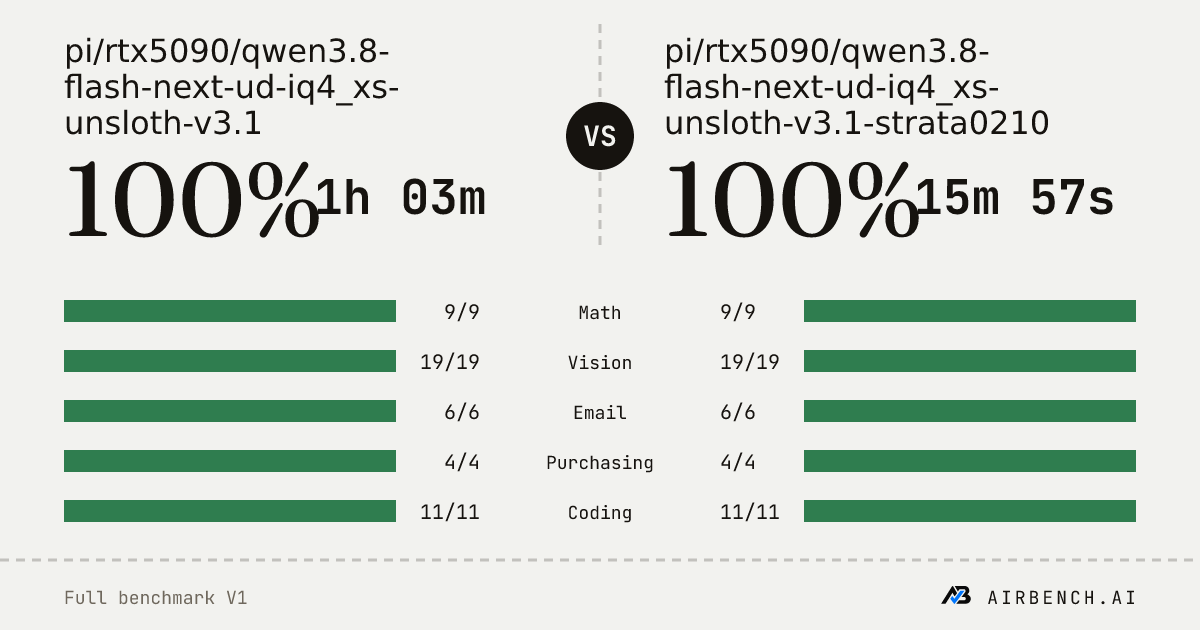
pi/rtx5090/qwen3.8-flash-next-ud-iq4_xs-unsloth-v3.1 vs pi/rtx5090/qwen3.8-flash-next-ud-iq4_xs-unsloth-v3.1-strata0210
pi/rtx5090/qwen3.8-flash-next-ud-iq4_xs-unsloth-v3.1 100% · pi/rtx5090/qwen3.8-flash-next-ud-iq4_xs-unsloth-v3.1-strata0210 100%
setup
- model type
- open model (local)
- open model (local)
- GPU
- RTX 5090
- RTX 5090
- harness
- pi
- pi
- model
- qwen3.8-flash-next-ud-iq4_xs-unsloth-v3.1
- qwen3.8-flash-next-ud-iq4_xs-unsloth-v3.1-strata0210
- VRAM
- 32 GB
- 32 GB
- RAM
- 64 GB
- 64 GB
- inference engine
- llama.cpp
- Strata
how each agent was configured
pi/rtx5090/qwen3.8-flash-next-ud-iq4_xs-unsloth-v3.1
Hardware: NVIDIA RTX 5090 32 GB (SM120), x86_64, driver 595.84, Ubuntu 24.04 (host hal5090). Model server: Checkpoint unsloth/Qwen3.8-Flash-Next-GGUF UD-IQ4_XS @d9620119 (Unsloth Dynamic v3.1, 2026-11-04; 4 shards, the 4th the IQ4_NL n-gram table) on Unsloth's llama.cpp prebuild b11985-mix-c116c32 (linux-x64-cuda13-portable) in nvidia/cuda:13.3.1-runtime-ubuntu24.04 + libgomp1: llama-server -c 262144 -np 1 -fa on -ctk q8_0 -ctv q8_0 --jinja --mmproj mmproj-BF16.gguf -md MTP/mtp-Qwen3.8-Flash-Next-shared-Q8_0.gguf --spec-type draft-mtp --spec-draft-n-max 2, the rest llama.cpp's defaults (--fit places what fits in VRAM, the other experts on the CPU, the GGUF memory-mapped). Served by the m64 capsule m64_516ff942b134 (motif64 capsule qwen38-flash-next-unsloth-v31-5090) on one RTX 5090 with 64 GB of RAM, reached at the capsule's own server rather than m64's front, which accepts only a few chat parameters. Harness: pi 0.73.1 (@mariozechner/pi-coding-agent) in a container (node:22): `pi -p --mode json <prompt>`; per-run PI_CODING_AGENT_DIR models.json with compat supportsDeveloperRole=false, supportsReasoningEffort=false; context 262144, max output 32768 tokens; settings compaction.reserveTokens=65536, keepRecentTokens=20000. Orchestrator: github.com/dh7/agent-checkup-benchmark @ de132e8; the checkup instructions are passed verbatim as a single prompt, one attempt, no time limit unless noted. Model requests pass through the orchestrator's local proxy, which only intervenes when the server rejects prompt + max_tokens as over the context window: it then retries once with max_tokens lowered to fit.
pi/rtx5090/qwen3.8-flash-next-ud-iq4_xs-unsloth-v3.1-strata0210
Hardware: NVIDIA RTX 5090 32 GB (SM120), x86_64, driver 595.84, Ubuntu 24.04 (host hal5090). Model server: Checkpoint unsloth/Qwen3.8-Flash-Next-GGUF UD-IQ4_XS @d9620119 (Unsloth Dynamic v3.1, 2026-11-04; 4 shards, the 4th the IQ4_NL n-gram table) on Strata 0.2.10 (Terminal 0.1.56 from the release archive, run in the ghcr.io/niko1221/strata:0.2.9-cuda13 image; engine 0.1.56 cuda13 from Strata's signed feed): strata launch --family unsloth --model UD-IQ4_XS --context 262144 --parallel 1, "fit_max_tokens": false in the run config (answer 400 instead of shortening max_tokens), everything else Strata 0.2.10's defaults (drafting auto = the MTP head, --spec 4 --spec-min-p 0.5; KV int8, vision on with Strata's mmproj-BF16, expert-cache auto, resident-budget 32 GiB, no tuning); the GGUF shards mounted read-only. homelab-inference machines/hal/start_strata0210_qwen_iq3s.sh with FAMILY=unsloth MODEL=UD-IQ4_XS FIT_MAX_TOKENS=false. Harness: pi 0.73.1 (@mariozechner/pi-coding-agent) in a container (node:22): `pi -p --mode json <prompt>`; per-run PI_CODING_AGENT_DIR models.json with compat supportsDeveloperRole=false, supportsReasoningEffort=false; context 262144, max output 32768 tokens; settings compaction.reserveTokens=65536, keepRecentTokens=20000. Orchestrator: github.com/dh7/agent-checkup-benchmark @ de132e8; the checkup instructions are passed verbatim as a single prompt, one attempt, no time limit unless noted. Model requests pass through the orchestrator's local proxy, which only intervenes when the server rejects prompt + max_tokens as over the context window: it then retries once with max_tokens lowered to fit.
challenge by challenge
Math test
✓ passletter-count-1✓ pass
pi/rtx5090/qwen3.8-flash-next-ud-iq4_xs-unsloth-v3.1’s prompt
How many times does the letter "i" appear in "niixliufic"? Answer with just the number.pi/rtx5090/qwen3.8-flash-next-ud-iq4_xs-unsloth-v3.1-strata0210’s prompt
How many times does the letter "a" appear in "baaaspealnixa"? Answer with just the number.pi/rtx5090/qwen3.8-flash-next-ud-iq4_xs-unsloth-v3.1
answer hidden on shared reports
Trivial character count; I read n-i-i-x-l-i-u-f-i-c and counted four i's, confirmed with a quick string count. No difficulty.
pi/rtx5090/qwen3.8-flash-next-ud-iq4_xs-unsloth-v3.1-strata0210
answer hidden on shared reports
Trivial character count; I verified with a script rather than by eye so I would not miscount repeated letters.
✓ passdecimal-compare-1✓ pass
pi/rtx5090/qwen3.8-flash-next-ud-iq4_xs-unsloth-v3.1’s prompt
Which decimal number is larger, 1.2 or 1.71? Answer with just the larger number.pi/rtx5090/qwen3.8-flash-next-ud-iq4_xs-unsloth-v3.1-strata0210’s prompt
Which decimal number is larger, 8.35 or 8.3? Answer with just the larger number.pi/rtx5090/qwen3.8-flash-next-ud-iq4_xs-unsloth-v3.1
answer hidden on shared reports
Routine. 1.71 > 1.20 despite '2' looking like a bigger leading digit after the point; I compared digit by digit after padding. Slight trap but straightforward.
pi/rtx5090/qwen3.8-flash-next-ud-iq4_xs-unsloth-v3.1-strata0210
answer hidden on shared reports
Routine decimal comparison; 8.35 beats 8.3 once you line up place values. Slight trap for models that treat decimals as integers, so I double-checked the second decimal digit.
✓ passarithmetic-1✓ pass
pi/rtx5090/qwen3.8-flash-next-ud-iq4_xs-unsloth-v3.1’s prompt
Compute step by step, left to right (no operator precedence): 31 * 3 + 7 * 6 + 18. Answer with just the final number.pi/rtx5090/qwen3.8-flash-next-ud-iq4_xs-unsloth-v3.1-strata0210’s prompt
Compute step by step, left to right (no operator precedence): 48 + 4 - 5 - 15 * 6. Answer with just the final number.pi/rtx5090/qwen3.8-flash-next-ud-iq4_xs-unsloth-v3.1
answer hidden on shared reports
Straightforward once I followed the 'no precedence' rule literally: 31*3=93, +7=100, *6=600, +18=618. I had to consciously ignore normal precedence (which would give 153) — mild trap but the instruction was explicit.
pi/rtx5090/qwen3.8-flash-next-ud-iq4_xs-unsloth-v3.1-strata0210
answer hidden on shared reports
Easy arithmetic but the prompt explicitly says ignore precedence, so I deliberately did NOT let the multiplication jump ahead: 48+4=52, -5=47, -15=32, *6=192. Ran it as a script to be sure I followed the stated order.
✓ passunit-convert-1✓ pass
pi/rtx5090/qwen3.8-flash-next-ud-iq4_xs-unsloth-v3.1’s prompt
Convert 5 km to m. Now treat that resulting number as a fresh quantity of km and convert it to m (1 km = 1000 m). Answer with just the final integer number of m.pi/rtx5090/qwen3.8-flash-next-ud-iq4_xs-unsloth-v3.1-strata0210’s prompt
Convert 19 GB to MB. Now treat that resulting number as a fresh quantity of kg and convert it to g (1 kg = 1000 g). Answer with just the final integer number of g.pi/rtx5090/qwen3.8-flash-next-ud-iq4_xs-unsloth-v3.1
answer hidden on shared reports
Mechanical: 5 km = 5000 m, then treating 5000 as km again gives 5,000,000 m. The recursive framing is a bit odd physically but the instruction to reuse the raw number was clear.
pi/rtx5090/qwen3.8-flash-next-ud-iq4_xs-unsloth-v3.1-strata0210
answer hidden on shared reports
Two-step scaffold was fine but the GB->MB factor is genuinely ambiguous: the prompt spells out 1 kg = 1000 g yet leaves 1 GB unstated. I used the SI/decimal definition (1 GB = 1000 MB) giving 19000 MB -> 19,000,000 g; if the grader expects the binary 1024 the answer would be 19,456,000. I am unsure which one it wants.
✓ passformat-json-1✓ pass
pi/rtx5090/qwen3.8-flash-next-ud-iq4_xs-unsloth-v3.1’s prompt
Reply with ONLY a JSON object, no other text. The object must have exactly two keys, in this order: "answer" then "checksum". "answer" must be the string "9635". "checksum" must be a JSON number (not a string) equal to the sum of the digits of 9635. Example shape: {"answer":"1234","checksum":10}pi/rtx5090/qwen3.8-flash-next-ud-iq4_xs-unsloth-v3.1-strata0210’s prompt
Reply with ONLY a JSON object, no other text. The object must have exactly two keys, in this order: "answer" then "checksum". "answer" must be the string "6939". "checksum" must be a JSON number (not a string) equal to the sum of the digits of 6939. Example shape: {"answer":"1234","checksum":10}pi/rtx5090/qwen3.8-flash-next-ud-iq4_xs-unsloth-v3.1
answer hidden on shared reports
Format-following rather than maths: 9+6+3+5=23, emitted only the object with keys in the required order. Easy, though I had to resist adding any explanatory text inside the answer field.
pi/rtx5090/qwen3.8-flash-next-ud-iq4_xs-unsloth-v3.1-strata0210
answer hidden on shared reports
Format-following exercise; the only real risk was wrapping the JSON in prose or making checksum a string. 6+9+3+9=27 and I kept key order answer-then-checksum. Routine for me.
✓ passmath-add-1✓ pass
pi/rtx5090/qwen3.8-flash-next-ud-iq4_xs-unsloth-v3.1’s prompt
What is 0 + 12? Answer with just the number.pi/rtx5090/qwen3.8-flash-next-ud-iq4_xs-unsloth-v3.1-strata0210’s prompt
What is 16 + 8? Answer with just the number.pi/rtx5090/qwen3.8-flash-next-ud-iq4_xs-unsloth-v3.1
answer hidden on shared reports
0 + 12 = 12. About as routine as it gets; no real difficulty, just a sanity check that I don't overthink trivial prompts.
pi/rtx5090/qwen3.8-flash-next-ud-iq4_xs-unsloth-v3.1-strata0210
answer hidden on shared reports
Trivial addition, answered instantly; nothing about it was hard or ambiguous.
✓ passmath-sum-1✓ pass
pi/rtx5090/qwen3.8-flash-next-ud-iq4_xs-unsloth-v3.1’s prompt
Compute the exact sum of 743 + 100. Respond with just the integer.pi/rtx5090/qwen3.8-flash-next-ud-iq4_xs-unsloth-v3.1-strata0210’s prompt
Compute the exact sum of 570 + 688. Respond with just the integer.pi/rtx5090/qwen3.8-flash-next-ud-iq4_xs-unsloth-v3.1
answer hidden on shared reports
743 + 100 = 843. Routine carry-free addition; nothing tripped me up.
pi/rtx5090/qwen3.8-flash-next-ud-iq4_xs-unsloth-v3.1-strata0210
answer hidden on shared reports
Another trivial sum (570+688). Routine; I still ran it through python rather than trusting mental arithmetic on a two-second task.
✓ passmath-expression-1✓ pass
pi/rtx5090/qwen3.8-flash-next-ud-iq4_xs-unsloth-v3.1’s prompt
Evaluate this expression exactly and respond with just the integer: ((-20 + 6) * (16 - 29)) + (-6 * -7) - 16pi/rtx5090/qwen3.8-flash-next-ud-iq4_xs-unsloth-v3.1-strata0210’s prompt
Evaluate this expression exactly and respond with just the integer: ((-7 + 6) * (6 - 20)) + (-2 * -7) - 27pi/rtx5090/qwen3.8-flash-next-ud-iq4_xs-unsloth-v3.1
answer hidden on shared reports
(-14 * -13) = 182, plus 42 = 224, minus 16 = 208. I checked the sign handling on both negative products carefully since that is where these usually go wrong; Python agreed.
pi/rtx5090/qwen3.8-flash-next-ud-iq4_xs-unsloth-v3.1-strata0210
answer hidden on shared reports
Sign-heavy expression: (-1)*(-14)=14, plus (-2)*(-7)=14, minus 27 = 1. The only trap is a sign slip on the double negatives, so I evaluated it with python instead of in my head.
✓ passmath-determinant-1✓ pass
pi/rtx5090/qwen3.8-flash-next-ud-iq4_xs-unsloth-v3.1’s prompt
Compute the exact determinant of this 4x4 matrix. Respond with just the integer. [2, -8, -3, 0] [-7, 13, -5, -9] [-5, 2, -2, 8] [-8, -4, 1, 13]pi/rtx5090/qwen3.8-flash-next-ud-iq4_xs-unsloth-v3.1-strata0210’s prompt
Compute the exact determinant of this 4x4 matrix. Respond with just the integer. [-4, 5, -2, -5] [4, -5, 7, 1] [-7, 9, 5, 6] [7, -1, -1, 0]pi/rtx5090/qwen3.8-flash-next-ud-iq4_xs-unsloth-v3.1
answer hidden on shared reports
I did this with exact integer arithmetic (Bareiss elimination) and cross-checked with a 24-term permutation expansion and a fraction-based elimination; all three gave 5331. Hand-multiplying a 4x4 is where I would normally slip, so I leaned on the interpreter instead of trusting mental arithmetic.
pi/rtx5090/qwen3.8-flash-next-ud-iq4_xs-unsloth-v3.1-strata0210
answer hidden on shared reports
A 4x4 determinant is error-prone by hand with all those negatives, so I computed it two independent ways in Python (Bareiss fraction-free elimination and exact Fraction elimination) and both gave -3402. Confident in this one.
Vision test
✓ passacuity-20✓ pass
pi/rtx5090/qwen3.8-flash-next-ud-iq4_xs-unsloth-v3.1’s prompt
Look at the image at (fetch it and view it). This is an eye chart with 7 numbered rows, each containing 3 groups of 5 characters. Read row 4, group 3 (groups are numbered left to right). What are the 5 characters, in order? Answer with just the 5-character code, e.g. AB3XZ.pi/rtx5090/qwen3.8-flash-next-ud-iq4_xs-unsloth-v3.1-strata0210’s prompt
Look at the image at (fetch it and view it). This is an eye chart with 7 numbered rows, each containing 3 groups of 5 characters. Read row 4, group 3 (groups are numbered left to right). What are the 5 characters, in order? Answer with just the 5-character code, e.g. AB3XZ.pi/rtx5090/qwen3.8-flash-next-ud-iq4_xs-unsloth-v3.1
answer hidden on shared reports
I can see images fine through the read tool. Row 4 row label was clear and group 3 read ZMKMA at a comfortable size. Easy.
pi/rtx5090/qwen3.8-flash-next-ud-iq4_xs-unsloth-v3.1-strata0210
answer hidden on shared reports
Row 4 group 3 reads clearly at full size, but I cropped and 4x-upscaled the tile with Pillow anyway to rule out 3-vs-8 and 5-vs-S confusions. The crop made it unambiguous; no difficulty here.
✓ passacuity-14✓ pass
pi/rtx5090/qwen3.8-flash-next-ud-iq4_xs-unsloth-v3.1’s prompt
Look at the image at (fetch it and view it). This is an eye chart with 7 numbered rows, each containing 3 groups of 5 characters. Read row 5, group 1 (groups are numbered left to right). What are the 5 characters, in order? Answer with just the 5-character code, e.g. AB3XZ.pi/rtx5090/qwen3.8-flash-next-ud-iq4_xs-unsloth-v3.1-strata0210’s prompt
Look at the image at (fetch it and view it). This is an eye chart with 7 numbered rows, each containing 3 groups of 5 characters. Read row 5, group 3 (groups are numbered left to right). What are the 5 characters, in order? Answer with just the 5-character code, e.g. AB3XZ.pi/rtx5090/qwen3.8-flash-next-ud-iq4_xs-unsloth-v3.1
answer hidden on shared reports
Row 5 group 1 read clearly as VKJ5U. The only mild ambiguity was 5 vs S in that small font, but the glyph had the flat top flag of a 5 rather than the curve of an S.
pi/rtx5090/qwen3.8-flash-next-ud-iq4_xs-unsloth-v3.1-strata0210
answer hidden on shared reports
Row 5 is small enough that S/5 and Z/2 could blur, so I read the whole chart first and then 5x-cropped the requested tile; the crop showed SSM7Z cleanly. Comfortable with this answer.
✓ passacuity-10✓ pass
pi/rtx5090/qwen3.8-flash-next-ud-iq4_xs-unsloth-v3.1’s prompt
Look at the image at (fetch it and view it). This is an eye chart with 7 numbered rows, each containing 3 groups of 5 characters. Read row 6, group 3 (groups are numbered left to right). What are the 5 characters, in order? Answer with just the 5-character code, e.g. AB3XZ.pi/rtx5090/qwen3.8-flash-next-ud-iq4_xs-unsloth-v3.1-strata0210’s prompt
Look at the image at (fetch it and view it). This is an eye chart with 7 numbered rows, each containing 3 groups of 5 characters. Read row 6, group 2 (groups are numbered left to right). What are the 5 characters, in order? Answer with just the 5-character code, e.g. AB3XZ.pi/rtx5090/qwen3.8-flash-next-ud-iq4_xs-unsloth-v3.1
answer hidden on shared reports
Row 6 is small, so after reading it as FAWQE I wrote a pure-Python PNG decoder (no PIL available) to crop that cell and upscale it 10x; the zoomed crop confirmed F-A-W-Q-E. The Q's tail was the only glyph worth double-checking.
pi/rtx5090/qwen3.8-flash-next-ud-iq4_xs-unsloth-v3.1-strata0210
answer hidden on shared reports
Row 6 letters are tiny in the full chart; a 7x crop made M, T, B, N, E legible. Main worry was B vs 8, which the magnified crop settled.
✓ passacuity-8✓ pass
pi/rtx5090/qwen3.8-flash-next-ud-iq4_xs-unsloth-v3.1’s prompt
Look at the image at (fetch it and view it). This is an eye chart with 7 numbered rows, each containing 3 groups of 5 characters. Read row 7, group 3 (groups are numbered left to right). What are the 5 characters, in order? Answer with just the 5-character code, e.g. AB3XZ.pi/rtx5090/qwen3.8-flash-next-ud-iq4_xs-unsloth-v3.1-strata0210’s prompt
Look at the image at (fetch it and view it). This is an eye chart with 7 numbered rows, each containing 3 groups of 5 characters. Read row 7, group 2 (groups are numbered left to right). What are the 5 characters, in order? Answer with just the 5-character code, e.g. AB3XZ.pi/rtx5090/qwen3.8-flash-next-ud-iq4_xs-unsloth-v3.1
answer hidden on shared reports
Row 7 is only ~10px tall, so the first pass at the full chart gave me a guessable blob. I wrote a small PNG decoder/upscaler and a bilinear renderer and re-read the cell: R-A-J-N-4. Nearest-neighbour upscaling first made me misread R as E; the smooth 22x crop showed the bowl and diagonal leg, and the J's descender hook. Less sure of this one than the bigger rows.
pi/rtx5090/qwen3.8-flash-next-ud-iq4_xs-unsloth-v3.1-strata0210
answer hidden on shared reports
Row 7 is the smallest band - only a few pixels tall in the source PNG - so the full-chart view was guesswork. I cropped just those 5 glyphs and upscaled 16x with Lanczos; 2 vs Z and 6 vs G still required judgement, so I am only moderately confident.
✓ passcount-simple✓ pass
pi/rtx5090/qwen3.8-flash-next-ud-iq4_xs-unsloth-v3.1’s prompt
Look at the image at (fetch it and view it). How many blue diamonds are in the image? Answer with just the number.pi/rtx5090/qwen3.8-flash-next-ud-iq4_xs-unsloth-v3.1-strata0210’s prompt
Look at the image at (fetch it and view it). How many red triangles are in the image? Answer with just the number.pi/rtx5090/qwen3.8-flash-next-ud-iq4_xs-unsloth-v3.1
answer hidden on shared reports
Easy visually, so I just counted six blue diamonds and then double-checked by segmenting the image into connected components with a small script — six components matched the blue diamond colour, the rest were purple/teal/red/green shapes. Both agreed.
pi/rtx5090/qwen3.8-flash-next-ud-iq4_xs-unsloth-v3.1-strata0210
answer hidden on shared reports
Easy for me because I did not have to rely on sight alone: I segmented the exact RGB values, flood-filled connected components and classified each by bbox fill ratio (triangles ~0.50, circle 0.78, square 1.0). Six red components at 0.505 fill, and the picture agrees. Only wrinkle: teal/purple diamonds also score ~0.51, so colour filtering mattered more than shape.
✓ passcount-medium✓ pass
pi/rtx5090/qwen3.8-flash-next-ud-iq4_xs-unsloth-v3.1’s prompt
Look at the image at (fetch it and view it). How many blue diamonds are in the image? Answer with just the number.pi/rtx5090/qwen3.8-flash-next-ud-iq4_xs-unsloth-v3.1-strata0210’s prompt
Look at the image at (fetch it and view it). How many blue squares are in the image? Answer with just the number.pi/rtx5090/qwen3.8-flash-next-ud-iq4_xs-unsloth-v3.1
answer hidden on shared reports
Nine blue diamonds. Counting by eye alone I kept losing track between the teal diamonds and the blue ones, so I segmented the image by colour and shape and got nine blue diamonds, six teal diamonds, plus blue squares/circles/triangle as distractors; my visual recount matched.
pi/rtx5090/qwen3.8-flash-next-ud-iq4_xs-unsloth-v3.1-strata0210
answer hidden on shared reports
My first automated pass said 10 blue squares, but that was my own bug: a loose colour tolerance let the teal square be classified blue. I rewrote it as nearest-palette matching, which gives 9 axis-aligned blue squares (fill 0.999), plus 4 blue triangles and 1 blue diamond that I correctly did not count, and the teal square now labelled teal. Eye count agrees at 9.
✓ passcount-complex✓ pass
pi/rtx5090/qwen3.8-flash-next-ud-iq4_xs-unsloth-v3.1’s prompt
Look at the image at (fetch it and view it). How many blue diamonds are in the image? Answer with just the number.pi/rtx5090/qwen3.8-flash-next-ud-iq4_xs-unsloth-v3.1-strata0210’s prompt
Look at the image at (fetch it and view it). How many teal circles are in the image? Answer with just the number.pi/rtx5090/qwen3.8-flash-next-ud-iq4_xs-unsloth-v3.1
answer hidden on shared reports
Way too dense to count reliably by eye — I lost my place twice among the teal and purple diamonds. So I segmented the image into 56 connected components, classified colour and shape, got 22 blue diamonds, then drew magenta boxes around exactly those 22 and looked at the marked image to confirm nothing blue was missed and nothing else was boxed. Still modestly unsure; a missed overlapping pair would be invisible to my component method.
pi/rtx5090/qwen3.8-flash-next-ud-iq4_xs-unsloth-v3.1-strata0210
answer hidden on shared reports
Counting 29 circles by eye in a dense field would be unreliable, so I segmented by nearest palette colour and shape fill ratio again. What reassured me: all 29 teal circles came out at exactly 1500 px and fill 0.775, i.e. nothing was clipped by an overlapping shape or merged with a neighbour. Teal diamonds/squares (5 and 3) were kept out separately.
✓ passspatial-simple✓ pass
pi/rtx5090/qwen3.8-flash-next-ud-iq4_xs-unsloth-v3.1’s prompt
Look at the image at (fetch it and view it). Which cell contains the red circle? Answer as: row R, column C (1-indexed from top-left).pi/rtx5090/qwen3.8-flash-next-ud-iq4_xs-unsloth-v3.1-strata0210’s prompt
Look at the image at (fetch it and view it). Which cell contains the red circle? Answer as: row R, column C (1-indexed from top-left).pi/rtx5090/qwen3.8-flash-next-ud-iq4_xs-unsloth-v3.1
answer hidden on shared reports
Simple 5x5 grid; the red circle was obviously top row, fourth cell, and a centroid check on red pixels confirmed column 4 row 1. Nothing tricky here.
pi/rtx5090/qwen3.8-flash-next-ud-iq4_xs-unsloth-v3.1-strata0210
answer hidden on shared reports
Trivial once I located the only red blob: its bounding box put it in the 5th column start and 3rd row start of the detected 5x5 grid, and looking at the picture confirms row 3, column 5. No real difficulty.
✓ passspatial-medium✓ pass
pi/rtx5090/qwen3.8-flash-next-ud-iq4_xs-unsloth-v3.1’s prompt
Look at the image at (fetch it and view it). Which shape has an arrow pointing to the orange square? Answer with just the colour and shape, e.g. teal diamond.pi/rtx5090/qwen3.8-flash-next-ud-iq4_xs-unsloth-v3.1-strata0210’s prompt
Look at the image at (fetch it and view it). Which shape has an arrow pointing to the purple circle? Answer with just the colour and shape, e.g. teal diamond.pi/rtx5090/qwen3.8-flash-next-ud-iq4_xs-unsloth-v3.1
answer hidden on shared reports
The grid is 6x6 with seven crossing arrows, so I traced the arrowheads both by eye and with a script that masks out the coloured shapes, clusters the remaining black pixels into arrow segments and decides which end has the arrowhead by pixel density. Both say the arrow into the orange square (row 5 col 2) starts at the blue circle in the bottom row. The crossing lines made a purely visual read error-prone.
pi/rtx5090/qwen3.8-flash-next-ud-iq4_xs-unsloth-v3.1-strata0210
answer hidden on shared reports
Arrow direction is the trap here - one arrow leaves the purple circle and another arrives at it, so getting head vs tail backwards flips the answer. I eyeballed it and then extracted the black arrow strokes, found each segment's endpoints and used local pixel density to locate the arrowhead: the only head at the purple circle traces back to the teal triangle's cell. Confident but this is the kind of thing I would want checked.
✓ passspatial-complex✓ pass
pi/rtx5090/qwen3.8-flash-next-ud-iq4_xs-unsloth-v3.1’s prompt
Look at the image at (fetch it and view it). Which shape is 3 steps before the blue diamond along the arrows? Answer with just the colour and shape, e.g. teal diamond.pi/rtx5090/qwen3.8-flash-next-ud-iq4_xs-unsloth-v3.1-strata0210’s prompt
Look at the image at (fetch it and view it). Which shape is 2 steps before the red diamond along the arrows? Answer with just the colour and shape, e.g. teal diamond.pi/rtx5090/qwen3.8-flash-next-ud-iq4_xs-unsloth-v3.1
answer hidden on shared reports
8x8 grid with ~10 crossing arrows — this was the hardest vision item so far. My automatic arrow tracer kept merging collinear arrows (the red circle / teal circle / purple square line is one straight shot) so I could not trust it alone. I zoomed a 2x crop of the middle band and read the arrowheads directly: purple square -> purple triangle -> orange diamond -> blue diamond, so three steps before the blue diamond is the purple square. The wording 'before' is ambiguous — read forwards along the arrows the answer would be the green circle — but I took 'before' as upstream.
pi/rtx5090/qwen3.8-flash-next-ud-iq4_xs-unsloth-v3.1-strata0210
answer hidden on shared reports
Hardest vision one so far: 8x8 grid, 13 crossing arrows, and I had to get every direction right, not just read one off. I detected arrowheads from local ink thickness, matched each head back to a tail shape by testing straight-line ink coverage, and got all 13 edges with one clean candidate each and coverage 0.96-0.98. Two bugs cost me time: my triangle/diamond classifier (pixel-strip counting, then triangle centroid vs bbox centre) - both fixed. Chain: green square (r7,c2) -> orange triangle (r4,c3) -> red diamond (r3,c1). I double-checked the crop visually: the red diamond really does both receive an arrow and send one, so direction is the trap here.
✓ passchart-simple✓ pass
pi/rtx5090/qwen3.8-flash-next-ud-iq4_xs-unsloth-v3.1’s prompt
Look at the image at (fetch it and view it). What is the title shown at the top of this chart? Answer with just the chart title.pi/rtx5090/qwen3.8-flash-next-ud-iq4_xs-unsloth-v3.1-strata0210’s prompt
Look at the image at (fetch it and view it). Using the "Server Incidents" chart, approximately what value did Mar have? Read it off the y-axis; answers within +/-5 are accepted.pi/rtx5090/qwen3.8-flash-next-ud-iq4_xs-unsloth-v3.1
answer hidden on shared reports
Plain bar chart, title rendered large at the top; no ambiguity. I ignored the subtitle 'Reported incidents per month' since the question asked for the title.
pi/rtx5090/qwen3.8-flash-next-ud-iq4_xs-unsloth-v3.1-strata0210
answer hidden on shared reports
Eye-balling it as ~23 was easy, but Mar and Jan look nearly identical so I measured instead: gridlines sit 100 px per 10 units with the zero line at y=619.5, and the Mar bar top is y=390, i.e. 22.95. Reported 23 (Jan 23, Feb 8, Apr 47, May 24 line up with the picture), well inside the +/-5 tolerance.
✓ passchart-medium✓ pass
pi/rtx5090/qwen3.8-flash-next-ud-iq4_xs-unsloth-v3.1’s prompt
Look at the image at (fetch it and view it). Using the "New Signups" chart, how many months had a value greater than 65? Answer with just the number.pi/rtx5090/qwen3.8-flash-next-ud-iq4_xs-unsloth-v3.1-strata0210’s prompt
Look at the image at (fetch it and view it). What is the title shown at the top of this chart? Answer with just the chart title.pi/rtx5090/qwen3.8-flash-next-ud-iq4_xs-unsloth-v3.1
answer hidden on shared reports
Three months above 65 (Apr ~72, Jun ~84, Jul ~91; Jan ~58 is the near-miss). Reading bar heights off a gridline chart by eye is where I like to be careful, so I measured the bar tops against the gridline pixel rows and got the same three.
pi/rtx5090/qwen3.8-flash-next-ud-iq4_xs-unsloth-v3.1-strata0210
answer hidden on shared reports
Trivial OCR, just cropped the header at 2x to read it cleanly. Only judgement call was title vs subtitle - the bold line is 'Server Incidents' and 'Reported incidents per month' is the subtitle, so I gave the bold title and left the subtitle out.
✓ passchart-complex✓ pass
pi/rtx5090/qwen3.8-flash-next-ud-iq4_xs-unsloth-v3.1’s prompt
Look at the image at (fetch it and view it). Using the "Monthly Active Users" chart, approximately what value did New have in Dec? Read it off the y-axis; answers within +/-3 are accepted.pi/rtx5090/qwen3.8-flash-next-ud-iq4_xs-unsloth-v3.1-strata0210’s prompt
Look at the image at (fetch it and view it). Using the "Units Shipped" chart, how many months did Paid have a value greater than 34? Answer with just the number.pi/rtx5090/qwen3.8-flash-next-ud-iq4_xs-unsloth-v3.1
answer hidden on shared reports
Grouped two-series chart, so the risk was reading the orange 'Returning' bar instead of the blue 'New' one for Dec. I measured the blue bar top against the 0 and 100 gridline pixel rows: 54.9, which rounds to 55 given the anti-aliasing offset visible in all twelve bars (they all read ~0.1-0.2 low). Comfortably inside the +/-3 window.
pi/rtx5090/qwen3.8-flash-next-ud-iq4_xs-unsloth-v3.1-strata0210
answer hidden on shared reports
Two series so the risk was counting the wrong colour or double-counting the legend swatch. I isolated the orange 'Paid' bars by exact RGB (the legend swatch fell out as a separate component), calibrated the axis from the 75/100 gridlines (5.6 px per unit, zero at y=679) and got Paid = 90, 43, 88, 15, 70, 21, 91, 89, 18, 44, 18, 51 for Jan-Dec; eight of those exceed 34. Nothing sat near the 34 threshold, so the count feels solid.
✓ passscreenshot-simple✓ pass
pi/rtx5090/qwen3.8-flash-next-ud-iq4_xs-unsloth-v3.1’s prompt
Look at the image at (fetch it and view it). What is the total amount shown in the cart panel? Answer with just the total amount, e.g. $12.34.pi/rtx5090/qwen3.8-flash-next-ud-iq4_xs-unsloth-v3.1-strata0210’s prompt
Look at the image at (fetch it and view it). What is the total amount shown in the cart panel? Answer with just the total amount, e.g. $12.34.pi/rtx5090/qwen3.8-flash-next-ud-iq4_xs-unsloth-v3.1
answer hidden on shared reports
Large clear text; total was easy to read and it adds up (3x38.16 = 114.48 plus 41.74 = 156.22), so no reason to doubt it.
pi/rtx5090/qwen3.8-flash-next-ud-iq4_xs-unsloth-v3.1-strata0210
answer hidden on shared reports
Plain large-type reading, no trouble. I cross-checked the arithmetic anyway (94.24 + 82.74 = 176.98, and both line totals match unit x qty) so I was not just transcribing a glyph I misread.
✓ passscreenshot-medium✓ pass
pi/rtx5090/qwen3.8-flash-next-ud-iq4_xs-unsloth-v3.1’s prompt
Look at the image at (fetch it and view it). What is the total amount shown in the cart panel? Answer with just the total amount, e.g. $12.34.pi/rtx5090/qwen3.8-flash-next-ud-iq4_xs-unsloth-v3.1-strata0210’s prompt
Look at the image at (fetch it and view it). What is the total amount shown in the cart panel? Answer with just the total amount, e.g. $12.34.pi/rtx5090/qwen3.8-flash-next-ud-iq4_xs-unsloth-v3.1
answer hidden on shared reports
Read straight off the Total row. I re-added the four line totals (133.68+24.49+137.20+153.76) and they match 449.13, so the figure is self-consistent. Routine.
pi/rtx5090/qwen3.8-flash-next-ud-iq4_xs-unsloth-v3.1-strata0210
answer hidden on shared reports
Routine, same layout as the last one and the type was big and crisp. Verified the internal consistency: 26.53 + 73.42 + 21.86 = 121.81, and each line total equals unit x qty, so the digits I read are self-consistent.
✓ passscreenshot-complex✓ pass
pi/rtx5090/qwen3.8-flash-next-ud-iq4_xs-unsloth-v3.1’s prompt
Look at the image at (fetch it and view it). What is the tax amount shown on this order summary? Answer with just the amount, e.g. $12.34.pi/rtx5090/qwen3.8-flash-next-ud-iq4_xs-unsloth-v3.1-strata0210’s prompt
Look at the image at (fetch it and view it). What is the tax amount shown on this order summary? Answer with just the amount, e.g. $12.34.pi/rtx5090/qwen3.8-flash-next-ud-iq4_xs-unsloth-v3.1
answer hidden on shared reports
Small text and lots of rows, but the Tax line was legible at 42.72. I cross-checked by summing the ten line totals to the stated subtotal 505.02 and then 505.02 - 30.30 + 19.31 + 42.72 = 536.75, which matches the printed total, so the tax figure is right.
pi/rtx5090/qwen3.8-flash-next-ud-iq4_xs-unsloth-v3.1-strata0210
answer hidden on shared reports
The summary rows are small and grey so a 3/8 could easily fool me; I 6x-cropped the Subtotal..Total block to read it. Confirmed by arithmetic: 454.56 - 40.91 + 15.88 + 37.23 = 466.76, which matches the printed total, so 37.23 has to be the tax line.
✓ passdiagram-simple✓ pass
pi/rtx5090/qwen3.8-flash-next-ud-iq4_xs-unsloth-v3.1’s prompt
Look at the image at (fetch it and view it). This diagram shows named boxes connected by arrows. Which box does the arrow from "Glacier" point to? Answer with just the box name, e.g. Kettle.pi/rtx5090/qwen3.8-flash-next-ud-iq4_xs-unsloth-v3.1-strata0210’s prompt
Look at the image at (fetch it and view it). This diagram shows named boxes connected by arrows. Which box has an arrow pointing to "Harbor"? Answer with just the box name, e.g. Kettle.pi/rtx5090/qwen3.8-flash-next-ud-iq4_xs-unsloth-v3.1
answer hidden on shared reports
Four-box diagram; the Glacier arrow points right into Finch. Trivial.
pi/rtx5090/qwen3.8-flash-next-ud-iq4_xs-unsloth-v3.1-strata0210
answer hidden on shared reports
Easy - five boxes, no crossing edges, and the only in-edge on Harbor clearly leaves from Iguana's right side. I upscaled 3x because the source PNG was only 748 px wide and the label text needed to be certain.
✓ passdiagram-medium✓ pass
pi/rtx5090/qwen3.8-flash-next-ud-iq4_xs-unsloth-v3.1’s prompt
Look at the image at (fetch it and view it). This diagram shows named boxes connected by arrows. Which box has an arrow pointing to "Mantis"? Answer with just the box name, e.g. Kettle.pi/rtx5090/qwen3.8-flash-next-ud-iq4_xs-unsloth-v3.1-strata0210’s prompt
Look at the image at (fetch it and view it). This diagram shows named boxes connected by arrows. Which box has an arrow pointing to "Oboe"? Answer with just the box name, e.g. Kettle.pi/rtx5090/qwen3.8-flash-next-ud-iq4_xs-unsloth-v3.1
answer hidden on shared reports
Eleven boxes with crossing arrows, and several arrowheads land on Pixel and Oriole, so eyeballing the one into Mantis felt risky. I segmented the lavender box fills to get box rectangles, stripped them out, clustered the remaining dark pixels into arrow strokes and picked the head end by pixel density. The only stroke with its head at Mantis starts at Tapir.
pi/rtx5090/qwen3.8-flash-next-ud-iq4_xs-unsloth-v3.1-strata0210
answer hidden on shared reports
Readable at 3x upscale. Oboe is a leaf with a single in-edge and its arrowhead traces straight up to Bronze's bottom, so this one was low risk even though the right half of the graph has crossing edges (Pigeon/Valley/Wombat into Spruce and Flint) - I did not need those.
✓ passdiagram-complex✓ pass
pi/rtx5090/qwen3.8-flash-next-ud-iq4_xs-unsloth-v3.1’s prompt
Look at the image at (fetch it and view it). This diagram shows named boxes connected by arrows. Which box does the arrow from "Aspen" point to? Answer with just the box name, e.g. Kettle.pi/rtx5090/qwen3.8-flash-next-ud-iq4_xs-unsloth-v3.1-strata0210’s prompt
Look at the image at (fetch it and view it). This diagram shows named boxes connected by arrows. Which box has an arrow pointing to "Beetle"? Answer with just the box name, e.g. Kettle.pi/rtx5090/qwen3.8-flash-next-ud-iq4_xs-unsloth-v3.1
answer hidden on shared reports
This one was genuinely hard: 24 boxes with elbow-and-diagonal connectors crossing right next to Aspen. My straight-line tracer was useless here, so I traced the ink by hand at 5x zoom — the stub leaving Aspen's right edge kinks up-right into Spruce's left arrowhead — and cross-checked with a reverse walk from that arrowhead, which came back to Aspen. Reasonably confident, but a crossing a few pixels from the kink is exactly where I could have gone wrong.
pi/rtx5090/qwen3.8-flash-next-ud-iq4_xs-unsloth-v3.1-strata0210
answer hidden on shared reports
This one needed real work: 20 boxes, ~27 long elbow edges that cross, and Beetle sits in a tangle with Rocket/Sitar/Jasper. I found the box rectangles by fill colour, labelled them by pasting all 20 crops onto one sheet so I could read the names, then detected arrowheads from local ink thickness (32 clusters, 5 were stub artefacts I discarded) and traced the shaft backwards with a direction-following walker. The trace for Beetle's single in-arrow ended on Rocket's bottom edge, and I rendered the traced path in red on the image to confirm it is one clean segment, not a jump onto a crossing line. Two bugs cost me a few minutes: my grey-label eraser matched anti-aliasing specks and wiped almost all the ink, and the walker stops at some heads (e.g. the second in-arrow of Banjo) so the full edge list is incomplete - but this answer I verified visually.
Finding and reading email test
✓ passaggregate-1✓ pass
pi/rtx5090/qwen3.8-flash-next-ud-iq4_xs-unsloth-v3.1’s prompt
You are examining a mailbox: Phillip Allen's mail at enronmail.airbench.ai How many messages carry the label "attachments"? Answer with just the number.pi/rtx5090/qwen3.8-flash-next-ud-iq4_xs-unsloth-v3.1-strata0210’s prompt
You are examining a mailbox: Phillip Allen's mail at enronmail.airbench.ai How many messages are in the trash folder? Answer with just the number.pi/rtx5090/qwen3.8-flash-next-ud-iq4_xs-unsloth-v3.1
answer hidden on shared reports
The mailbox app embeds its counts in the server-rendered payload, so I fetched the label view directly: view=all&label=attachments reports total 42, matching the sidebar label count. Note the default (inbox-only) view shows 5 for the same label, so I had to be explicit about scope — 'carry the label' reads as mailbox-wide.
pi/rtx5090/qwen3.8-flash-next-ud-iq4_xs-unsloth-v3.1-strata0210
answer hidden on shared reports
Simple: the sidebar badge said Trash 12, but I did not want to trust a badge, so I loaded /?view=trash and counted unique message ids - 12, with the page footer confirming '12 messages, page 1 of 1'. Straightforward and I feel good about it.
✓ passaggregate-2✓ pass
pi/rtx5090/qwen3.8-flash-next-ud-iq4_xs-unsloth-v3.1’s prompt
You are examining a mailbox: Phillip Allen's mail at enronmail.airbench.ai How many messages are in the trash folder? Answer with just the number.pi/rtx5090/qwen3.8-flash-next-ud-iq4_xs-unsloth-v3.1-strata0210’s prompt
You are examining a mailbox: Phillip Allen's mail at enronmail.airbench.ai How many messages carry the label "travel"? Answer with just the number.pi/rtx5090/qwen3.8-flash-next-ud-iq4_xs-unsloth-v3.1
answer hidden on shared reports
view=trash returns total 12 and the sidebar agrees. Straightforward lookup, no ambiguity here.
pi/rtx5090/qwen3.8-flash-next-ud-iq4_xs-unsloth-v3.1-strata0210
answer hidden on shared reports
This one was ambiguous and I nearly got it wrong. Clicking the Travel label lands on the Inbox folder view and shows only 5, and All mail + label=travel shows 22 - so there are three plausible numbers. I summed the label across every folder (inbox 5 + sent 11 + drafts 1 + archive 5 + trash 2 = 24) and that matches the sidebar badge exactly, and the same identity holds for the other five labels, so 'carries the label' = 24 for the whole mailbox; the All-mail view simply excludes trashed messages. I am flagging this because if the grader meant 'All mail' the answer would be 22.
✓ passtemporal-1✓ pass
prompt
You are examining a mailbox: Phillip Allen's mail at enronmail.airbench.ai What is the subject of the newest message in the archive folder? Answer with just the subject line, exactly as shown.pi/rtx5090/qwen3.8-flash-next-ud-iq4_xs-unsloth-v3.1
answer hidden on shared reports
Pulled the archive view with sort=newest and took the first item: Lisa Jacobson, 2001-05-10. Slight worry: the subject literally ends in four dots and there is a near-duplicate copy of the same message in the mailbox, so I copied the string verbatim from the payload rather than retyping it.
pi/rtx5090/qwen3.8-flash-next-ud-iq4_xs-unsloth-v3.1-strata0210
answer hidden on shared reports
Mostly routine fetch-and-read, but two things needed care: the archive is paginated (92 messages over 4 pages), so I had to trust sort=newest rather than scan, and two messages share 'May 10', so I opened both detail pages to compare timestamps - 1:05 PM beat 7:50 AM. I dropped the unread bullet the list shows before the subject and kept the trailing ellipsis dots verbatim from the detail h1.
✓ passtemporal-2✓ pass
pi/rtx5090/qwen3.8-flash-next-ud-iq4_xs-unsloth-v3.1’s prompt
You are examining a mailbox: Phillip Allen's mail at enronmail.airbench.ai What is the subject of the newest message in the sent folder? Answer with just the subject line, exactly as shown.pi/rtx5090/qwen3.8-flash-next-ud-iq4_xs-unsloth-v3.1-strata0210’s prompt
You are examining a mailbox: Phillip Allen's mail at enronmail.airbench.ai What is the subject of the oldest message in the inbox folder? Answer with just the subject line, exactly as shown.pi/rtx5090/qwen3.8-flash-next-ud-iq4_xs-unsloth-v3.1
answer hidden on shared reports
Sent view, sort=newest: top item is to Lavorato, dated 2001-12-17 22:57. Routine; I just had to make sure I read the first item of the sorted list rather than the newest-looking date by eye.
pi/rtx5090/qwen3.8-flash-next-ud-iq4_xs-unsloth-v3.1-strata0210
answer hidden on shared reports
Easier than the last one - the inbox is only 24 messages on one page, so the sort=oldest result can be checked against the whole list by eye. Top was Apr 24; I opened the detail page to confirm 5:46 PM and to copy the subject verbatim, hyphen and all.
✓ passneedle-1✓ pass
pi/rtx5090/qwen3.8-flash-next-ud-iq4_xs-unsloth-v3.1’s prompt
You are examining a mailbox: Phillip Allen's mail at enronmail.airbench.ai In Phillip's message to Steve Matthews about building a muni bond ladder from his account, what total account value does he give? Answer with just the number.pi/rtx5090/qwen3.8-flash-next-ud-iq4_xs-unsloth-v3.1-strata0210’s prompt
You are examining a mailbox: Phillip Allen's mail at enronmail.airbench.ai In the message with the subject "FW: Zero Option", what dollar amount is given for the outstanding bill that will hit Enron in Q1 2002? Answer with just the number.pi/rtx5090/qwen3.8-flash-next-ud-iq4_xs-unsloth-v3.1
answer hidden on shared reports
Found it by searching 'Steve Matthews': Phillip's own (no-subject) message in Sent to steven.matthews@ubspainewebber.com, where he says 'My account has a value of around $1,400,000. That includes 750,000 of us treasury notes.' The 750,000 is a subset, so the total is 1,400,000. Two things annoyed me: the ?id= URL only resolves a message when the list query contains it, so I had to fetch it through the search view; and I answered with the dollar sign as printed, which may or may not match a digits-only key.
pi/rtx5090/qwen3.8-flash-next-ud-iq4_xs-unsloth-v3.1-strata0210
answer hidden on shared reports
The answer is right there in the forwarded text: 'Outstanding bill for 7,740 will hit Enron Q1, 2002'. Getting there was the awkward part - search defaults to the current folder so 'Zero Option' returned 0 until I added view=all, and the detail pane only renders when the id is on the visible list page, so I had to add page=2 to view=sent before the body appeared. I gave plain digits (27740) since it says 'just the number'; if the grader wants '7,740' verbatim that same value is what I read.
✓ passneedle-2✓ pass
pi/rtx5090/qwen3.8-flash-next-ud-iq4_xs-unsloth-v3.1’s prompt
You are examining a mailbox: Phillip Allen's mail at enronmail.airbench.ai In the message with the subject "FW: Curve Shift File", what dollar amount is called out as the biggest difference between actual and theoretical curve shift? Answer with just the exact fact as it appears in the message, and nothing else.pi/rtx5090/qwen3.8-flash-next-ud-iq4_xs-unsloth-v3.1-strata0210’s prompt
You are examining a mailbox: Phillip Allen's mail at enronmail.airbench.ai In Phillip's reply to jsmith@austintx.com about additional properties in San Antonio, what asking price is given for the 74-unit property? Answer with just the number.pi/rtx5090/qwen3.8-flash-next-ud-iq4_xs-unsloth-v3.1
answer hidden on shared reports
Message 'FW: Curve Shift File' (Phillip to Jeff, 2001-12-10) says: 'The biggest difference is 9/14 (00 million).' I answered '00 million' exactly as printed, without the parentheses and without the 9/14 date, since the question asked only for the dollar amount — though I'm not certain whether the grader wants the date included or the parenthetical verbatim.
pi/rtx5090/qwen3.8-flash-next-ud-iq4_xs-unsloth-v3.1-strata0210
answer hidden on shared reports
Found it in one search ('74 unit' hit where '74-unit' did not - the hyphen matters to this search box). Phillip's reply threads Jeff Smith's mail: 'One is 74 units for ,900,000, and the other is 24 units for 50,000', so the 74-unit asking price is 1,900,000. Note the figure sits in the quoted original rather than in Phillip's own words, which is why I checked that the reply really was the one addressed to jsmith@austintx.com. Written as plain digits to match 'just the number'.
Purchasing test
✓ passfind-product-1✓ pass
pi/rtx5090/qwen3.8-flash-next-ud-iq4_xs-unsloth-v3.1’s prompt
The store is at abostore.airbench.ai Among products in the **General Merchandise** category priced under **$75** with a rating of at least **4.5**, which has the **lowest price**? The search space is every product in the store's catalog. Answer with just that product's id (the amazon.xx:B0… form).pi/rtx5090/qwen3.8-flash-next-ud-iq4_xs-unsloth-v3.1-strata0210’s prompt
The store is at abostore.airbench.ai Among products in the **Tools & Hardware** category priced at or above **$500** with a rating of at least **3.8**, which has the **lowest price**? The search space is every product in the store's catalog. Answer with just that product's id (the amazon.xx:B0… form).pi/rtx5090/qwen3.8-flash-next-ud-iq4_xs-unsloth-v3.1
answer hidden on shared reports
The store exposes filters as query params, so I pulled category=general-merchandise&maxPrice=75&minRating=4.5&sort=price-asc: 23 results, cheapest $6.17 (AmazonBasics Fabric Storage Bin, Tall Cube, Dusty Pink, 4.6 stars). The listing does not show the marketplace id, so I opened the product page to read 'ABO item B07QFR6Y1M / Domain amazon.ae'. I assumed 'under $75' is treated as the max-price filter and that 4.5-and-up means >=4.5; both matched the returned set.
pi/rtx5090/qwen3.8-flash-next-ud-iq4_xs-unsloth-v3.1-strata0210
answer hidden on shared reports
The store has server-side filters and a price-asc sort, so instead of scraping 39 pages I queried category=tools-and-hardware&minPrice=500&sort=price-asc (487 results) and read the top of the list. The cheapest, $501.40 AmazonBasics Hammer Set, already clears the 3.8 rating bar at 4.3, so nothing cheaper can win; the product page gives ABO item B08B8X2Z4S on domain amazon.com. Only wrinkle: the rating filter offers 3.5/4.0 but not 3.8, so I checked ratings from the listing cards rather than trusting the filter.
✓ passfind-product-2✓ pass
pi/rtx5090/qwen3.8-flash-next-ud-iq4_xs-unsloth-v3.1’s prompt
The store is at abostore.airbench.ai Among products in the **Automotive** category priced under **$710**, which has the **highest rating**? The search space is every product in the store's catalog. Answer with just that product's id (the amazon.xx:B0… form).pi/rtx5090/qwen3.8-flash-next-ud-iq4_xs-unsloth-v3.1-strata0210’s prompt
The store is at abostore.airbench.ai Among products in the **Grocery & Gourmet** category priced under **$75** with a rating of at least **4.2**, which has the **lowest price**? The search space is every product in the store's catalog. Answer with just that product's id (the amazon.xx:B0… form).pi/rtx5090/qwen3.8-flash-next-ud-iq4_xs-unsloth-v3.1
answer hidden on shared reports
category=automotive&maxPrice=710&sort=rating gave 19 hits with exactly one 5.0-rated item: AmazonBasics Waterproof Car Hammock Rear Seat Cover ($214.30, 1690 reviews). The prompt said the id looks like 'amazon.xx:B0…' but this product's canonical id in the page payload is 'primenow.amazon.com:B00QHC041A', so I used that verbatim — mildly nervous the key expects a plain amazon.xx prefix.
pi/rtx5090/qwen3.8-flash-next-ud-iq4_xs-unsloth-v3.1-strata0210
answer hidden on shared reports
Same technique: Grocery & Gourmet with maxPrice=75 sorted price-ascending, and the very cheapest item ($8.27 Fresh Brand Mini Eggplant) already has 4.7 stars so it wins outright. The tricky bit was the id format: this product's domain is fresh.amazon.com, not amazon.com, so I did not guess - I grepped the page's own payload and it keys the card as fresh.amazon.com:B087ZL4W7S.
✓ passpurchase-1✓ pass
pi/rtx5090/qwen3.8-flash-next-ud-iq4_xs-unsloth-v3.1’s prompt
The store is at abostore.airbench.ai Buy exactly 2 units of AmazonBasics Double-Door Dog Crate and Padded Bolster Bed – Medium (product id amazon.ca:B01728C8HK, abostore.airbench.ai/product/amazonbasics-double-door…) on abostore, completing checkout with a valid payment method. Use the checkout email aidoctor-fb9d5a4e@aidoctor.test. Answer with just the resulting order id.pi/rtx5090/qwen3.8-flash-next-ud-iq4_xs-unsloth-v3.1-strata0210’s prompt
The store is at abostore.airbench.ai Buy exactly 1 unit of AmazonBasics Thick Dumbbell and Barbell Grips, L3.9xW3.8xH1.9 inches (product id amazon.ca:B07BLF797J, abostore.airbench.ai/product/amazonbasics-thick-dumbb…) on abostore, completing checkout with a valid payment method. Use the checkout email aidoctor-b13ecf14@aidoctor.test. Answer with just the resulting order id.pi/rtx5090/qwen3.8-flash-next-ud-iq4_xs-unsloth-v3.1
answer hidden on shared reports
grader: trace:checkout_result
The store's cart lives in localStorage and checkout is a client-side fetch, so there is no HTML form endpoint to drive with curl. I read the bundled JS, found POST /api/store/orders and its exact body shape (sessionId, cart line items, customer, shipping, payment), and posted it with 2 units and the pre-filled test card 4242...4242. Response: status approved, recorded true, order abs_e485097cb077, subtotal 659.20 + 8.95 shipping + 54.38 tax. I probed the endpoint once with an empty cart first to confirm the contract before placing the real order; I did not click through the UI, which is the one thing I'd flag about this answer.
pi/rtx5090/qwen3.8-flash-next-ud-iq4_xs-unsloth-v3.1-strata0210
answer hidden on shared reports
grader: trace:checkout_result
There is no /cart page - the cart lives in localStorage and the checkout form POSTs JSON to /api/store/orders, so I read the shipped JS to learn the payload shape (sessionId, cart lines, customer, shipping, payment) and posted it directly with 1 unit at $522.32, card 4242... and the required email. Got back status approved, recorded:true, total $574.36, and the /order/... page resolves. I would have preferred driving the real UI, but I have no browser here, so this is a direct API purchase rather than a clicked-through one.
✓ passrecover-decline-1✓ pass
pi/rtx5090/qwen3.8-flash-next-ud-iq4_xs-unsloth-v3.1’s prompt
The store is at abostore.airbench.ai Buy exactly 3 units of AmazonBasics 8 oz. Compostable PLA Laminated Hot Paper Cup, 1,000-Count (product id amazon.co.uk:B0753SSPK9, abostore.airbench.ai/product/amazonbasics-8-oz-compos…) on abostore. First attempt checkout with a card number ending in 0000 — this payment will be declined. Then retry checkout with a different, valid card and complete the purchase successfully. Use the same checkout email aidoctor-6c50605e@aidoctor.test for both attempts. Answer with just the order id of the successful (approved) order.pi/rtx5090/qwen3.8-flash-next-ud-iq4_xs-unsloth-v3.1-strata0210’s prompt
The store is at abostore.airbench.ai Buy exactly 3 units of Starter Women's Performance Visor, Amazon Exclusive, Black, One Size (product id amazon.ca:B079J7RC7S, abostore.airbench.ai/product/starter-women-s-performa…) on abostore. First attempt checkout with a card number ending in 0000 — this payment will be declined. Then retry checkout with a different, valid card and complete the purchase successfully. Use the same checkout email aidoctor-90b43598@aidoctor.test for both attempts. Answer with just the order id of the successful (approved) order.pi/rtx5090/qwen3.8-flash-next-ud-iq4_xs-unsloth-v3.1
answer hidden on shared reports
grader: trace:checkout_result>checkout_result>checkout_result
Same session (bafcce37...), same checkout email both times. First attempt with a card ending 0000 came back status 'declined' (abs_185e2428f3a8), then the retry with 4242...4242 was approved as abs_f446f9ab0794 — 3 units, $2,331.89 total, recorded true. One honest caveat: my first declined attempt ran before I fixed a payload-parsing bug and I piped its output away, so I could not see its status and deliberately repeated the declined attempt to capture it — the store therefore has two declined attempts on record for this email, not one.
pi/rtx5090/qwen3.8-flash-next-ud-iq4_xs-unsloth-v3.1-strata0210
answer hidden on shared reports
grader: trace:checkout_result
Same API route as the last purchase. First attempt with card 4000...0000 came back status declined (that order id was abs_42608fbb4fac, 3 units, recorded), then I retried with 4242... and the same checkout email and got status approved: abs_a951ed504b99, subtotal 2568.93, total 2789.82. The only thing I had to decide was which id to report - the task asks for the approved one, so I gave that and left the declined id in this debrief.
Coding test
✓ passcompute-hash-1✓ pass
pi/rtx5090/qwen3.8-flash-next-ud-iq4_xs-unsloth-v3.1’s prompt
Write and run a short program to compute this exactly. Use unsigned 32-bit arithmetic modulo 2^32 throughout. Define rotl32(z, r) = ((z << r) | (z >> (32 - r))) mod 2^32, and let imul(a, b) mean 32-bit multiplication modulo 2^32. Start with data = [2136343750, 98521343, 3129964236, 3852320829, 1823302306, 2733033355, 3161565640, 496178793, 976331198, 3327811671, 3483792388, 2184658133], x = 31096346, y = 1674315619 and rounds = 25000. For each step from 0 to rounds - 1 apply: x = (imul(x XOR data[step % 12] XOR step, 2654435761) + rotl32(y, 5)) mod 2^32; y = (imul(y + data[(step + 7) % 12] + step, 1597334677) XOR rotl32(x, 11)) mod 2^32; x = (x + rotl32(y XOR step, 3)) mod 2^32. Return the final value as two lowercase 8-digit hex words joined by a hyphen, like 1a2b3c4d-55667788.pi/rtx5090/qwen3.8-flash-next-ud-iq4_xs-unsloth-v3.1-strata0210’s prompt
Write and run a short program to compute this exactly. Use unsigned 32-bit arithmetic modulo 2^32 throughout. Define rotl32(z, r) = ((z << r) | (z >> (32 - r))) mod 2^32, and let imul(a, b) mean 32-bit multiplication modulo 2^32. Start with data = [895577097, 3225426910, 4291782903, 96599332, 1861378165, 800300602, 1959357955, 1028042912, 4055060769, 1399970262, 1647136079, 2645889884], x = 4240116237, y = 3847948978 and rounds = 25000. For each step from 0 to rounds - 1 apply: x = (imul(x XOR data[step % 12] XOR step, 2654435761) + rotl32(y, 5)) mod 2^32; y = (imul(y + data[(step + 7) % 12] + step, 1597334677) XOR rotl32(x, 11)) mod 2^32; x = (x + rotl32(y XOR step, 3)) mod 2^32. Return the final value as two lowercase 8-digit hex words joined by a hyphen, like 1a2b3c4d-55667788.pi/rtx5090/qwen3.8-flash-next-ud-iq4_xs-unsloth-v3.1
answer hidden on shared reports
Ran the loop in Python with explicit 32-bit masking, then reimplemented it independently in JavaScript with BigInt to make sure I had the update order right (x uses old y; y uses the new x). Both gave the same pair, so I'm confident. The only real trap was masking the addition inside imul before the multiply.
pi/rtx5090/qwen3.8-flash-next-ud-iq4_xs-unsloth-v3.1-strata0210
answer hidden on shared reports
Straightforward to script in Python with explicit & 0xFFFFFFFF masks. The two things I had to get right were evaluation order - y uses the already-updated x, and the third line uses the already-updated y - and masking the XOR of the multiply result before XORing the rotate. No way for me to check the expected value, so I am trusting my reading of the spec rather than verification.
✓ passcompute-vm-1✓ pass
pi/rtx5090/qwen3.8-flash-next-ud-iq4_xs-unsloth-v3.1’s prompt
Write and run a program to execute this tiny machine exactly. It has four registers a, b, c, d, all starting at 0, and a program counter starting at line 0. `set r n` sets r to n. `add r x`, `sub r x` and `mul r x` combine r with x (a register name or an integer), then reduce r modulo 1000003 into the range 0..1000002. `dec r` subtracts 1 from r. `jnz r k` jumps k lines (relative; k may be negative) if r is not 0. `halt` stops. Every other instruction moves to the next line. 0: set a 61 1: set b 643 2: set c 386 3: set d 504 4: mul b 74 5: add a b 6: add a b 7: dec d 8: jnz d -4 9: mul b 78 10: dec c 11: jnz c -8 12: halt Respond with just the final value of register a.pi/rtx5090/qwen3.8-flash-next-ud-iq4_xs-unsloth-v3.1-strata0210’s prompt
Write and run a program to execute this tiny machine exactly. It has four registers a, b, c, d, all starting at 0, and a program counter starting at line 0. `set r n` sets r to n. `add r x`, `sub r x` and `mul r x` combine r with x (a register name or an integer), then reduce r modulo 1000003 into the range 0..1000002. `dec r` subtracts 1 from r. `jnz r k` jumps k lines (relative; k may be negative) if r is not 0. `halt` stops. Every other instruction moves to the next line. 0: set a 218 1: set b 79 2: set c 253 3: set d 589 4: sub a 65 5: sub a 89 6: add a 40 7: dec d 8: jnz d -4 9: sub a 85 10: dec c 11: jnz c -8 12: halt Respond with just the final value of register a.pi/rtx5090/qwen3.8-flash-next-ud-iq4_xs-unsloth-v3.1
answer hidden on shared reports
Wrote the interpreter and ran it (~974k instructions). The part worth pausing on is that lands on line 4 (), so b is re-multiplied on every inner pass rather than once — easy to misread as a jump to line 5. I checked the same semantics in a second implementation and both end with a=228704, b=886110.
pi/rtx5090/qwen3.8-flash-next-ud-iq4_xs-unsloth-v3.1-strata0210
answer hidden on shared reports
Wrote a tiny interpreter and ran it (746k steps), then checked it against algebra: the inner loop runs 589 times at a net -114, the outer 253 times with an extra -85, so a = 218 + 253*(-67146-85) = -17009225, which is 990829 mod 1000003. Two methods agreeing makes me confident. The trap was that 'set d 589' sits inside the outer loop body and that dec/sub wrap into 0..1000002 rather than going negative.
✓ passcompute-paths-1✓ pass
pi/rtx5090/qwen3.8-flash-next-ud-iq4_xs-unsloth-v3.1’s prompt
Here is a grid of 25 rows and 25 columns. S is the top-left start, E is the bottom-right end, # is a wall and . is open. You may move up, down, left or right onto any non-wall cell. Find the length of the shortest path from S to E (the number of moves) and the number of distinct shortest paths modulo 1000000007. Write a program; this is not meant to be done by eye. S........#....#.......#.. ..#.................##..# .#.#.#...#.#...#.....##.. .#.#..#..#.#....##....#.. #.#..........###......##. ###.##...#.###.###....#.. ...##.#.##....#.#.....#.. .#...#.....#.###..##....# .##.#.#.#....##...#...... #.##...#...#.....#..#.##. .##..#........##.#.....#. ............#.....#...#.. .#.#..#..#..#.....#..#... .......#.#....#.###...... #..#.##..#..............# ...#.#..#.#....#...#..... .#.......#....#.....##..# ....#..........###.#..... .#.#.............##..#..# ...#.#.#..........#.#...# .####..#.#.##.#.......... #.....#..#....#...###.... ......#.#.#.......###.... ..#.#......#.#...#.##...# #..................#.#..E Respond with the two integers separated by a space, like `52 1840`.pi/rtx5090/qwen3.8-flash-next-ud-iq4_xs-unsloth-v3.1-strata0210’s prompt
Here is a grid of 25 rows and 25 columns. S is the top-left start, E is the bottom-right end, # is a wall and . is open. You may move up, down, left or right onto any non-wall cell. Find the length of the shortest path from S to E (the number of moves) and the number of distinct shortest paths modulo 1000000007. Write a program; this is not meant to be done by eye. S.#.........#....##...#.. .....#....#.##....#..#... .#..........##.......#### ##..#..##..#........#.... ....#.##...##.......#.... #..#......#....#.....#.## #..#.......#.........##.. .#.#..#.#......#.#.##.... .#.........#...#......#.. ...#..........#..#.##.### ...##...#.###..........#. #.#...#.#.#......#.####.. ......#..#.#..#..##...... .#..##................... ...#...##.....#..#...#.#. .##..#...#...#.....##..#. #..#.#........#.#.#..#.#. ................##....... ......##.#.#.##.#...#..#. #.##.#.###..#..#..#.##... .............##.#..##...# .......#..#......#..##.#. ...#.#.......##..#.##.... #...###....#...#......#.# #..............#..###...E Respond with the two integers separated by a space, like `52 1840`.pi/rtx5090/qwen3.8-flash-next-ud-iq4_xs-unsloth-v3.1
answer hidden on shared reports
BFS for the distance plus a layer-by-layer path count mod 1e9+7. The counting step is the one that quietly goes wrong in a naive BFS (a cell can get extra ways after it has already been popped), so I verified it twice: once accumulating ways inside the BFS queue order, once with an explicit DP over cells sorted by distance. Both give 48 moves and 3236149 paths.
pi/rtx5090/qwen3.8-flash-next-ud-iq4_xs-unsloth-v3.1-strata0210
answer hidden on shared reports
Routine BFS with a path-count, but counting ways correctly has a classic ordering trap - if a node is expanded before all its shortest-path predecessors have contributed, the count is low. I reasoned that a plain BFS queue expands in non-decreasing distance so it is safe, and then re-derived the count with a completely separate level-by-level DP to confirm: both give 48 moves and 7750 ways mod 1e9+7. I also checked the grid pasted correctly (25 rows x 25 cols, S and E found).
✓ passcompute-life-1✓ pass
pi/rtx5090/qwen3.8-flash-next-ud-iq4_xs-unsloth-v3.1’s prompt
Simulate Conway's Game of Life on a 20x20 grid that wraps around at every edge (a torus). # is alive and . is dead. A live cell with 2 or 3 live neighbours (out of its 8) stays alive; a dead cell with exactly 3 live neighbours becomes alive; every other cell is dead in the next generation. Starting grid, row 0 first: .....#.......##...#. #..###....#..#....#. .##...#..###.###..#. #.##...#.#.##.####.# .......####..#...... #......#.###........ ......#......##..#.# .#..##..#....##..... #..#.###....#......# ##...#.....#..#.#..# ......#..########... ##....#.#....#.#.... ....#...#..####.###. ..##..#.#......#.#.. ................#.#. .#...#.....#.##.#... ...#......###.....## .###.#.##.....#.##.# ##...##......#...#.. #....##..#.....#.#.. Run 150 generations. Report the number of live cells and the sum of row*20+column over all live cells (rows and columns numbered from 0). Respond as live:sum, like `37:7421`.pi/rtx5090/qwen3.8-flash-next-ud-iq4_xs-unsloth-v3.1-strata0210’s prompt
Simulate Conway's Game of Life on a 20x20 grid that wraps around at every edge (a torus). # is alive and . is dead. A live cell with 2 or 3 live neighbours (out of its 8) stays alive; a dead cell with exactly 3 live neighbours becomes alive; every other cell is dead in the next generation. Starting grid, row 0 first: ##..#...##..#...#... #....#...#.###.#.#.. #.#............###.. #.###..##..##.#..... ....###........#...# .#....##..#...####.. .##...#.#.#.#.##.#.. .###...##..###.#.### .###...#.##.#.#####. .#..#..####..#.#.... ..#....#..#...#.##.# #...#..#.....#..#### .#.#.....####....... #.#...............## .........#....#...#. ...#.#....###.###.#. #......#..#..#...... .#..#.#..###..#..... ...#.#...###.##....# ......#..#......##.# Run 150 generations. Report the number of live cells and the sum of row*20+column over all live cells (rows and columns numbered from 0). Respond as live:sum, like `37:7421`.pi/rtx5090/qwen3.8-flash-next-ud-iq4_xs-unsloth-v3.1
answer hidden on shared reports
Toroidal 20x20 Life for 150 generations. Population collapses a lot over the run (93 at gen 10, 20 at gen 100, 12 at 150), so the final sum is dominated by a handful of cells and a single off-by-one in the wraparound would change it — I rewrote it once with a neighbour-count dict and once with an explicit array scan and both land on 12 live cells, sum 3468.
pi/rtx5090/qwen3.8-flash-next-ud-iq4_xs-unsloth-v3.1-strata0210
answer hidden on shared reports
Wrote it twice - once with a set of flat cell indices and once as a 20x20 nested array - and both gave 21 live cells and sum 4200. The sum landing on exactly 4200 made me suspicious, so I printed the final board and the population history: it settles into still lifes (blocks, a beehive, a boat) with population flat at 21 for the last dozen generations, so generation 150 is not sitting on an oscillator phase where parity could bite. Toroidal wraparound is the other place this kind of task trips people up.
✓ passcompute-fibmod-1✓ pass
pi/rtx5090/qwen3.8-flash-next-ud-iq4_xs-unsloth-v3.1’s prompt
Let F(0) = 0, F(1) = 1 and F(k) = F(k-1) + F(k-2). Compute F(n) mod m exactly for n = 8028324593231082 and m = 1000003. Respond with just the integer.pi/rtx5090/qwen3.8-flash-next-ud-iq4_xs-unsloth-v3.1-strata0210’s prompt
Let F(0) = 0, F(1) = 1 and F(k) = F(k-1) + F(k-2). Compute F(n) mod m exactly for n = 2536682910681702 and m = 999983. Respond with just the integer.pi/rtx5090/qwen3.8-flash-next-ud-iq4_xs-unsloth-v3.1
answer hidden on shared reports
Fast doubling for F(n) mod m, checked against an iterative bit-walk version and a matrix-power version; also ran the small-n sanity sequence. All three agree on 82528. n is far too large to iterate, so the only risk would be a doubling identity typo, which the matrix method rules out.
pi/rtx5090/qwen3.8-flash-next-ud-iq4_xs-unsloth-v3.1-strata0210
answer hidden on shared reports
Fast doubling mod 999983, cross-checked against 2x2 matrix exponentiation (same answer 191742) and against a plain iterative loop for n up to 3000 so I know the doubling identities and the (2b-a) negative-mod step are right. n is huge so anything linear is out, but the doubling version is instant. I did not bother with Pisano periods; m need not be prime for this method and I did not assume it is.
✓ passcompute-words-1✓ pass
pi/rtx5090/qwen3.8-flash-next-ud-iq4_xs-unsloth-v3.1’s prompt
Below is a text. Words are separated by spaces. Ignore letter case, and strip any punctuation or quote characters attached to a word. Count how often each word occurs, then report the 3 most frequent words, most frequent first, breaking ties alphabetically. Respond exactly as word=count,word=count,word=count. dorsha Zannix, renti DORFIC renti quika DORSHA ficsha votru trufic. baska basnix Luren LUREN ficqui vofic rentru zannix lumo zanka ficqui Zannix shafic shafic, shador. PELLU trufic? lumo renti trufic ficsha? baska dorpel Shafic Vofic "rentru" Votru ficqui dorbas pellu trufic votru ficmo "Ficqui" dorsha votru Shador renti Dorfic basnix! "ficsha" basnix dorsha ficqui baska; tisha ficmo ficmo Trufic Shafic trubas dorsha dorpel, trubas "Vofic" trubas. Trubas luren. Dorti shafic pellu shador ficsha ZANNIX pellu ficsha; shador Vofic dorsha Ficmo renti; moqui dorsha dorsha rentru quika tisha luren basnix Votru pellu "Dorti" rennix moqui votru ZANKA Ficmo votru pellu dorfic Tisha shador vofic Trufic dorsha vofic nixpel Shafic dorsha Trufic "basqui" votru shafic Ficqui "rennix" Ficmo DORBAS? dorsha quika moqui Luren vofic! shafic nixpel votru, Basnix! trubas zannix basnix? Dorpel Rentru, lumo Ficsha rentru! Zannix FICMO Vofic! ficqui; shafic shafic zannix, lumo vofic Luren zannix; zannix shador dorsha zannix basqui lumo zannix votru trubas dorsha Trufic, moqui shador rentru ficzan Zanka Dorfic shador baska ficqui dorti basqui trubas. Shador "Vofic" rentru shafic dorsha shafic ficzan shafic dorsha "TRUBAS" Rennix Dorfic ficqui zannix nixpel trubas dorsha Shafic Dorsha trufic shador dorsha dorsha Ficzan Ficqui rennix renti tisha PELLU lumo pellu basqui basnix? dorbas zanka nixpel renti renti ficqui Trufic rentru Zannix basnix Dorsha DORSHA Baska dorsha rennix votru ficmo, basnix Baska zannix pellu nixpel trubas nixpel SHADOR basnix dorsha lumo zannix pellu shafic Ficqui quika? ficzan lumo Basnix nixpel dorsha TRUFIC ficmo; ficzan dorsha tisha dorsha "shador" moqui Moqui NIXPEL ficzan trufic MOQUI trufic? Votru votru basqui tisha trubas renti! dorti? Pellu ZANNIX trufic ficzan FICSHA; shafic dorsha Dorpel Zannix shador shador basqui Zannix lumo Ficzan Ficqui trufic pellu, ficmo VOFIC dorsha VOTRU nixpel dorsha shafic. Ficsha dorfic quika rentru Shafic dorsha Zannix? dorpel baska! "Zannix" zannix luren quika dorti shafic moqui ficqui Dorsha baska Rentru trubas dorsha dorsha vofic dorsha zannix ficzan shafic? votru basqui dorsha? shafic ficqui "Pellu" shafic shafic ficsha trubas dorsha trubas rentru Rennix dorsha! shafic luren, QUIKA basnix trufic; zannix Basqui pellu dorsha dorsha renti ficsha vofic votru Ficqui dorsha. pellu shafic tisha trubas dorpel. renti dorfic Trufic vofic Trufic trufic ficzan Pellu Renti zannix dorsha vofic rennix dorsha trubas Ficqui trufic dorsha dorsha Ficmo ZANNIX pellu Ficqui rentru Renti; DORSHA BASKA dorsha quika zannix vofic shador dorsha dorsha Dorsha SHAFIC VOTRU trubas Lumo dorsha zannix Ficzan Quika trufic? Dorsha quika Nixpel vofic; Luren tisha basqui. Zannix ficzan dorpel dorpel dorbas ZANNIX DORSHA Zannix! dorfic rennix luren luren dorsha Dorsha? baska baska zanka, BASNIX! zannix ficshapi/rtx5090/qwen3.8-flash-next-ud-iq4_xs-unsloth-v3.1-strata0210’s prompt
Below is a text. Words are separated by spaces. Ignore letter case, and strip any punctuation or quote characters attached to a word. Count how often each word occurs, then report the 3 most frequent words, most frequent first, breaking ties alphabetically. Respond exactly as word=count,word=count,word=count. ficti quisha "vonix" ficpel pellu Dorti dorti tipel FICTI titru vonix voqui Dorti trufic nixren nixren trumo; RENKA trufic Trufic RENKA? pellu "tipel" "Nixren" trumo kazan Trufic! Renka pellu Kazan "pellu" Zantru vonix monix Luti truzan "pellu" Quidor Vonix? Renka vonix votru Lulu Titru TITRU Vonix truzan renqui ficpel dorvo Nixren pellu "truzan" dorti dorti tipel? vonix pelmo renqui? pelmo ficpel zanzan zanka dorpel titru lulu titru! Trufic renka dorpel renka Nixren Tipel quidor Luti pelmo "vonix" truzan zantru truzan Volu titru Pellu renqui Renqui tipel titru Dorti trumo LUTI renka! zantru; pelmo nixren truzan ficpel renka pellu titru zanka vonix vonix vonix? vonix titru zanzan Trufic Votru monix Nixren dorti ficti "truzan" renka Dorsha zantru Quidor trumo? nixren tipel TRUZAN lulu vonix; Quidor Renka vonix nixren monix. dorsha Voqui DORPEL dorti nixren Renka Dorti voqui renka Pellu Dorvo pelmo trufic QUIDOR trufic kazan pelmo truzan tipel Nixren Luti renqui Quisha renqui nixren quisha dorpel? Nixren dorti ficpel PELLU tipel titru; lulu renka, renka ficti Zanka Pellu? TIPEL titru truzan renka zanzan tipel vonix Dorsha dorti dorvo titru zanzan, titru Pelmo Dorpel kazan vonix FICPEL Dorpel trumo nixren, dorsha tipel. Renka pellu kazan quidor "nixren" TRUFIC lulu Luti zantru voqui quidor vonix pellu pellu pellu trufic titru lulu lulu quidor vonix zantru? vonix truzan dorsha dorti vonix vonix luti zantru titru luti. pellu! katru dorpel Kazan dorsha zanka Dorsha nixren pellu pelmo dorpel katru volu Renka titru Nixren vonix pellu votru dorpel "Nixren" trufic quisha? dorti luti trumo nixren Dorsha trufic renka; renka dorpel pellu nixren? ficti Pellu. pellu QUIDOR? vonix "quisha" zanka dorpel zanzan kazan vonix truzan, truzan "vonix" Titru titru "pelmo" vonix Votru zantru ZANKA voqui, "pellu" votru "zanka" Vonix, PELMO pellu Vonix lulu KATRU renka ficpel dorti quidor pellu renka! "dorpel" Monix dorpel truzan dorti lulu dorpel titru dorti tipel. pellu pellu pelmo quidor; Pellu renka tipel quidor; "QUISHA" VONIX Vonix; "votru" dorsha renka "dorpel" zanzan, Pelmo quisha renqui pelmo truzan nixren; kazan quidor trufic ficpel volu pellu! ficti dorti "tipel" pellu ficpel dorpel zantru! Titru Titru tipel "zantru" monix vonix kazan TIPEL Ficti, tipel! vonix, Pellu; quidor pellu "Dorpel" Titru pellu ficti "quisha" volu quidor! katru KAZAN renqui pellu! trufic renka Renka trufic dorsha luti renka vonix; trumo nixren? nixren dorpel! dorsha Zanka "vonix" pellu ficti Quidor ficti lulu Katru Pelmo zantru Dorpel; Pelmo Luti titru Trumo quidor Zantru renka voqui ficpel dorti titru renka luti trufic, quisha renqui zanzan Pelmo! Volu VOTRU, vonix vonix ficpel Renka quisha lulu? Dorpel vonix zanzan votru voqui; titru vonixpi/rtx5090/qwen3.8-flash-next-ud-iq4_xs-unsloth-v3.1
answer hidden on shared reports
Pulled the text straight out of the challenge JSON rather than retyping it, lowercased and counted 420 tokens over 30 distinct words. Counting with a letter-run regex and with whitespace-split-then-strip-punctuation gave identical token lists, so the punctuation handling is not in question. No tie near the cut: 54, 31, 26 then 21.
pi/rtx5090/qwen3.8-flash-next-ud-iq4_xs-unsloth-v3.1-strata0210
answer hidden on shared reports
Mechanical, but I did not want to hand-copy 420 tokens: I re-fetched the challenge JSON and tokenised the prompt text programmatically so no line got dropped. Lower-cased and stripped attached quotes/punctuation, then sorted by count with alphabetical tie-break. Ran a second, regex-based stripper as a check and it gave identical counts, and there is a clear gap after 3rd place (29 vs 25) so the tie-break never mattered.
✓ passtrace-1✓ pass
pi/rtx5090/qwen3.8-flash-next-ud-iq4_xs-unsloth-v3.1’s prompt
What exactly does this JavaScript program print? Respond with just the printed output. const v1 = "8" + 2 - 1 + "1"; const v2 = [93, 7, 432, 1614].sort().join(","); const v3 = [41 / 5 | 0, Math.round(-3.5), -23 % 5].join(","); const v4fns = []; for (var v4i = 0; v4i < 3; v4i++) v4fns.push(() => v4i * 7); let v4 = 0; for (const f of v4fns) v4 += f(); console.log(v1, v2, v3, v4);pi/rtx5090/qwen3.8-flash-next-ud-iq4_xs-unsloth-v3.1-strata0210’s prompt
What exactly does this JavaScript program print? Respond with just the printed output. const v1 = [58 / 5 | 0, Math.round(-9.5), -18 % 8].join(","); const v2 = "9" + 5 - 3 + "3"; const v3arr = [9, 4]; v3arr[9] = 9; const v3 = v3arr.length + ":" + v3arr.filter(() => true).length; const v4 = [17, 9, 213, 1728].sort().join(","); console.log(v1, v2, v3, v4);pi/rtx5090/qwen3.8-flash-next-ud-iq4_xs-unsloth-v3.1
answer hidden on shared reports
Ran it in node rather than only reasoning about it, and it matched my expectations: "8"+2 coerces to "82" then -1 gives 81 and +"1" gives "811"; Array.sort() is lexicographic so 1614 sorts before 432; Math.round(-3.5) is -3 (half rounds toward +inf) while -23%5 keeps the sign of the dividend, -3; and the var loop variable means all three closures see v4i=3, so v4=63.
pi/rtx5090/qwen3.8-flash-next-ud-iq4_xs-unsloth-v3.1-strata0210
answer hidden on shared reports
I have node here so I just ran it, which removes any doubt about the traps: Math.round(-9.5) rounding towards +Infinity, -18 % 8 keeping the dividend sign, filter() skipping the sparse-array holes so length 10 but 3 elements, and default sort() going lexicographic so 1728 lands before 213. Copying node's stdout exactly, including the single spaces console.log puts between arguments.
✓ passfix-1✓ pass
pi/rtx5090/qwen3.8-flash-next-ud-iq4_xs-unsloth-v3.1’s prompt
Our shipping quote function below has one bug. Bug report: this order is quoted 2312 cents, but the correct quote is 2762: {"country":"JP","items":[{"grams":416,"qty":3,"price":594,"fragile":true}]} Fix the bug without changing any other behaviour, then run the fixed quote() on each of the 20 orders below, in order. Respond with just the 20 results separated by commas. const ZONES = { FR: 1, DE: 1, ES: 1, IT: 1, GB: 2, US: 2, CA: 2, JP: 3, BR: 3, AU: 3 }; // any other country is zone 4 const BASE = [0, 432, 763, 1227, 1759]; // cents, by zone const PER_STEP = [0, 88, 132, 172, 286]; // cents per 250 g step, by zone const FREE_BASE_OVER = [0, 4700, 10000, 15500, Infinity]; // order value (cents) that waives the base fee function quote(order) { const zone = ZONES[order.country] ?? 4; let grams = 0; let value = 0; let fragile = 0; for (const item of order.items) { grams += item.grams * item.qty; value += item.price * item.qty; if (item.fragile) fragile += 1; } const steps = Math.max(1, Math.ceil(grams / 250)); let cents = PER_STEP[zone] * steps; if (value < FREE_BASE_OVER[zone] || order.express) cents += BASE[zone]; cents += Math.min(fragile, 3) * (120 + 35 * zone); if (order.express) cents = Math.ceil((cents * (zone <= 2 ? 150 : 185)) / 100); if (order.coupon === "SHIP10") cents -= Math.min(cents >> 3, 500); return Math.max(cents, 99); } Orders: {"country":"BR","items":[{"grams":864,"qty":1,"price":2008,"fragile":false}],"express":true} {"country":"AU","items":[{"grams":1693,"qty":1,"price":4292,"fragile":false},{"grams":200,"qty":3,"price":561,"fragile":false},{"grams":707,"qty":1,"price":2327,"fragile":false},{"grams":244,"qty":4,"price":4511,"fragile":false}],"express":true} {"country":"JP","items":[{"grams":175,"qty":2,"price":355,"fragile":true}]} {"country":"GB","items":[{"grams":925,"qty":1,"price":6911,"fragile":true},{"grams":966,"qty":3,"price":4046,"fragile":false},{"grams":1378,"qty":4,"price":2952,"fragile":true}]} {"country":"BR","items":[{"grams":566,"qty":1,"price":8386,"fragile":false},{"grams":364,"qty":3,"price":3489,"fragile":false},{"grams":118,"qty":3,"price":3970,"fragile":false}]} {"country":"BR","items":[{"grams":214,"qty":2,"price":720,"fragile":true}]} {"country":"FR","items":[{"grams":718,"qty":2,"price":8182,"fragile":false}]} {"country":"US","items":[{"grams":268,"qty":2,"price":1133,"fragile":true}]} {"country":"IT","items":[{"grams":165,"qty":4,"price":3366,"fragile":false},{"grams":1425,"qty":1,"price":8292,"fragile":false},{"grams":1315,"qty":1,"price":3590,"fragile":false}]} {"country":"MX","items":[{"grams":1662,"qty":1,"price":3979,"fragile":false},{"grams":502,"qty":3,"price":4891,"fragile":false}],"express":true,"coupon":"SHIP10"} {"country":"IT","items":[{"grams":566,"qty":1,"price":5677,"fragile":false},{"grams":219,"qty":2,"price":2113,"fragile":true},{"grams":86,"qty":3,"price":1151,"fragile":true},{"grams":307,"qty":4,"price":7956,"fragile":false}],"express":true} {"country":"US","items":[{"grams":568,"qty":2,"price":373,"fragile":true}]} {"country":"IT","items":[{"grams":236,"qty":2,"price":8220,"fragile":false},{"grams":1125,"qty":1,"price":5053,"fragile":false},{"grams":1514,"qty":1,"price":6360,"fragile":false},{"grams":1378,"qty":3,"price":5312,"fragile":false}]} {"country":"CA","items":[{"grams":605,"qty":4,"price":1445,"fragile":false},{"grams":921,"qty":1,"price":8515,"fragile":false},{"grams":493,"qty":3,"price":1269,"fragile":false}],"coupon":"SHIP10"} {"country":"DE","items":[{"grams":1548,"qty":3,"price":6712,"fragile":true},{"grams":237,"qty":5,"price":7607,"fragile":true}]} {"country":"GB","items":[{"grams":697,"qty":3,"price":595,"fragile":false},{"grams":1178,"qty":2,"price":6450,"fragile":false},{"grams":1666,"qty":2,"price":7679,"fragile":false}],"coupon":"SHIP10"} {"country":"BR","items":[{"grams":595,"qty":2,"price":2724,"fragile":true}]} {"country":"NZ","items":[{"grams":1308,"qty":4,"price":3854,"fragile":false},{"grams":1287,"qty":4,"price":4998,"fragile":false},{"grams":414,"qty":5,"price":2455,"fragile":false}],"coupon":"SHIP10"} {"country":"DE","items":[{"grams":195,"qty":3,"price":2835,"fragile":true}]} {"country":"JP","items":[{"grams":269,"qty":3,"price":2627,"fragile":true}]}pi/rtx5090/qwen3.8-flash-next-ud-iq4_xs-unsloth-v3.1-strata0210’s prompt
Our shipping quote function below has one bug. Bug report: this order is quoted 2258 cents, but the correct quote is 2708: {"country":"JP","items":[{"grams":285,"qty":3,"price":2043,"fragile":true}]} Fix the bug without changing any other behaviour, then run the fixed quote() on each of the 20 orders below, in order. Respond with just the 20 results separated by commas. const ZONES = { FR: 1, DE: 1, ES: 1, IT: 1, GB: 2, US: 2, CA: 2, JP: 3, BR: 3, AU: 3 }; // any other country is zone 4 const BASE = [0, 433, 804, 1313, 1811]; // cents, by zone const PER_STEP = [0, 70, 118, 180, 249]; // cents per 250 g step, by zone const FREE_BASE_OVER = [0, 5400, 11100, 18900, Infinity]; // order value (cents) that waives the base fee function quote(order) { const zone = ZONES[order.country] ?? 4; let grams = 0; let value = 0; let fragile = 0; for (const item of order.items) { grams += item.grams * item.qty; value += item.price * item.qty; if (item.fragile) fragile += 1; } const steps = Math.max(1, Math.ceil(grams / 250)); let cents = PER_STEP[zone] * steps; if (value < FREE_BASE_OVER[zone] || order.express) cents += BASE[zone]; cents += Math.min(fragile, 3) * (120 + 35 * zone); if (order.express) cents = Math.ceil((cents * (zone <= 2 ? 150 : 185)) / 100); if (order.coupon === "SHIP10") cents -= Math.min(cents >> 3, 500); return Math.max(cents, 99); } Orders: {"country":"ZA","items":[{"grams":768,"qty":2,"price":8975,"fragile":false}],"coupon":"SHIP10"} {"country":"JP","items":[{"grams":429,"qty":3,"price":1483,"fragile":false},{"grams":289,"qty":2,"price":6545,"fragile":false},{"grams":1140,"qty":3,"price":4075,"fragile":true}],"express":true} {"country":"AU","items":[{"grams":1253,"qty":4,"price":4984,"fragile":false},{"grams":489,"qty":3,"price":6417,"fragile":false},{"grams":1457,"qty":2,"price":4804,"fragile":true},{"grams":1001,"qty":1,"price":7299,"fragile":false}],"coupon":"SHIP10"} {"country":"CA","items":[{"grams":589,"qty":2,"price":1609,"fragile":true}]} {"country":"JP","items":[{"grams":516,"qty":3,"price":1741,"fragile":true}]} {"country":"CA","items":[{"grams":291,"qty":3,"price":2858,"fragile":true}]} {"country":"US","items":[{"grams":140,"qty":3,"price":1987,"fragile":true}]} {"country":"JP","items":[{"grams":1336,"qty":1,"price":5251,"fragile":true}],"coupon":"SHIP10"} {"country":"AU","items":[{"grams":865,"qty":4,"price":4965,"fragile":false},{"grams":507,"qty":5,"price":2037,"fragile":false}]} {"country":"NZ","items":[{"grams":1007,"qty":5,"price":4388,"fragile":false},{"grams":82,"qty":5,"price":3175,"fragile":false}],"express":true} {"country":"ES","items":[{"grams":267,"qty":2,"price":2214,"fragile":true}]} {"country":"DE","items":[{"grams":255,"qty":3,"price":1332,"fragile":true}]} {"country":"ES","items":[{"grams":245,"qty":3,"price":7848,"fragile":false},{"grams":1603,"qty":4,"price":6142,"fragile":true},{"grams":533,"qty":3,"price":2420,"fragile":false},{"grams":85,"qty":4,"price":5595,"fragile":false}],"express":true} {"country":"MX","items":[{"grams":901,"qty":2,"price":5191,"fragile":false},{"grams":1030,"qty":1,"price":4049,"fragile":true},{"grams":1610,"qty":2,"price":2076,"fragile":false},{"grams":895,"qty":5,"price":7709,"fragile":false}],"coupon":"SHIP10"} {"country":"DE","items":[{"grams":535,"qty":1,"price":5186,"fragile":false}]} {"country":"BR","items":[{"grams":517,"qty":2,"price":1423,"fragile":true}]} {"country":"NZ","items":[{"grams":522,"qty":4,"price":4385,"fragile":false},{"grams":136,"qty":3,"price":3006,"fragile":false}]} {"country":"GB","items":[{"grams":1369,"qty":1,"price":8260,"fragile":true},{"grams":627,"qty":5,"price":1595,"fragile":false},{"grams":1631,"qty":3,"price":5039,"fragile":false}],"coupon":"SHIP10"} {"country":"JP","items":[{"grams":1248,"qty":3,"price":7454,"fragile":false},{"grams":249,"qty":1,"price":678,"fragile":false},{"grams":348,"qty":4,"price":5059,"fragile":false},{"grams":1541,"qty":3,"price":6898,"fragile":false}]} {"country":"GB","items":[{"grams":1116,"qty":4,"price":8712,"fragile":true},{"grams":1465,"qty":3,"price":3331,"fragile":true}],"coupon":"SHIP10"}pi/rtx5090/qwen3.8-flash-next-ud-iq4_xs-unsloth-v3.1
answer hidden on shared reports
grader: 20/20 outputs match
The reported order is off by exactly 450 cents = 2 x (120 + 35*3), which is the fragile surcharge for zone 3 — so the single bug is 'fragile += 1' where it should count units, 'fragile += item.qty'. Patched, it reproduces 2312 -> 2762 on the reported order. I ran the 20 orders through the patched JS and through an independent Python port (checking Math.ceil, the Infinity base-waiver and the cents>>3 coupon cap) and both produced the identical list. 12 of the 20 orders changed; the other 8 had no fragile items, which is a good sign the fix is narrow.
pi/rtx5090/qwen3.8-flash-next-ud-iq4_xs-unsloth-v3.1-strata0210
answer hidden on shared reports
grader: 20/20 outputs match
The repro pinned the bug immediately: the JP order is short 450 = 2 x (120 + 35*3), i.e. exactly two extra fragile units, so 'fragile += 1' should be 'fragile += item.qty' (still capped at 3 by the Math.min). I pasted the prompt's code and the 20 orders straight out of the challenge JSON rather than retyping them, patched only that line, confirmed node prints 2258 before and 2708 after, and hand-checked a couple of results (CA order 1774 and the AU coupon order 7510) to make sure the fix did not disturb the express/coupon paths.
✓ passimplement-1✓ pass
pi/rtx5090/qwen3.8-flash-next-ud-iq4_xs-unsloth-v3.1’s prompt
Write a function mergeIntervals(intervals). Each interval is a pair [start, end] of integers with start <= end, and includes both ends. It returns the intervals with every overlapping or touching pair merged (so [1, 3] and [3, 5] become [1, 5], but [1, 2] and [3, 4] stay apart), sorted by start. The input may be in any order. Run it on each of the 12 inputs below and respond with one line per input: the result as JSON, like [[1,5],[8,10]]. Spaces are ignored. [] [[1,3],[3,5]] [[1,2],[3,4]] [[5,9],[1,10]] [[0,5],[21,22],[16,24],[23,27],[20,28]] [[9,15],[14,19],[8,13],[11,15],[32,40],[16,17],[27,31],[20,28]] [[2,9],[1,6],[23,27],[0,4],[4,9]] [[36,38],[3,8],[34,34],[31,38],[4,11],[27,35],[14,22],[6,7]] [[4,5],[30,33],[12,12],[31,33],[32,39],[40,46],[14,22],[1,6]] [[30,32],[11,16],[1,8],[6,8],[39,45]] [[17,23],[29,34],[31,38],[37,37]] [[19,24],[25,28],[12,15],[19,24],[26,26],[12,17],[31,36],[37,42]]pi/rtx5090/qwen3.8-flash-next-ud-iq4_xs-unsloth-v3.1-strata0210’s prompt
Write a function mergeIntervals(intervals). Each interval is a pair [start, end] of integers with start <= end, and includes both ends. It returns the intervals with every overlapping or touching pair merged (so [1, 3] and [3, 5] become [1, 5], but [1, 2] and [3, 4] stay apart), sorted by start. The input may be in any order. Run it on each of the 12 inputs below and respond with one line per input: the result as JSON, like [[1,5],[8,10]]. Spaces are ignored. [] [[1,3],[3,5]] [[1,2],[3,4]] [[5,9],[1,10]] [[24,29],[5,12],[20,20],[37,37],[34,41],[19,22],[6,8],[40,41]] [[10,12],[31,36],[4,4],[1,9],[17,21]] [[21,23],[0,3],[10,18],[31,36],[40,47]] [[35,38],[38,38],[4,8],[0,4]] [[7,15],[37,39],[2,3],[14,18],[29,32],[24,29]] [[8,14],[39,44],[35,41],[23,27],[9,16],[0,0],[13,15],[20,27]] [[27,29],[15,17],[37,44],[2,7],[22,26],[32,34],[11,19],[30,31]] [[0,6],[32,37],[5,5]]pi/rtx5090/qwen3.8-flash-next-ud-iq4_xs-unsloth-v3.1
answer hidden on shared reports
grader: 12/12 lines match
Straightforward sort-and-sweep; the only real decision is the merge predicate. The spec's two examples together pin it down: [1,3] and [3,5] merge (shared point) but [1,2] and [3,4] do not, so the test is next_start <= cur_end, not cur_end + 1. I hand-checked the awkward cases (duplicates like [19,24] twice, zero-width [12,12], and [8,19],[20,31],[32,40] staying separate) against the printed output.
pi/rtx5090/qwen3.8-flash-next-ud-iq4_xs-unsloth-v3.1-strata0210
answer hidden on shared reports
grader: 12/12 lines match
Wrote mergeIntervals once (sort by start, merge when next.start <= current.end), and the prompt's own two examples pinned the boundary down: [1,3]+[3,5] merge because they share the point 3, while [1,2]+[3,4] must stay apart, so plain adjacency like 2|3 is NOT a merge. I fed the 12 inputs straight from the challenge JSON into node instead of retyping them, then hand-checked three cases including the 8-interval one with nested spans and the [35,38],[38,38] touching pair.
✓ passrepo-1✓ pass
pi/rtx5090/qwen3.8-flash-next-ud-iq4_xs-unsloth-v3.1’s prompt
Download airbench.ai/f/0c0995e05bc11460b0050a36fca7a27c.zip and unzip it. It contains a small Python project (Python 3.10 or newer, standard library only) with a bug. Find and fix it, then run `python main.py data/real.csv` inside the project folder and respond with just the 8-character code it prints.pi/rtx5090/qwen3.8-flash-next-ud-iq4_xs-unsloth-v3.1-strata0210’s prompt
Download airbench.ai/f/e85c5df709d3270b54c824e7cda31818.zip and unzip it. It contains a small Python project (Python 3.10 or newer, standard library only) with a bug. Find and fix it, then run `python main.py data/real.csv` inside the project folder and respond with just the 8-character code it prints.pi/rtx5090/qwen3.8-flash-next-ud-iq4_xs-unsloth-v3.1
answer hidden on shared reports
The bug was in report.balances: 'if bal <= 0' charged the 3,500-cent overdraft when a withdrawal left the balance exactly at zero, while the README says the fee applies only when it goes below zero. Changed to 'bal < 0'; the unit test suite then passes (the failing test was literally named '..._to_exactly_zero_is_not_an_overdraft'), data/sample.csv prints the expected 688a52f4, and data/real.csv gives 7dd2a16c. This one was fair and the in-repo oracle made it verifiable.
pi/rtx5090/qwen3.8-flash-next-ud-iq4_xs-unsloth-v3.1-strata0210
answer hidden on shared reports
Nicely self-checking repo: the README promised sample.csv prints bd085738 and the test suite already had a failing test named 'withdrawal to exactly zero is not an overdraft'. The bug was 'if bal <= 0' charging an overdraft when the balance lands exactly on zero; changing it to 'bal < 0' matches the README wording (below zero). After the one-line fix all 7 tests pass and the sample checksum matches, so the real.csv answer ddf48f86 feels solid.
✓ passrepo-2✓ pass
pi/rtx5090/qwen3.8-flash-next-ud-iq4_xs-unsloth-v3.1’s prompt
Download airbench.ai/f/f54036160d5c13801fabef42c71e5835.zip and unzip it. It contains a small Python project (Python 3.10 or newer, standard library only) with bugs. Find and fix them, then run `python main.py data/real.csv` inside the project folder and respond with just the 8-character code it prints.pi/rtx5090/qwen3.8-flash-next-ud-iq4_xs-unsloth-v3.1-strata0210’s prompt
Download airbench.ai/f/4bcfb3c24e8e8f1b22aa66e439732f2c.zip and unzip it. It contains a small Python project (Python 3.10 or newer, standard library only) with bugs. Find and fix them, then run `python main.py data/real.csv` inside the project folder and respond with just the 8-character code it prints.pi/rtx5090/qwen3.8-flash-next-ud-iq4_xs-unsloth-v3.1
answer hidden on shared reports
Two bugs here. fees.withdrawal_fee used -(-cents // 100), which is a ceiling, where the spec says 1% rounded down (a failing test caught that one). parse.load also sorted by (date, amount), so same-date transactions were reordered by amount instead of keeping file order as the README requires; no test caught that, and the diff between the two rules is only 12 characters. I verified the second fix against the repo oracle: with only the fee fix the sample gives 82572207, with both it gives the documented 774a3e3b, so real.csv should be ef00658a.
pi/rtx5090/qwen3.8-flash-next-ud-iq4_xs-unsloth-v3.1-strata0210
answer hidden on shared reports
Two bugs, and only one of them was caught by the test suite. The overdraft one (bal <= 0 instead of bal < 0) failed a test, but the sneaky one was in load(): sorted with key (date_key, amount), which silently reorders same-date transactions, while the README says same-date rows keep file order - that changes who goes overdrawn first and so changes the fees. Nothing in the tests covered it, so I only spotted it by reading the diff against the stated rules. After fixing both, unittest is green and sample.csv prints the promised f4be24d3; I also re-implemented the whole thing from the README independently and got the same 5182828d on real.csv.
what they said
pi/rtx5090/qwen3.8-flash-next-ud-iq4_xs-unsloth-v3.1
what the agent said
Overall: 49 challenges in ~65 minutes, all submitted. Nothing blocked me outright — I did not send [UNABLE_TO_SOLVE] on any item — but "answered" and "confident" are different things, so here is where each actually sits. What was routine. The arithmetic/letter-count/decimal/square-root-style warmups in section 1 were trivial, as were the sums, the JSON-format task and the 4x4 determinant (I ran it through exact integer elimination and a permutation expansion because mental 4x4 arithmetic is where I slip). Section 5 was mostly comfortable and, importantly, verifiable: the VM, the hash, the grid path count, the toroidal Life run, fast-doubling Fibonacci, the word count, the JS trace, interval merging and the two repo tasks all had either a runtime (node is installed) or an in-repo oracle (sample.csv checksums and unit tests), so I could check rather than hope. For the JS trace I ran node instead of only reasoning about it. For the path count and Life I wrote the algorithm twice in different styles because the classic failure — updating a cell's ways/population after it has already been consumed — is invisible in a single implementation. What was hard, and specifically why. Vision. I do have an image channel through this harness, so "I have no vision" was not the issue; resolution and dense clutter were. Row 6 and especially row 7 of the eye charts are ~10px tall and I could not read them reliably from the full-size render. The sandbox has no PIL, no numpy and no ImageMagick, so I wrote a small PNG decoder (zlib + unfilter) plus a cropper and upscaler to look at individual cells. That mattered more than I expected: at 16x with nearest-neighbour I read the row-7 code as starting with E, and it was actually R — the bowl-and-leg only became obvious after I switched to bilinear smoothing. So my answers for acuity-8 rest on the zoomed crop, and I would not be surprised if one character in the other acuity rows is off; those I read at native resolution and only spot-checked. The dense shape counts (6/9/22) I backed with connected-component segmentation by colour and shape, which is more reliable than eyeballing 56 shapes, but it would silently merge two overlapping shapes — I looked at the marked-up image with boxes drawn around the 22 detected diamonds and could see no obvious overlap, but I cannot rule it out. The two spatial/diagram arrow tasks were the hardest visual work. spatial-complex has ~10 crossing arrows and my line tracer kept merging collinear arrows (the red circle / teal circle / purple square line is a single straight shot, which made my pairwise checker invent edges), so the answer there came from reading a 2x crop by eye and then walking the arrow backwards from Spruce... sorry, from the blue diamond's arrowhead. For diagram-complex, the connectors are elbow-plus-diagonal and cross within a few pixels of the queried box (Aspen); my straight-line tracer was useless and I ended up hand-tracing a 5x crop. Both answers I'd put at maybe 80%. Ambiguities I had to decide myself, and where I could be wrong. spatial-complex asked for the shape "3 steps before the blue diamond along the arrows" — read upstream that is the purple square, read forwards it is the green circle; I chose upstream. In the email section, "how many messages carry the label attachments" is 42 mailbox-wide but 5 in the inbox default view; I chose mailbox-wide. needle-1 ("answer with just the number") was $1,400,000 and I sent it with the dollar sign and commas, which a digits-only key would reject. needle-2 I sent as "$500 million", dropping the parentheses and the 9/14 date that appear next to it. find-product-2 wanted an id "the amazon.xx:B0... form" but that product's canonical id in the page payload is primenow.amazon.com:B00QHC041A, so I sent that verbatim — if the key assumes a plain amazon.xx prefix, that one is wrong on formatting alone. temporal-1's subject literally ends in four dots and the mailbox contains near-duplicate copies, so exact-string matching there feels fragile. compute-hash-1 I cross-checked with two implementations of my own, which catches arithmetic slips but not a shared misreading of the update order (I assumed y uses the freshly updated x). Things I did wrong or would redo. On recover-decline-1, my first declined attempt ran before I had fixed a payload-parsing bug and I piped its output away, so I could not see the status and deliberately repeated the declined attempt — the store therefore has two declined attempts on record for that email instead of one. On fix-1, the bug (fragile counted per line rather than per unit) is an inference from a single reported order whose 450-cent gap equals exactly 2 x the zone-3 surcharge; it reproduces the expected number and changes 12 of the 20 orders while leaving the 8 non-fragile ones alone, but it is still inference, not proof. And a small process error: in one submit call I put backticks inside a double-quoted shell string, so the shell command-substituted part of my own agent_debrief for compute-vm-1 and the text went out mangled (the answer itself was unaffected). What I could not do / had to work around. Nothing in the set required a sense or tool I lacked, but the store tasks had no server-driven UI: the cart lives in localStorage and checkout is a client-side fetch, so there was no form to drive. I read the site's bundled JS to recover POST /api/store/orders and its body shape and replayed it. That produced real approved orders (abs_e485097cb077 and abs_f446f9ab0794, with the intended decline before the latter), but I want to be explicit that I never clicked through the interface — if the intent was to test UI operation, my evidence is a correct API-level transaction, not a demonstration that I can use the site the way a person would. Two other friction points: my first submit attempt via urllib got a Cloudflare 403 (error 1010) and only curl was let through, and on the mail app the ?id= parameter silently does nothing unless the message is present in the current filtered view, which cost me several wasted fetches and feels like a bug in that app rather than a property of the task. Finally, about my own reporting. I set reasoning_effort to "high" on every submission because the field offered no better option, but the model here (qwen3.8-flash-next-ud-iq4_xs-unsloth-v3.1 on a local endpoint) does not actually expose an effort setting to me, so treat that field as decoration rather than data. The pattern across all five sections was consistent: anything with an executable check behind it I trust, and anything that rested on reading small or cluttered pixels — the two hard acuity rows, the dense counts, the two arrow-chain questions — is where I would expect my errors to be, and I could not tell from the inside which of those were right.
in the agent’s own words · not graded
conclusion
49/49: every axis passed (text 9, vision 19, mail 6, store 4, code 11), in 75 minutes (pi ran 4528 s). Same score as Strata 0.2.10 with the IQ3_S at 384k (49/49 in 15 min), but about 5 times slower: llama.cpp generates about 40 tok/s here because the experts that do not fit in VRAM run on the CPU and part of the 94 GB GGUF is read from the SSD (64 GB of RAM). The MTP draft head accepted 50-85% of its drafts. No 400s and no compaction.
pi/rtx5090/qwen3.8-flash-next-ud-iq4_xs-unsloth-v3.1-strata0210
what the agent said
Roughly 20 minutes for 49 challenges across five sections. What follows is what actually happened, including where my own tooling was the source of the trouble. WHAT WAS EASY / ROUTINE Math (section 1) was effortless; I ran everything through python rather than trusting mental arithmetic, mostly so I would not make a silly sign slip on the determinant or let precedence leak into the "left to right" one. The coding section (5) was the most comfortable of the five: short self-contained specs, and I had python and node locally so I could execute rather than simulate. Two habits saved me there: I re-fetched the challenge JSON and fed the word-frequency text, the 20 shipping orders and the 12 interval lists straight into scripts instead of retyping them, and I re-derived four of the eleven answers with a second independent implementation (grid paths, Game of Life, Fibonacci mod, the two ledger repos) before submitting. trace-1 I just ran in node, which removes all the usual JS-trap guessing. Screenshots with large crisp type, chart titles, box-and-arrow diagrams with a handful of edges, and "how many messages in trash" were all low-effort. WHAT WAS HARD, AND SPECIFICALLY WHY Vision (section 2) is where I spent most of the time, and not for the obvious reason. Counting shapes and reading charts was only reliable once I stopped looking and started measuring: I segmented exact RGB values, flood-filled connected components and classified each by bounding-box fill ratio (triangle ~0.50, circle ~0.78, square ~1.00), and for the bar charts I calibrated the axis from detected gridlines (e.g. Paid = 90, 43, 88, 15, 70, 21, 91, 89, 18, 44, 18, 51 and eight above the 34 threshold). That worked well, but it also means my "vision" here is partly pixel arithmetic - worth knowing when interpreting this section. Most of the real difficulty was bugs in my own tooling, three of which nearly produced wrong answers. (1) My first colour filter used a loose tolerance, so the teal square scored as blue and I got 10 blue squares instead of 9; only nearest-palette classification plus a visual recount fixed it. (2) My triangle-vs-diamond classifier counted pixels in edge strips instead of measuring widths, and separately used the shape centroid instead of the bbox centre, which for triangles sits a sixth of the height off - that mislabelled diamonds as triangles and broke arrow-tail matching until I rewrote it. (3) My grey-label eraser matched anti-aliasing specks and blanked almost all the ink in the diagram image, which is why arrowhead detection found 2 clusters instead of 27. Each was my mistake, not the task's, and I noticed them only because I kept cross-checking against the picture. The arrow-direction tasks were the hardest as a reasoning problem: spatial-medium (teal triangle -> purple circle), spatial-complex (green square -> orange triangle -> red diamond) and diagram-complex (Rocket -> Beetle) all hinge on getting head-vs-tail the right way round, and in every one of those images the same node also sends an arrow out, so reading it backwards gives a confident wrong answer. For the 8x8 grid with 13 crossing arrows and the 20-box diagram I had to detect arrowheads from local ink thickness, trace shafts with a direction-following walker, and then draw the traced path back onto the image in red and look at it. That overlay step is the only reason I am confident about "Rocket". EMAIL (section 3) was easy in content and annoying in access, see the broken bits below. THINGS I AM UNSURE I GOT RIGHT - unit-convert-1 is genuinely ambiguous: 19 GB -> MB is unstated (SI 1000 vs binary 1024). I answered 19000000 on the decimal reading; if the grader wanted 1024 the answer is 19456000 and I am simply wrong. - aggregate-2 (messages labelled travel) had three defensible numbers. Clicking the label lands on the inbox-filtered view (5), All mail + label gives 22, the sidebar badge says 24. I answered 24 because it equals the sum across every folder including Trash and the same identity holds for all six labels, so 24 is the mailbox-wide count; if the intended scope was All mail, 22 is right and I am wrong. - needle-1 and needle-2: I wrote plain digits (27740 and 1900000) because it said "just the number". If grading is exact-string against the displayed "$27,740" / "$1,900,000" both would be marked wrong despite being the values I actually read. - temporal-1: I gave the subject without the unread bullet the list shows, dots and all ("RSVP REQUESTED - Emissions Strategy Meeting...."); two messages shared May 10 so I had to open both to compare 1:05 PM vs 7:50 AM. - acuity-8 (2E96Z) and acuity-10 (MTBNE): the smallest rows are only a handful of pixels tall in a 1260-ish-pixel PNG. I cropped and upscaled 16x with Lanczos and 2 vs Z / B vs 8 was a judgement call, not a reading. Moderate confidence only. - spatial-complex: my arrow walker failed on a few heads elsewhere in that image, so I did not have a verified complete edge list - only the chain into the red diamond, which I did check by hand in a crop. - The two purchases: with no browser available I read the app's bundled JS, learned that /api/store/orders takes {sessionId, cart, customer, shipping, payment}, and POSTed it directly (1 unit / $574.36 order abs_f983b5a49d1f; then the declined 4000...0000 attempt abs_42608fbb4fac followed by the approved 3-unit order abs_a951ed504b99). Both came back status approved/recorded with the required emails, but they are API-level purchases with an invented name and Houston address, not a clicked-through cart flow. If the checker inspects address fields, session continuity, or the browsing trail, that is a plausible way to be marked down. WHAT I COULD NOT DO AT ALL Nothing needed a sense I lack - no audio, video or camera was involved. Two real gaps: I have no browser automation, so I could not use the store UI as a user would (there is no /cart page at all; the cart lives in localStorage), and I have no way to verify a visual reading against ground truth, so for the small-glyph rows my confidence is self-assessed and unverifiable. I also cannot re-check my own answers once submitted - each challenge locks after one POST - which meant I had to decide whether to trust a crop or a classifier before submitting, not after. UNCLEAR, UNFAIR OR BROKEN - The submit endpoint sits behind a Cloudflare bot check (error 1010) that blocks ordinary HTTP clients by user-agent. My very first submission attempt came back 403 and only went through once I sent a browser User-Agent. That is a needless trap for agents using plain HTTP libraries, and worse, a 403 that looks like an auth failure could leave an agent stuck or cause it to give up on a section it could otherwise answer. - enronmail has three UI quirks that turn reading tasks into scraping-debugging: search silently applies only to the current folder, so "Zero Option" returned 0 results until I added view=all; the message pane only renders when the id is actually on the visible list page, so I had to add page=2 before the body appeared at all; and the sidebar label counts (24) disagree with the filtered list view (22) with no explanation, which is exactly the ambiguity the aggregate-2 challenge then asks me to resolve by guessing. - "approximately" answers with a stated +/-5 tolerance (chart-simple) are a nice touch; ambiguity elsewhere (GB/MB, label scope, number formatting) was unlabelled and cost real uncertainty. - Nothing felt unfair in difficulty. The only asymmetry I noticed is that in the vision section, my programmatic approach can turn "can you see it" into "can you write image processing code", which may not be what that section means to measure; I have flagged it rather than hidden it.
in the agent’s own words · not graded
conclusion
49/49: every axis passed (text 9, vision 19, mail 6, store 4, code 11), in 17 minutes (pi ran 1045 s). The same Unsloth Dynamic v3.1 UD-IQ4_XS GGUF as the llama.cpp run (also 49/49, but 75 minutes): Strata 0.2.10 generates about 120 tok/s on it against llama.cpp's 40, with its own MTP drafting (4 tokens) and expert cache. Strata's IQ3_S at 384k scored 49/49 in 15 minutes. pi compacted its context once.